The past continuous tense is a vital tool for anyone learning English, whether you’re a student, writer, or grammar enthusiast.
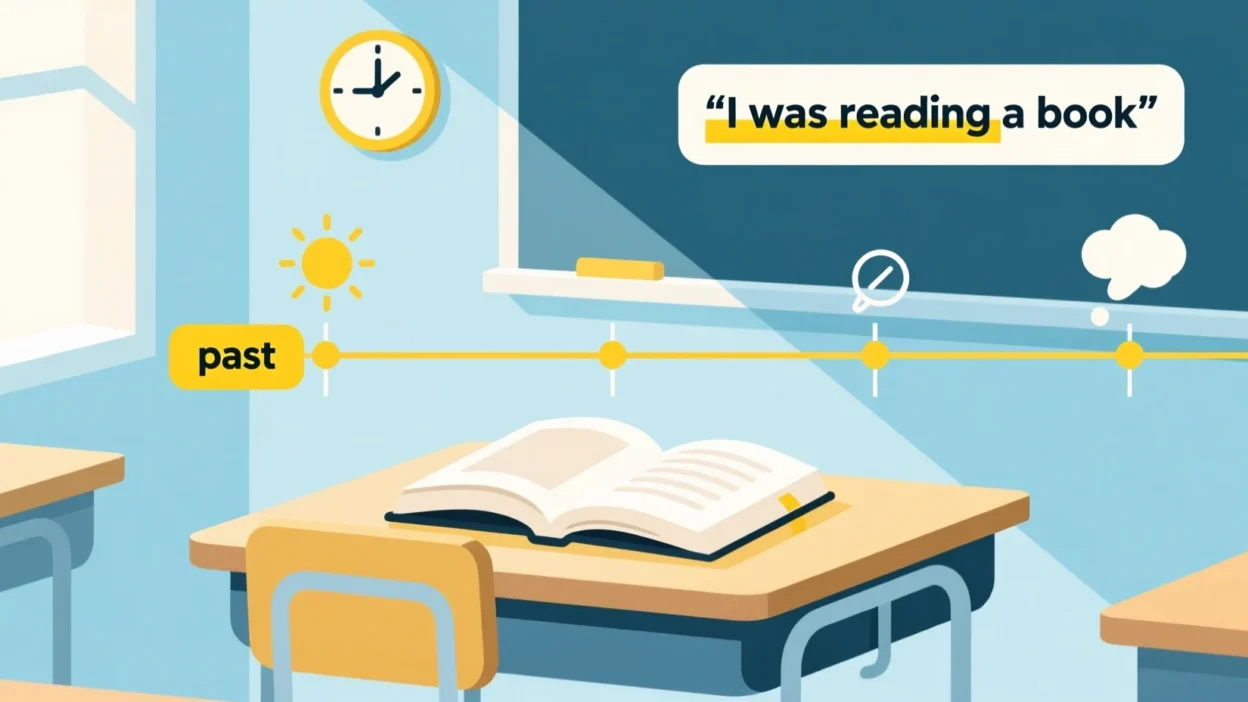
This tense helps describe actions that were ongoing in the past, adding depth to storytelling and everyday communication. Imagine saying, “I was reading a book when the phone rang.”
That’s the past continuous tense in action! It paints a picture of what was happening at a specific moment.
This beginner-friendly guide, we’ll explore its definition, usage, and examples, with practical tips to master it.
If you’re crafting a story or improving your grammar, understanding how to use the past continuous tense correctly will boost your skills.
Let’s dive into this verb tense with clear explanations, skimmable sections, and real-life examples to make learning fun and engaging!
What Is the Past Continuous Tense?
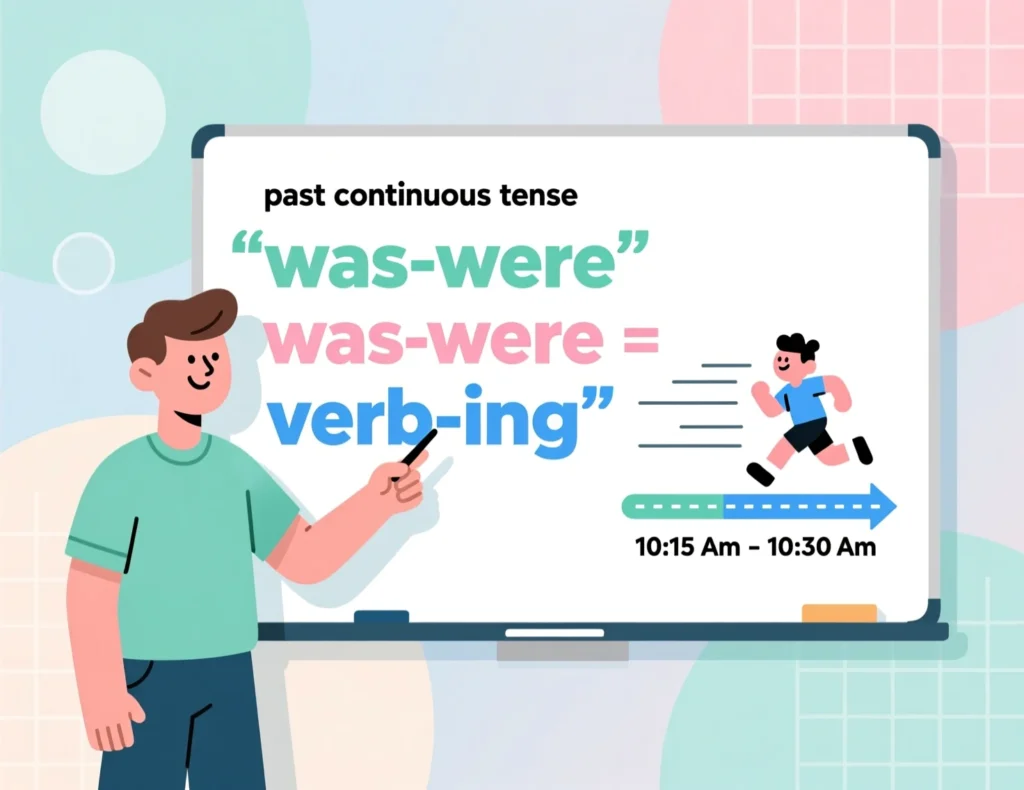
The past continuous tense describes actions that were in progress at a specific time in the past. It emphasizes the duration or ongoing nature of an activity. For example, “She was studying all evening” shows a continuous action. This tense is often used to set the scene, describe interrupted actions, or highlight simultaneous events. It’s formed with the helping verb “was/were” plus a verb ending in -ing. Think of it as a snapshot of something happening in the past, like “They were playing soccer when it started raining.” This tense adds context and clarity to your sentences, making it essential for storytelling and clear communication.
How to Recognize the Past Continuous Tense?
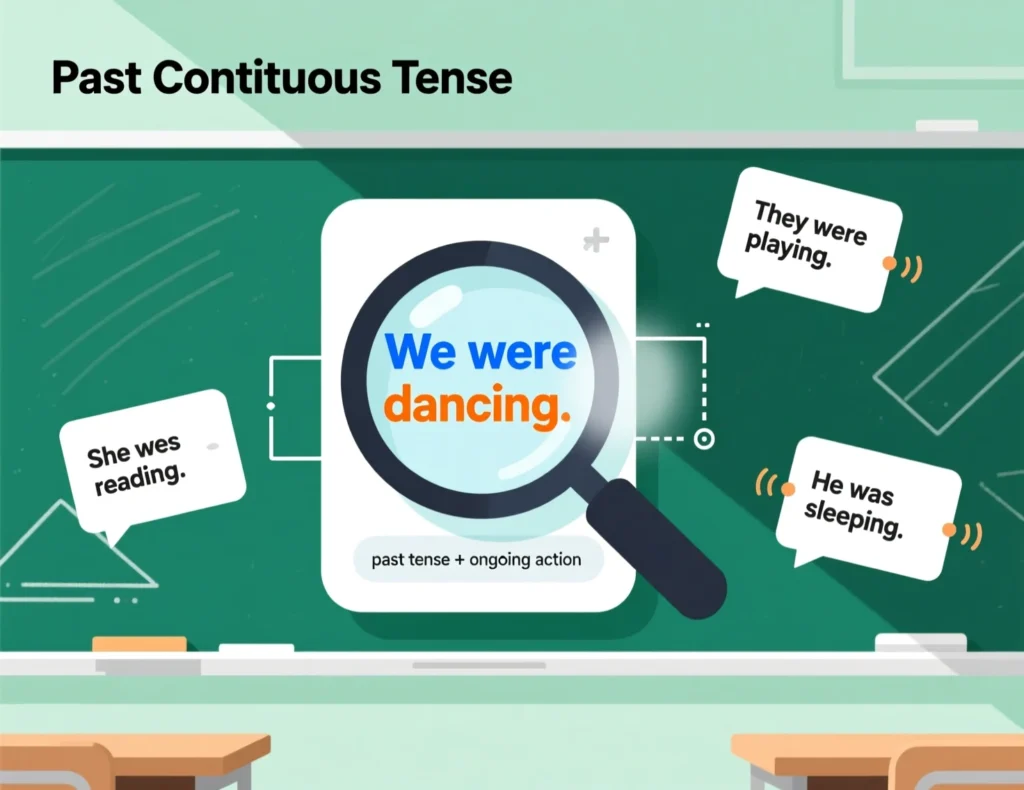
Recognizing the past continuous tense is simple. Look for was or were followed by a verb with an -ing ending. For example, in “We were dancing,” “were” is the helping verb, and “dancing” is the main verb. This tense often appears with time markers like “when,” “while,” or “at 5 p.m.” It’s commonly used to describe:
- Ongoing actions: “I was cooking dinner.”
- Interrupted actions: “She was reading when the doorbell rang.”
- Simultaneous actions: “While he was working, she was relaxing.”
Spotting these clues helps you identify the past continuous tense in texts or conversations.
Structure of a Sentence
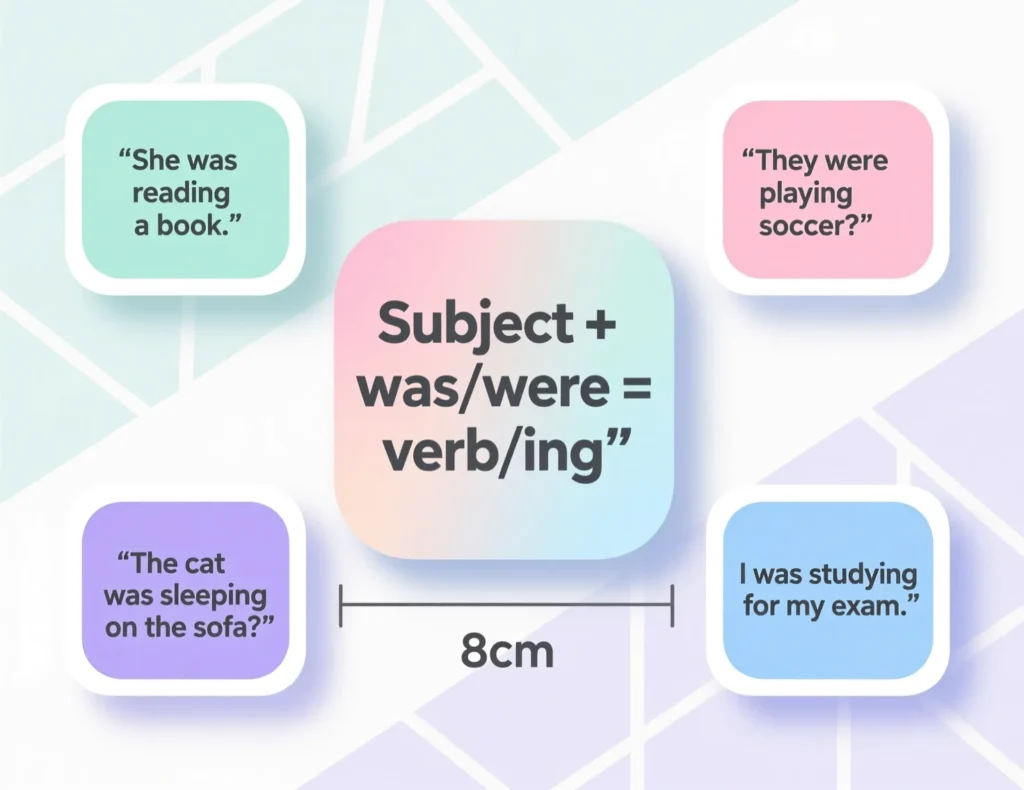
The past continuous tense follows a clear structure:
- Subject + was/were + verb-ing
Examples: - I was walking.
- They were singing.
For negative sentences, add “not”: - Subject + was/were + not + verb-ing (e.g., “She was not running.”)
For questions: - Was/Were + subject + verb-ing? (e.g., “Were you sleeping?”)
This structure ensures clarity when forming sentences in the past continuous tense.
Formation
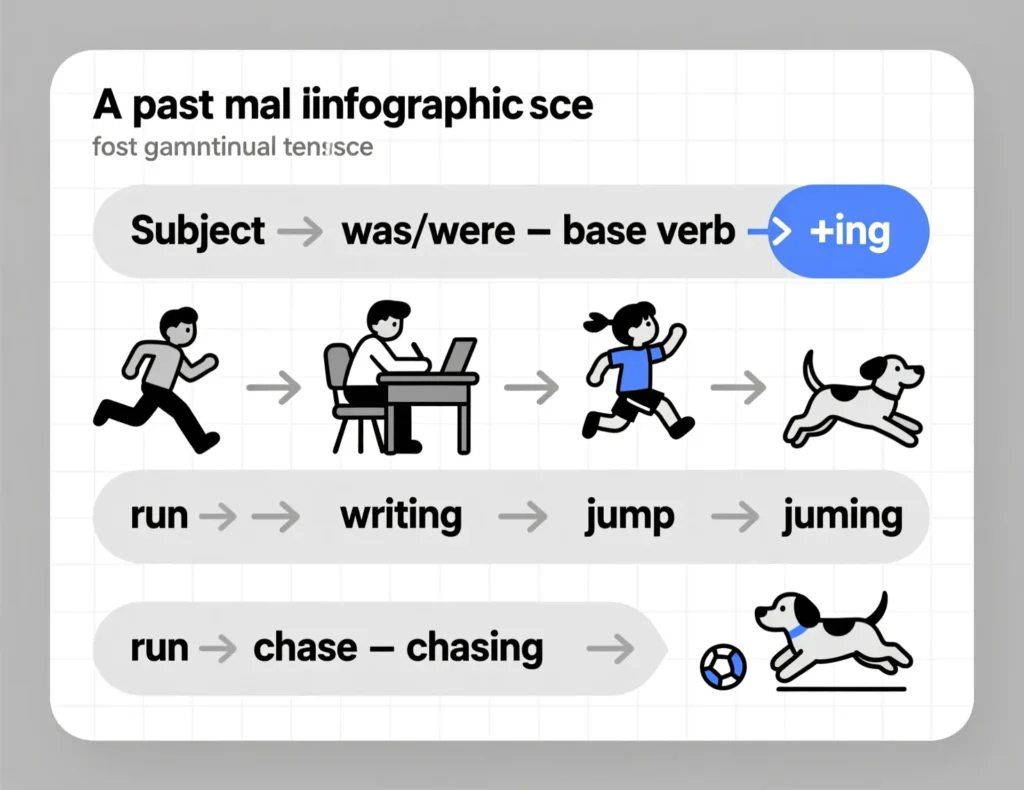
To form the past continuous tense, combine:
- Subject: The person or thing performing the action (e.g., I, she, they).
- Helping verb: Use was for singular subjects (I, he, she, it) or were for plural subjects (we, you, they).
- Main verb: Add -ing to the base verb (e.g., run → running).
Example: “He was writing a letter.” The formula is consistent, making it easy to apply across different subjects and verbs.
Verbs
The past continuous tense works with most action verbs that describe ongoing activities, such as:
- Run: She was running.
- Read: They were reading.
- Talk: We were talking.
Non-action verbs (e.g., know, believe) are rarely used in this tense because they describe states, not ongoing actions. Always ensure the verb fits the context of a continuous activity.
Helping Verbs
The helping verbs in the past continuous tense are was and were. They indicate the subject and number:
- Was: Used with singular subjects (I, he, she, it).
- Example: “I was studying.”
- Were: Used with plural subjects (we, you, they).
- Example: “They were laughing.”
These verbs are crucial for correct verb conjugation in this tense.
- Example: “They were laughing.”
Explanation of Some Verbs with Reference to Past Continuous Tense
Certain verbs shine in the past continuous tense because they describe actions with duration:
- Walk: “She was walking to school” shows an ongoing movement.
- Sing: “They were singing loudly” emphasizes a continuous activity.
- Write: “He was writing a story” highlights a task in progress.
These verbs work well because they naturally describe actions that can extend over time, unlike static verbs like “know” or “own.”
Table of Some Regular or Irregular Verbs in Past Continuous Tense
| Base Verb | Past Continuous Form | Example Sentence |
| Run | Was/were running | She was running in the park. |
| Sing | Was/were singing | They were singing a song. |
| Write | Was/were writing | He was writing a letter. |
| Eat | Was/were eating | We were eating dinner. |
| Go | Was/were going | I was going to the store. |
Simple Sentence Examples
- I was reading a book.
- She was cooking dinner.
- They were playing soccer.
- He was painting the house.
- We were watching a movie.
- You were talking on the phone.
- It was raining heavily.
- The kids were laughing loudly.
- John was studying for exams.
- The dog was barking at strangers.
Negative Sentence Examples
- I was not reading a book.
- She was not cooking dinner.
- They were not playing soccer.
- He was not painting the house.
- We were not watching a movie.
- You were not talking on the phone.
- It was not raining heavily.
- The kids were not laughing loudly.
- John was not studying for exams.
- The dog was not barking at strangers.
Interrogative Sentence Examples
- Was I reading a book?
- Was she cooking dinner?
- Were they playing soccer?
- Was he painting the house?
- Were we watching a movie?
- Were you talking on the phone?
- Was it raining heavily?
- Were the kids laughing loudly?
- Was John studying for exams?
- Was the dog barking at strangers?
Negative and Interrogative Sentence Examples
- Wasn’t I reading a book?
- Wasn’t she cooking dinner?
- Weren’t they playing soccer?
- Wasn’t he painting the house?
- Weren’t we watching a movie?
- Weren’t you talking on the phone?
- Wasn’t it raining heavily?
- Weren’t the kids laughing loudly?
- Wasn’t John studying for exams?
- Wasn’t the dog barking at strangers?
How to Conjugate Past Continuous Tense
Conjugating the past continuous tense is straightforward:
- Use was for singular subjects (I, he, she, it).
- Use were for plural subjects (we, you, they).
- Add -ing to the base verb.
- For negatives, insert not after was/were.
- For questions, invert was/were and the subject.
- Ensure the verb is an action verb.
- Check for spelling changes (e.g., run → running).
- Use time markers for context (e.g., “while”).
- Practice with different subjects.
- Test with real-life scenarios.
Conjugation Table
| Subject | Positive | Negative | Interrogative |
| I | I was walking | I was not walking | Was I walking? |
| You | You were walking | You were not walking | Were you walking? |
| He/She | He/she was walking | He/she was not walking | Was he/she walking? |
| It | It was walking | It was not walking | Was it walking? |
| We | We were walking | We were not walking | Were we walking? |
| They | They were walking | They were not walking | Were they walking? |
Spelling Changes or Irregularities
Most verbs in the past continuous tense follow the base verb + -ing rule, but some have spelling changes:
- Verbs ending in -e: Drop the “e” (e.g., write → writing).
- Consonant + vowel + consonant: Double the consonant (e.g., run → running).
- Verbs ending in -ie: Change to -y (e.g., lie → lying).
Irregular verbs don’t change their base form; they just add -ing (e.g., go → going). Always check for these exceptions to ensure correct verb conjugation.
Sentence Examples with Different Subjects
- I was reading a novel last night.
- You were playing games with friends.
- She was dancing at the party.
- He was fixing the car all morning.
- It was snowing in the evening.
- We were hiking in the mountains.
- They were singing in the choir.
- The cat was sleeping on the couch.
- John was writing an essay.
- The children were drawing pictures.
Common Mistakes with Past Continuous Tense
- Using non-action verbs (e.g., “I was knowing” is wrong).
- Forgetting “was/were” (e.g., “I reading” is incorrect).
- Mixing tenses (e.g., “She was cook yesterday” is wrong).
- Incorrect subject-verb agreement (e.g., “They was running”).
- Omitting -ing (e.g., “He was walk” is incorrect).
- Using it for completed actions (e.g., “I was finishing my homework” sounds odd).
- Misplacing “not” in negatives (e.g., “I not was reading”).
- Ignoring spelling rules (e.g., “runing” instead of “running”).
- Overusing time markers unnecessarily.
- Confusing with past simple (e.g., “I was reading” vs. “I read”).
How to Avoid Common Mistakes
- Use action verbs only for past continuous tense.
- Always include was/were before the verb.
- Match tense with context (ongoing actions).
- Use was for singular, were for plural.
- Add -ing correctly to the verb.
- Reserve past continuous for ongoing actions.
- Place “not” after was/were in negatives.
- Check spelling (e.g., running, not runing).
- Use time markers like “when” or “while” appropriately.
- Practice with verb tense examples to clarify usage.
Related Verbs and Synonyms for Past Continuous Tense
The past continuous tense doesn’t have synonyms, but some verbs are often confused with it:
- Walk vs. Stroll: “She was walking” vs. “She was strolling.”
- Talk vs. Chat: “They were talking” vs. “They were chatting.”
- Run vs. Jog: “He was running” vs. “He was jogging.”
These pairs differ in nuance but follow the same past continuous structure. Avoid mixing with past simple verbs like “walked” for completed actions.
Sentence Comparisons
- Past Continuous: She was walking home. Past Simple: She walked home.
- Past Continuous: They were talking loudly. Past Simple: They talked loudly.
- Past Continuous: He was running fast. Past Simple: He ran fast.
- Past Continuous: We were eating dinner. Past Simple: We ate dinner.
- Past Continuous: I was writing a letter. Past Simple: I wrote a letter.
Tips to Practice Using Past Continuous Tense
- Write a short story using past continuous tense.
- Describe a past event with “while” or “when.”
- Practice with a friend by asking questions.
- Use flashcards with verb conjugation examples.
- Create sentences with different subjects.
- Read books and spot past continuous usage.
- Watch movies and note ongoing actions.
- Try journaling about yesterday’s activities.
- Use grammar apps for practice.
- Take online quizzes for reinforcement.
Frequently Asked Questions
- What is the past continuous tense? It describes ongoing past actions.
- When do we use it? For actions in progress or interrupted in the past.
- What’s the structure? Subject + was/were + verb-ing.
- Can non-action verbs be used? Rarely, as they describe states.
- How do negatives work? Add “not” after was/were.
- How do questions form? Invert was/were and subject.
- What are common time markers? “When,” “while,” “at 5 p.m.”
- Are there irregular verbs? No, just spelling changes.
- How is it different from past simple? It emphasizes ongoing actions.
- How can I practice? Write stories or take quizzes.
Exercises
- Write 5 past continuous sentences about yesterday.
- Convert 5 past simple sentences to past continuous.
- Create 3 negative past continuous sentences.
- Form 3 interrogative past continuous sentences.
- Combine two past continuous actions with “while.”
- Rewrite a paragraph using past continuous tense.
- Identify past continuous in a short story.
- Practice with a partner using time markers.
- Use 5 different verbs in past continuous.
- Check your sentences with a grammar tool.
Quizzes
- What is the correct form: “She ___ (read) a book”?
- Is “They was running” correct? Why or why not?
- Form a negative: “He was playing.”
- Make a question: “You were sleeping.”
- Spot the error: “I was write a letter.”
- Choose the right verb: “We ___ (eat/eating) dinner.”
- Combine: “She was reading. He was cooking.”
- Correct: “The dog were barking.”
- Identify the tense: “They were dancing all night.”
- Fill in: “I ___ (study) when you called.”
True or False
- Past continuous uses “was/were” + verb-ing. (True)
- It describes completed actions. (False)
- “I was knowing” is correct. (False)
- “Were you running?” is a valid question. (True)
- Non-action verbs work well in this tense. (False)
- “She was not singing” is negative form. (True)
- Spelling changes occur in some verbs. (True)
- “They was reading” is correct. (False)
- Time markers like “while” are common. (True)
- It’s the same as past simple. (False)
Conclusion
Mastering the past continuous tense is a game-changer for students, writers, and language learners.
By understanding its definition, structure, and usage, you can describe ongoing past actions with confidence.
From forming sentences like “I was reading” to avoiding common mistakes like using non-action verbs, this tense adds richness to your communication.
Practice with our exercises, quizzes, and tips to make it second nature.
Try writing a short story or describing a past event using the past continuous tense to solidify your skills.
For extra help, use a grammar checker to refine your sentences. Keep practicing, and soon you’ll use this verb tense effortlessly!
Share your sentences in the comments or try our quizzes to test your knowledge.