Learning Spanish verbs can be exciting yet challenging, especially when it comes to irregular verbs like decir in the present tense.
The verb decir, meaning “to say” or “to tell,” is a cornerstone of Spanish communication, used in everyday conversations, storytelling, and writing.
If you’re a student, language learner, writer, or grammar enthusiast, mastering the decir present tense is essential for fluency.
This beginner-friendly guide will walk you through its definition, conjugation, sentence structures, and real-life examples.
We’ll also cover common mistakes, related verbs, and practical tips to help you use decir confidently.
By the end, you’ll have a clear understanding of how to use the decir present tense correctly and be ready to practice it in your own sentences.
Let’s dive into the world of Spanish verb conjugation and make learning decir fun and approachable!
What Is the Decir Present Tense?
The decir present tense is used to describe actions of saying or telling that are happening right now or are generally true. It’s an irregular verb, meaning it doesn’t follow the standard conjugation patterns of regular -ir verbs. In Spanish, decir is used to express statements, opinions, or information being communicated. For example, you might use it to say, “I tell my friend a story” or “She says she’s happy.” Understanding the decir present tense is key for language learners because it appears in daily conversations, from casual chats to formal discussions. Its irregularity makes it unique, but with practice, you’ll master its forms and uses.
How to Recognize the Decir Present Tense?
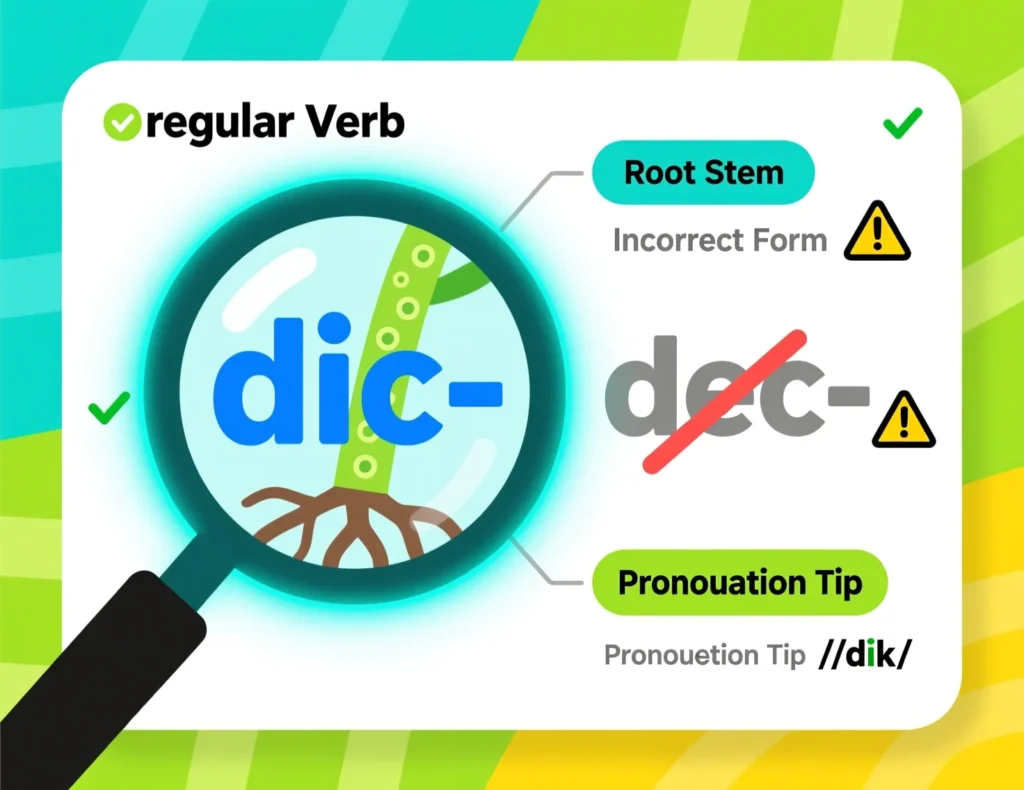
Recognizing the decir present tense is simple once you know its conjugated forms. Look for the irregular stem dic- (instead of the expected dec-) in most subject pronouns, paired with specific endings. For example, “digo” (I say) or “dices” (you say) are clear indicators. The verb often appears in sentences expressing current speech, opinions, or facts. For instance, “Ella dice que viene” (She says she’s coming) shows the present tense in action. Watch for contexts involving communication, such as storytelling, reporting, or giving instructions, to spot decir in use.
Structure of Sentences with Decir Present Tense
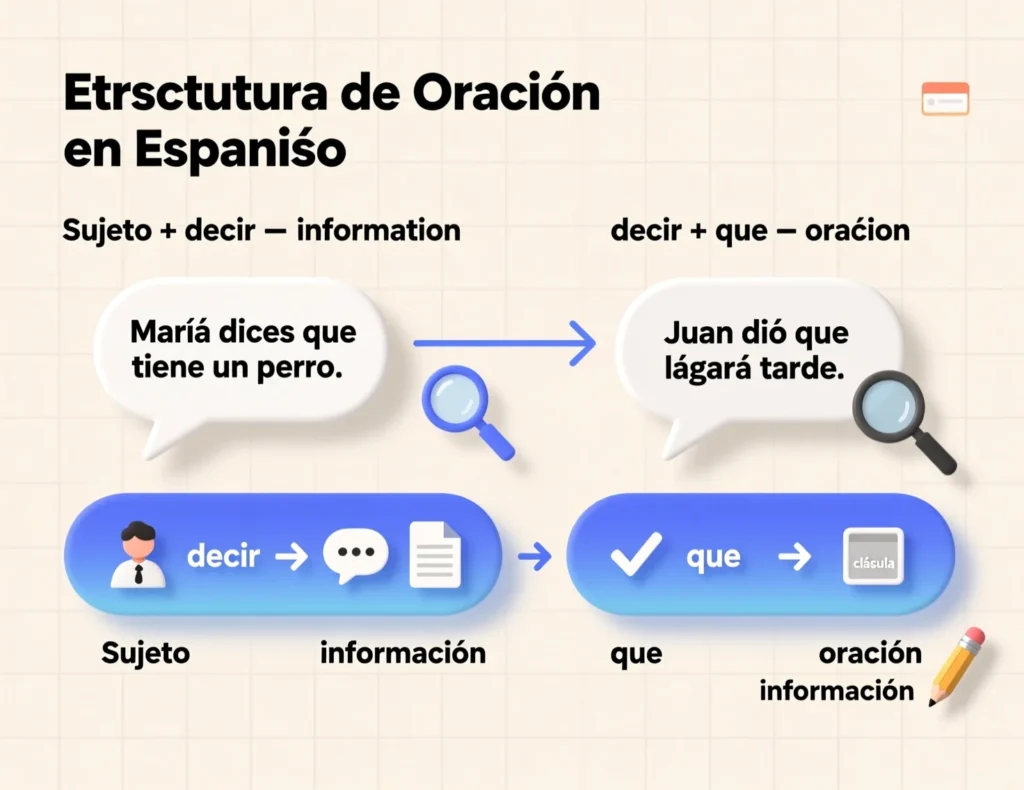
Sentences using the decir present tense typically follow this structure: Subject + conjugated form of decir + what is being said. For example:
- Yo digo la verdad (I say the truth).
- Ellos dicen una historia (They tell a story).
You can also include a subordinate clause introduced by que (that): Subject + decir + que + clause. For example, Tú dices que estás cansado (You say that you’re tired). This structure is versatile and used in both simple and complex sentences.
Formation of Decir Present Tense
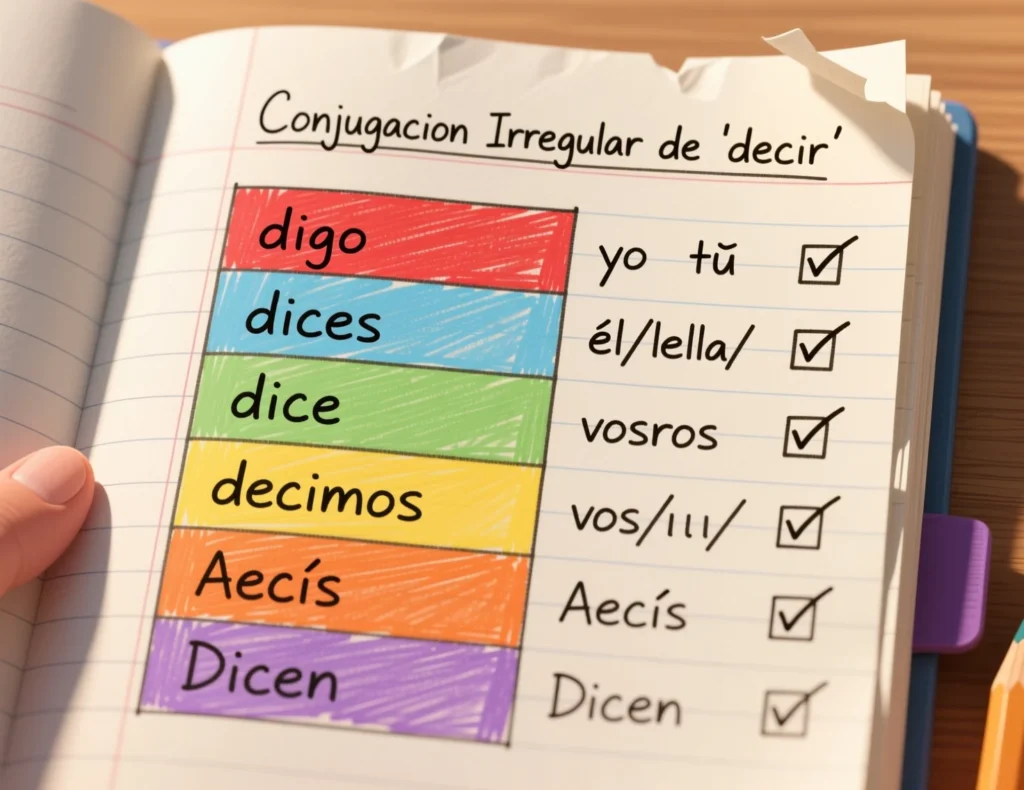
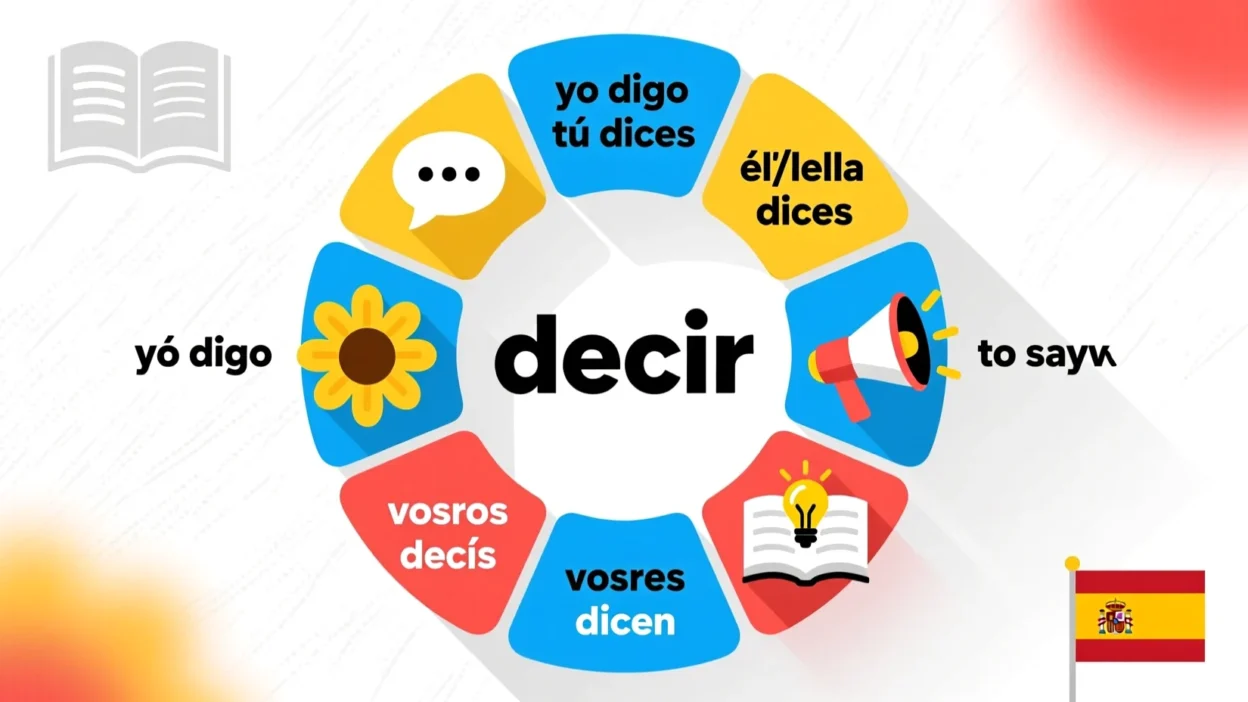
To form the decir present tense, you start with the irregular stem dic- for most subjects, except for nosotros and vosotros, which use dec-. Then, add the appropriate -ir verb endings. Here’s a quick breakdown:
- Yo: dic-o
- Tú: dic-es
- Él/Ella/Usted: dic-e
- Nosotros: dec-imos
- Vosotros: dec-ís
- Ellos/Ellas/Ustedes: dic-en
This irregular pattern makes decir distinct from regular verbs like vivir or comer.
Verbs and Helping Verbs
While decir is a standalone verb, it’s often paired with helping verbs or auxiliary verbs in certain contexts, especially in compound tenses (e.g., haber in the present perfect: he dicho, meaning “I have said”). In the present tense, decir doesn’t require helping verbs for basic usage. However, it can work with modal verbs like poder (to be able to) or querer (to want) to add nuance, e.g., Quiero decir algo (I want to say something).
Explanation of Verbs Related to Decir Present Tense
Some verbs share similar meanings or uses with decir, such as hablar (to speak), contar (to tell/recount), or expresar (to express). Unlike decir, which focuses on the act of saying or telling specific information, hablar is broader and refers to speaking in general. For example:
- Decir: Digo la verdad (I say the truth).
- Hablar: Hablo con mi amigo (I speak with my friend).
Contar is closer to decir when used to mean “to tell” a story, but decir is more versatile in direct statements.
Table of Regular and Irregular Verbs in Decir Present Tense
| Subject | Decir Conjugation | Example Sentence |
| Yo | digo | Digo la verdad. |
| Tú | dices | Dices algo interesante. |
| Él/Ella/Usted | dice | Dice que no puede venir. |
| Nosotros | decimos | Decimos una historia. |
| Vosotros | decís | Decís cosas raras. |
| Ellos/Ellas | dicen | Dicen que es verdad. |
Simple Sentence Examples
- Yo digo lo que pienso. (I say what I think.)
- Tú dices cosas divertidas. (You say funny things.)
- Ella dice que le gusta bailar. (She says she likes to dance.)
- Él dice la verdad siempre. (He always tells the truth.)
- Usted dice algo importante. (You say something important.)
- Nosotros decimos que es posible. (We say it’s possible.)
- Vosotros decís muchas historias. (You all tell many stories.)
- Ellos dicen que están cansados. (They say they’re tired.)
- Ellas dicen que llegarán tarde. (They say they’ll arrive late.)
- Mi amigo dice que estudia mucho. (My friend says he studies a lot.)
Negative Sentence Examples
- No digo nada malo. (I don’t say anything bad.)
- Tú no dices la verdad. (You don’t say the truth.)
- Ella no dice que vendrá. (She doesn’t say she’ll come.)
- Él no dice mucho. (He doesn’t say much.)
- Usted no dice su nombre. (You don’t say your name.)
- Nosotros no decimos mentiras. (We don’t tell lies.)
- Vosotros no decís nada nuevo. (You all don’t say anything new.)
- Ellos no dicen dónde están. (They don’t say where they are.)
- Ellas no dicen la razón. (They don’t say the reason.)
- Mi amigo no dice su opinión. (My friend doesn’t say his opinion.)
Interrogative Sentence Examples
- ¿Digo yo la verdad? (Do I say the truth?)
- ¿Dices tú algo interesante? (Do you say something interesting?)
- ¿Dice ella que vendrá? (Does she say she’ll come?)
- ¿Dice él su nombre? (Does he say his name?)
- ¿Dice usted algo? (Do you say something?)
- ¿Decimos nosotros la historia? (Do we tell the story?)
- ¿Decís vosotros algo nuevo? (Do you all say something new?)
- ¿Dicen ellos dónde están? (Do they say where they are?)
- ¿Dicen ellas la verdad? (Do they say the truth?)
- ¿Dice mi amigo algo? (Does my friend say something?)
Negative and Interrogative Sentence Examples
- ¿No digo yo nada malo? (Don’t I say anything bad?)
- ¿No dices tú la verdad? (Don’t you say the truth?)
- ¿No dice ella que vendrá? (Doesn’t she say she’ll come?)
- ¿No dice él mucho? (Doesn’t he say much?)
- ¿No dice usted su nombre? (Don’t you say your name?)
- ¿No decimos nosotros mentiras? (Don’t we tell lies?)
- ¿No decís vosotros nada nuevo? (Don’t you all say anything new?)
- ¿No dicen ellos dónde están? (Don’t they say where they are?)
- ¿No dicen ellas la razón? (Don’t they say the reason?)
- ¿No dice mi amigo su opinión? (Doesn’t my friend say his opinion?)
How to Conjugate Decir Present Tense
Conjugating decir in the present tense requires memorizing its irregular forms. Here’s a step-by-step guide:
- Identify the subject (e.g., yo, tú, él).
- Use the irregular stem dic- for most subjects, except nosotros and vosotros (dec-).
- Add the appropriate -ir verb endings: -o, -es, -e, -imos, -ís, -en.
- For yo, say digo (I say).
- For tú, say dices (you say).
- For él/ella/usted, say dice (he/she/you formal say).
- For nosotros, say decimos (we say).
- For vosotros, say decís (you all say).
- For ellos/ellas/ustedes, say dicen (they/you all say).
- Practice regularly to internalize the pattern.
Conjugation Table for Decir Present Tense
| Subject | Conjugation | Example |
| Yo | digo | Digo la verdad. |
| Tú | dices | Dices algo interesante. |
| Él/Ella/Usted | dice | Dice que no puede venir. |
| Nosotros | decimos | Decimos una historia. |
| Vosotros | decís | Decís cosas raras. |
| Ellos/Ellas | dicen | Dicen que es verdad. |
Spelling Changes or Irregularities
The decir present tense is irregular because it changes its stem from dec- to dic- for most subjects (except nosotros and vosotros). This stem change is unique and doesn’t follow the regular -ir verb pattern. Additionally, the yo form (digo) has a -go ending, similar to other irregular verbs like hacer (hago) or tener (tengo). There are no spelling changes beyond the stem irregularity, but learners must memorize the forms to avoid confusion.
Sentence Examples with Different Subjects
- Yo digo que este libro es bueno. (I say this book is good.)
- Tú dices que no te gusta. (You say you don’t like it.)
- Él dice que llegará pronto. (He says he’ll arrive soon.)
- Ella dice la verdad siempre. (She always tells the truth.)
- Usted dice cosas interesantes. (You say interesting things.)
- Nosotros decimos que es divertido. (We say it’s fun.)
- Vosotros decís historias raras. (You all tell weird stories.)
- Ellos dicen que no saben. (They say they don’t know.)
- Ellas dicen que están ocupadas. (They say they’re busy.)
- Mi hermano dice que estudia mucho. (My brother says he studies a lot.)
- La profesora dice que debemos practicar. (The teacher says we must practice.)
- Los niños dicen que quieren jugar. (The kids say they want to play.)
- Mi amiga dice que vendrá mañana. (My friend says she’ll come tomorrow.)
- Ustedes dicen que es fácil. (You all say it’s easy.)
- Juan dice que no entiende. (Juan says he doesn’t understand.)
Common Mistakes with Decir Present Tense
- Using the wrong stem: Saying deco instead of digo. Always use dic- for the yo form.
- Forgetting irregularity: Applying regular -ir endings (e.g., decir → deces instead of dices).
- Confusing with hablar: Using hablar when decir is needed for specific statements.
- Incorrect nosotros form: Saying dicimos instead of decimos.
- Misplacing que: Omitting que in sentences like Digo que es verdad.
- Overusing decir: Repeating decir when synonyms like contar or expresar fit better.
- Wrong subject agreement: Saying él dico instead of él dice.
- Negation errors: Placing no incorrectly, e.g., Digo no instead of No digo.
- Forgetting accents: Writing decis instead of decís for vosotros.
- Confusing tenses: Using dije (past tense) instead of digo for present.
How to Avoid These Mistakes
- Memorize the irregular stem dic- and dec- for nosotros/vosotros.
- Practice conjugations with flashcards or apps.
- Double-check sentences for que in subordinate clauses.
- Compare decir with synonyms to understand context.
- Use a grammar checker to catch errors.
Related Verbs and Synonyms for Decir Present Tense
Related verbs include hablar (to speak), contar (to tell/recount), expresar (to express), and manifestar (to state). Synonyms like contar are often confused with decir, but they differ in nuance:
- Decir: Digo la verdad (I say the truth) – direct statement.
- Contar: Cuento una historia (I tell a story) – narrative focus.
- Hablar: Hablo español (I speak Spanish) – general speech.
Sentence Comparisons
- Decir: Ella dice que está cansada (She says she’s tired).
- Contar: Ella cuenta una aventura (She tells an adventure).
- Hablar: Ella habla con su amiga (She speaks with her friend).
Tips to Practice Using Decir Present Tense
- Write 5 sentences daily using different subjects.
- Practice saying decir conjugations aloud.
- Use flashcards to memorize irregular forms.
- Engage in conversations and use decir to express opinions.
- Watch Spanish shows and note how decir is used.
- Join language exchange groups to practice.
- Use apps like Duolingo for verb conjugation drills.
- Create a story using decir in various forms.
- Record yourself speaking and check for accuracy.
- Quiz yourself with the exercises below.
Frequently Asked Questions
- What does decir mean in Spanish?
It means “to say” or “to tell.” - Is decir an irregular verb?
Yes, it uses the irregular stem dic- in most forms. - How do I conjugate decir for nosotros?
Use decimos (we say). - Can decir be used with que?
Yes, e.g., Digo que es verdad (I say it’s true). - What’s the difference between decir and hablar?
Decir is for specific statements; hablar is for general speech. - Why is the yo form digo?
It follows an irregular pattern with a -go ending. - How do I avoid mistakes with decir?
Memorize conjugations and practice regularly. - Can decir be used in questions?
Yes, e.g., ¿Dices la verdad? (Do you say the truth?) - What are some synonyms for decir?
Contar, expresar, manifestar. - How do I practice decir?
Use exercises, quizzes, and real-life conversations.
Exercises
- Conjugate decir for tú.
- Write a sentence using dice with ella.
- Make a negative sentence with nosotros.
- Form an interrogative sentence with usted.
- Use decir with que in a sentence.
- Write a sentence with ellos dicen.
- Create a negative interrogative sentence with tú.
- Conjugate decir for vosotros.
- Write a sentence comparing decir and contar.
- Use decir in a sentence with yo.
Quizzes
- What is the yo form of decir? (Answer: digo)
- How do you say “They say” in Spanish? (Answer: dicen)
- Is decimos correct for nosotros? (Answer: Yes)
- What’s wrong with deco? (Answer: Should be digo)
- What’s the stem for tú dices? (Answer: dic-)
- How do you say “Do you say?” in Spanish? (Answer: ¿Dices?)
- Is dice used for él? (Answer: Yes)
- What’s a synonym for decir? (Answer: Contar)
- How do you conjugate decir for ustedes? (Answer: dicen)
- What’s the negative of Digo la verdad? (Answer: No digo la verdad)
True or False
- Decir is a regular verb. (False)
- The yo form is digo. (True)
- Nosotros uses dicimos. (False)
- Decir can mean “to tell.” (True)
- Dices is for tú. (True)
- Hablar is the same as decir. (False)
- Dice is used for ella. (True)
- Decís is for vosotros. (True)
- Decir requires a helping verb in the present tense. (False)
- Dicen is for ellos. (True)
Conclusion
Mastering the decir present tense is a key step toward fluency in Spanish.
This irregular verb, meaning “to say” or “to tell,” is used daily in conversations, making it essential for language learners, students, and writers.
By understanding its conjugation, sentence structures, and common pitfalls, you can confidently use decir in various contexts.
Practice with the provided examples, exercises, and quizzes to reinforce your skills. Try incorporating decir into real-life conversations or writing to make it second nature.
For extra help, consider using a grammar checker or joining a language learning community.
Start practicing today, and soon you’ll be saying “Digo lo que pienso” (I say what I think) with ease! Share your progress in the comments or try our quizzes to test your knowledge.