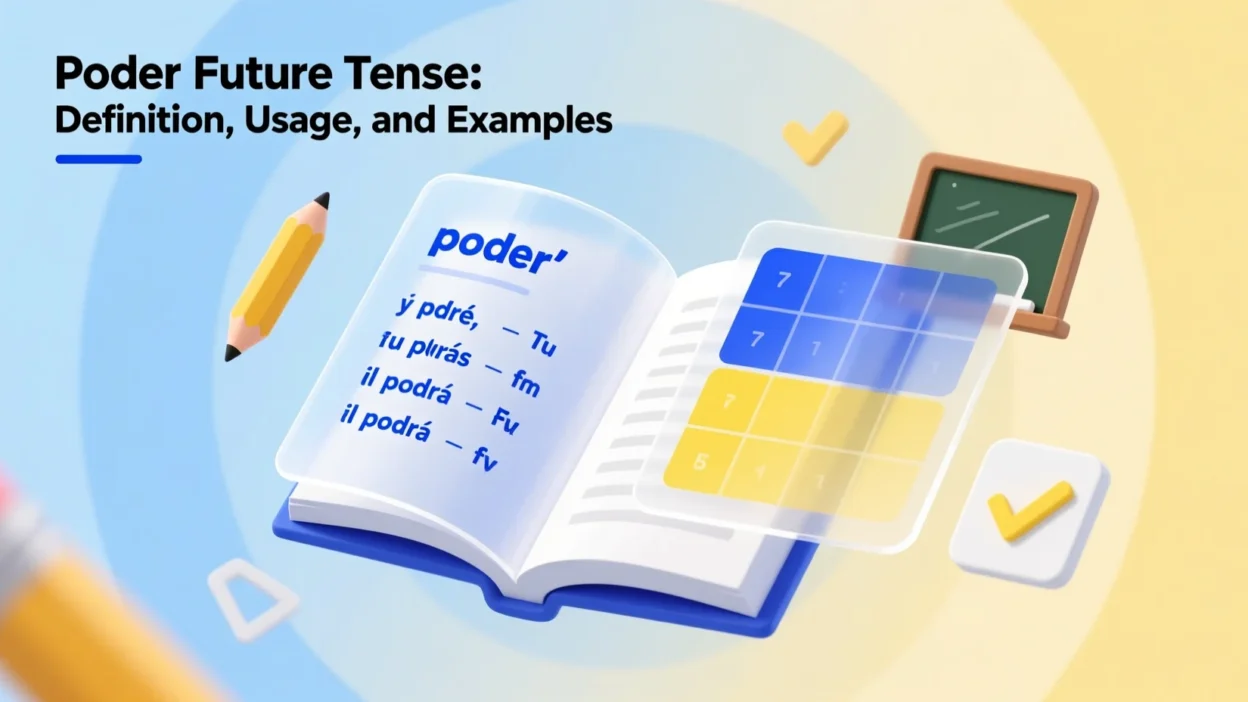
The poder future tense is a key component of Spanish grammar, essential for expressing possibilities, abilities, or permissions in the future.
If you’re a student, language learner, writer, or grammar enthusiast, mastering poder in the future tense will enhance your ability to communicate effectively in Spanish.
This verb, meaning “to be able to” or “can,” is incredibly versatile and frequently used in everyday conversations.
This beginner-friendly guide, we’ll explore the poder future tense, its structure, conjugation, and practical applications.
With clear explanations, real-life examples, and actionable tips, you’ll gain confidence in using this tense correctly.
Let’s dive into how to use poder future tense and make your Spanish conversations more dynamic!
What Is the Poder Future Tense?
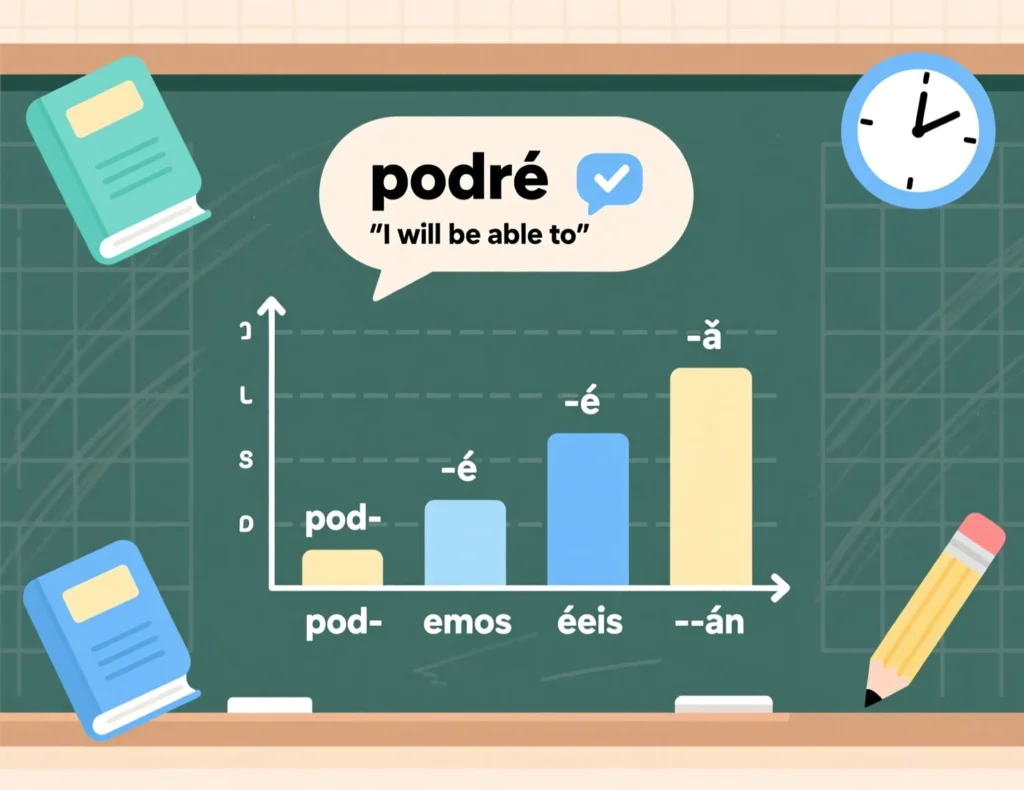
The poder future tense is used to describe the ability, possibility, or permission to do something in the future. For example, “I will be able to attend the meeting” translates to “Podré asistir a la reunión”. This tense is part of Spanish’s future tense conjugation, which is relatively straightforward compared to other tenses. Poder is an irregular verb, so its conjugation in the future tense follows a unique pattern. Understanding this tense is crucial for expressing future plans or hypothetical situations, such as “We will be able to travel next year.”
How to Recognize the Poder Future Tense?
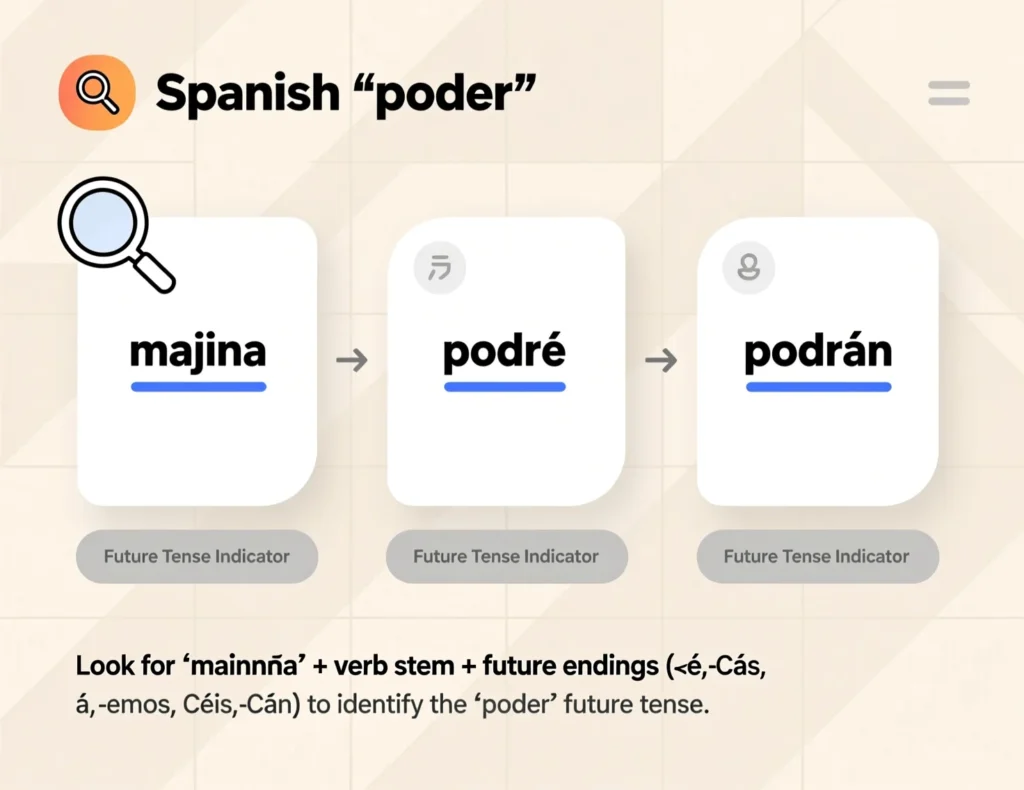
You can identify the poder future ten se by its distinct endings and the context of the sentence. Look for:
- Future-oriented words: Phrases like “tomorrow,” “next week,” or “in the future.”
- Conjugated forms of poder: Words like podré, podrás, or podrán.
- Context of ability or possibility: Sentences expressing what someone will be able to do.
For example, “Podré terminar el proyecto mañana” (“I will be able to finish the project tomorrow”) indicates future ability.
Structure of a Sentence in Poder Future Tense
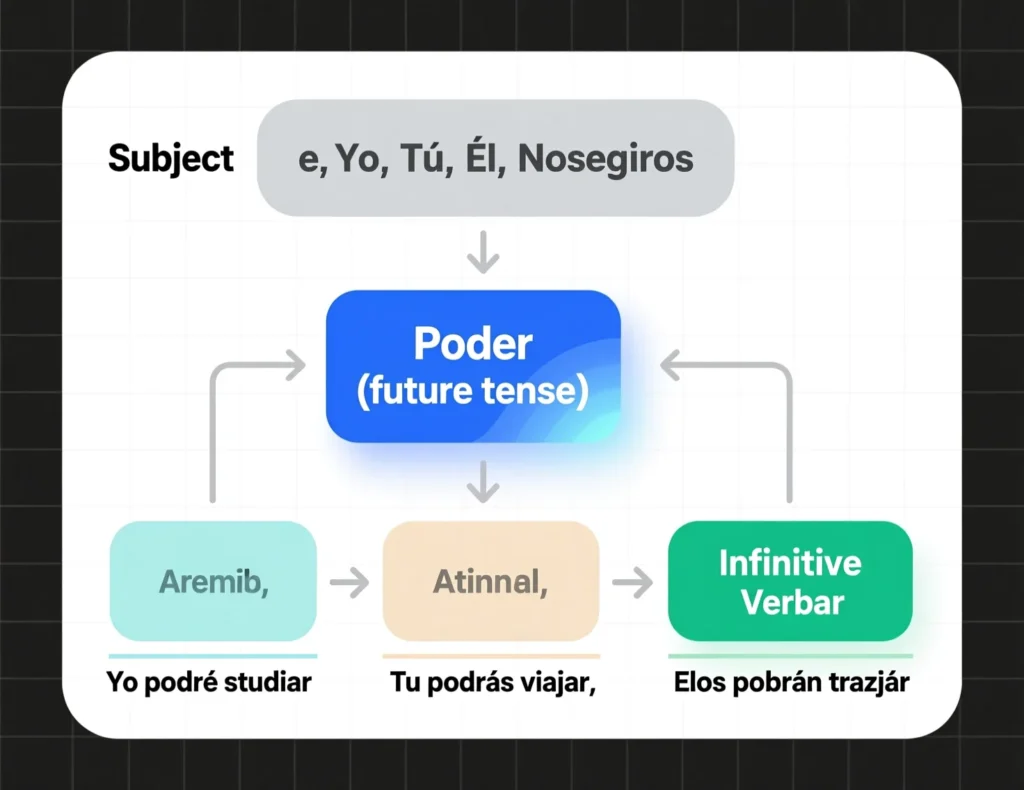
A typical sentence in the poder future tense follows this structure:
- Subject + conjugated poder + infinitive verb + additional information.
- Example: Yo + podré + estudiar + esta noche (“I will be able to study tonight”).
This structure emphasizes the subject’s ability to perform an action in the future.
Formation of Poder Future Tense
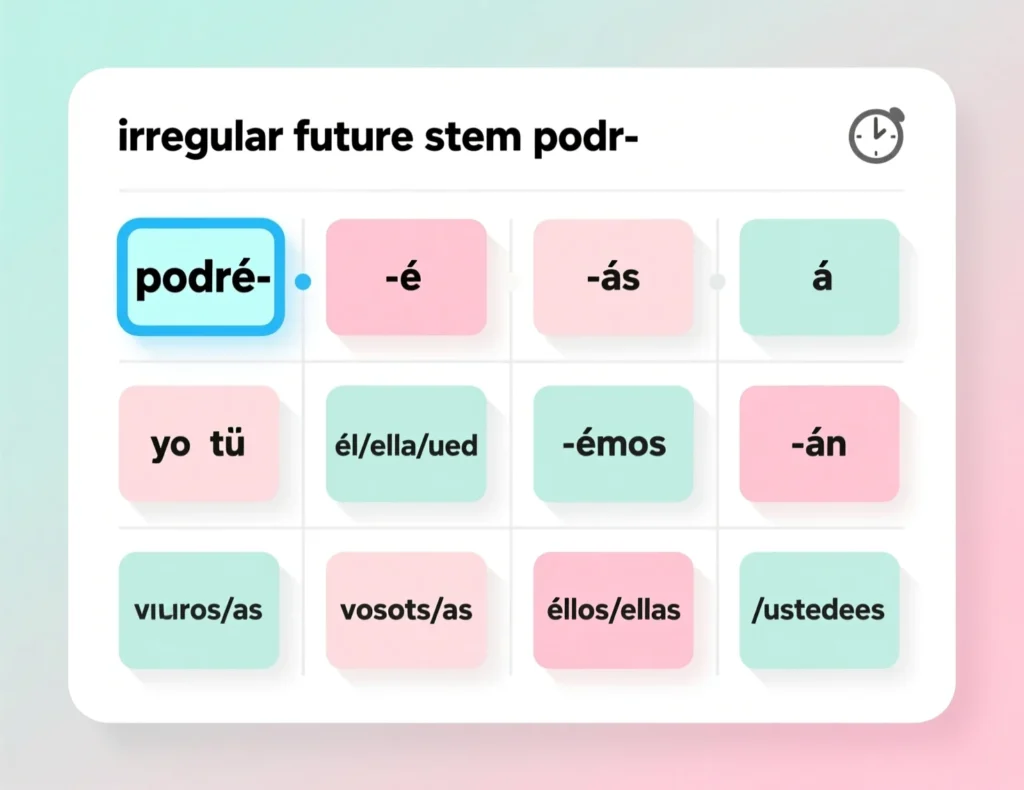
To form the poder future tense, you conjugate poder by adding future tense endings to the irregular stem podr-. Unlike regular verbs, poder does not use its infinitive form as the stem. The future tense endings are:
- -é, -ás, -á, -emos, -éis, -án.
Verbs in Poder Future Tense
Since poder is a modal verb, it is always paired with another verb in its infinitive form to indicate the action that can be performed. For example:
- Podré correr (“I will be able to run”).
- Podrás escribir (“You will be able to write”).
Helping Verbs
In Spanish, poder itself is a helping (modal) verb in the future tense, so it doesn’t require additional helping verbs like “will” in English. It directly conveys the future ability or possibility when conjugated.
Explanation of Verbs with Reference to Poder Future Tense
The poder future tense is used with a wide range of infinitive verbs to express future abilities. For instance:
- Podré aprender (“I will be able to learn”) shows the ability to acquire knowledge.
- Podrás viajar (“You will be able to travel”) indicates permission or opportunity.
- Podrán hablar (“They will be able to speak”) suggests a group’s future capability.
The infinitive verb following poder remains unchanged, making this tense easy to construct.
Table of Some Regular or Irregular Verbs in Poder Future Tense
| Subject | Poder Conjugation | Example with Infinitive Verb |
| Yo | Podré | Podré estudiar (I will be able to study) |
| Tú | Podrás | Podrás viajar (You will be able to travel) |
| Él/Ella/Usted | Podrá | Podrá trabajar (He/She will be able to work) |
| Nosotros | Podremos | Podremos salir (We will be able to go out) |
| Vosotros | Podréis | Podréis leer (You all will be able to read) |
| Ellos/Ellas/Ustedes | Podrán | Podrán comer (They will be able to eat) |
Simple Sentence Examples
- Yo podré terminar mi tarea esta noche. (I will be able to finish my homework tonight.)
- Tú podrás asistir al concierto mañana. (You will be able to attend the concert tomorrow.)
- Él podrá correr en la maratón. (He will be able to run in the marathon.)
- Ella podrá cantar en el evento. (She will be able to sing at the event.)
- Nosotros podremos viajar a España. (We will be able to travel to Spain.)
- Vosotros podréis aprender español rápido. (You all will be able to learn Spanish quickly.)
- Ellos podrán trabajar desde casa. (They will be able to work from home.)
- Usted podrá hablar con el gerente. (You will be able to speak with the manager.)
- Nosotros podremos comprar un coche nuevo. (We will be able to buy a new car.)
- Ellas podrán bailar en la fiesta. (They will be able to dance at the party.)
Negative Sentence Examples
- No podré terminar mi tarea esta noche. (I won’t be able to finish my homework tonight.)
- No podrás asistir al concierto mañana. (You won’t be able to attend the concert tomorrow.)
- No podrá correr en la maratón. (He won’t be able to run in the marathon.)
- No podrá cantar en el evento. (She won’t be able to sing at the event.)
- No podremos viajar a España. (We won’t be able to travel to Spain.)
- No podréis aprender español rápido. (You all won’t be able to learn Spanish quickly.)
- No podrán trabajar desde casa. (They won’t be able to work from home.)
- No podrá hablar con el gerente. (You won’t be able to speak with the manager.)
- No podremos comprar un coche nuevo. (We won’t be able to buy a new car.)
- No podrán bailar en la fiesta. (They won’t be able to dance at the party.)
Interrogative Sentence Examples
- ¿Podré terminar mi tarea esta noche? (Will I be able to finish my homework tonight?)
- ¿Podrás asistir al concierto mañana? (Will you be able to attend the concert tomorrow?)
- ¿Podrá correr en la maratón? (Will he be able to run in the marathon?)
- ¿Podrá cantar en el evento? (Will she be able to sing at the event?)
- ¿Podremos viajar a España? (Will we be able to travel to Spain?)
- ¿Podréis aprender español rápido? (Will you all be able to learn Spanish quickly?)
- ¿Podrán trabajar desde casa? (Will they be able to work from home?)
- ¿Podrá hablar con el gerente? (Will you be able to speak with the manager?)
- ¿Podremos comprar un coche nuevo? (Will we be able to buy a new car?)
- ¿Podrán bailar en la fiesta? (Will they be able to dance at the party?)
Negative and Interrogative Sentence Examples
- ¿No podré terminar mi tarea esta noche? (Won’t I be able to finish my homework tonight?)
- ¿No podrás asistir al concierto mañana? (Won’t you be able to attend the concert tomorrow?)
- ¿No podrá correr en la maratón? (Won’t he be able to run in the marathon?)
- ¿No podrá cantar en el evento? (Won’t she be able to sing at the event?)
- ¿No podremos viajar a España? (Won’t we be able to travel to Spain?)
- ¿No podréis aprender español rápido? (Won’t you all be able to learn Spanish quickly?)
- ¿No podrán trabajar desde casa? (Won’t they be able to work from home?)
- ¿No podrá hablar con el gerente? (Won’t you be able to speak with the manager?)
- ¿No podremos comprar un coche nuevo? (Won’t we be able to buy a new car?)
- ¿No podrán bailar en la fiesta? (Won’t they be able to dance at the party?)
How to Conjugate Poder Future Tense
To conjugate poder in the future tense, follow these steps:
- Use the irregular stem podr-.
- Add the future tense endings: -é, -ás, -á, -emos, -éis, -án.
- Ensure the subject matches the conjugation.
- Pair poder with an infinitive verb.
- Check for context to ensure the future tense is appropriate.
- Practice with different subjects (e.g., yo, tú, él).
- Use poder to express ability or possibility.
- Avoid adding unnecessary helping verbs.
- Memorize the irregular stem for poder.
- Test your conjugation with real-life sentences.
Conjugation Table for Poder Future Tense
| Subject | Conjugation | Example Sentence |
| Yo | Podré | Podré estudiar. (I will be able to study.) |
| Tú | Podrás | Podrás viajar. (You will be able to travel.) |
| Él/Ella/Usted | Podrá | Podrá trabajar. (He/She will be able to work.) |
| Nosotros | Podremos | Podremos salir. (We will be able to go out.) |
| Vosotros | Podréis | Podréis leer. (You all will be able to read.) |
| Ellos/Ellas/Ustedes | Podrán | Podrán comer. (They will be able to eat.) |
Spelling Changes or Irregularities
The verb poder is irregular in the future tense because it uses the stem podr- instead of the infinitive poder. This is a key irregularity to remember, as most regular verbs use their full infinitive as the stem. No additional spelling changes occur beyond this stem change.
Additional Sentence Examples
- Yo podré ayudar a mis amigos mañana. (I will be able to help my friends tomorrow.)
- Tú podrás ganar el concurso. (You will be able to win the contest.)
- Ella podrá escribir una novela. (She will be able to write a novel.)
- Él podrá conducir el coche nuevo. (He will be able to drive the new car.)
- Nosotros podremos visitar el museo. (We will be able to visit the museum.)
- Vosotros podréis cocinar una cena deliciosa. (You all will be able to cook a delicious dinner.)
- Ellos podrán terminar el proyecto a tiempo. (They will be able to finish the project on time.)
- Usted podrá aprender a bailar salsa. (You will be able to learn to dance salsa.)
- Nosotras podremos hablar en español fluido. (We will be able to speak fluent Spanish.)
- Ellas podrán pintar la casa. (They will be able to paint the house.)
- Yo podré descansar después del trabajo. (I will be able to rest after work.)
- Tú podrás leer el libro nuevo. (You will be able to read the new book.)
- Él podrá jugar al fútbol con amigos. (He will be able to play soccer with friends.)
- Nosotros podremos ahorrar dinero. (We will be able to save money.)
- Ellos podrán celebrar su aniversario. (They will be able to celebrate their anniversary.)
Common Mistakes with Poder Future Tense
- Using the wrong stem: Some learners use poder- instead of podr-. Always use podr-.
- Forgetting the infinitive: Poder must be followed by an infinitive verb (e.g., podré estudiar, not podré estudio).
- Confusing with present tense: Saying puedo instead of podré for future actions.
- Incorrect endings: Using present tense endings like -o instead of -é.
- Omitting the subject: Spanish requires explicit subjects like yo or tú.
- Misplacing no: In negative sentences, place no before poder (e.g., no podré).
- Overusing poder: Avoid using poder when another verb like querer is more appropriate.
- Ignoring context: Ensure the future tense fits the sentence’s time frame.
- Incorrect pronunciation: Stress the correct syllable in podré (po-DRÉ).
- Mixing with conditional tense: Don’t confuse podré (future) with podría (conditional).
Related Verbs and Synonyms for Poder Future Tense
- Querer (to want): Often confused with poder. Querer expresses desire, while poder expresses ability.
- Example: Querré estudiar (I will want to study) vs. Podré estudiar (I will be able to study).
- Saber (to know how to): Indicates knowledge or skill, not general ability.
- Example: Sabré nadar (I will know how to swim) vs. Podré nadar (I will be able to swim).
- Lograr (to manage to): Suggests achieving something, often with effort.
- Example: Lograré terminar (I will manage to finish) vs. Podré terminar (I will be able to finish).
Tips to Practice Using Poder Future Tense
- Write 5 sentences daily using poder future tense.
- Practice with a language partner to use poder in conversations.
- Create flashcards for poder conjugations.
- Use apps like Duolingo to reinforce verb conjugation.
- Translate English sentences with “will be able to” into Spanish.
- Read Spanish texts to spot poder future tense in context.
- Record yourself speaking sentences with poder.
- Join online Spanish forums to practice writing.
- Watch Spanish movies and note poder usage.
- Take quizzes to test your poder conjugation skills.
Frequently Asked Questions
- What does poder mean in the future tense? It means “will be able to.”
- Is poder irregular in the future tense? Yes, it uses the stem podr-.
- Can poder be used alone? No, it requires an infinitive verb.
- How is poder different from querer? Poder indicates ability; querer indicates desire.
- What are common mistakes with poder? Using the wrong stem or tense.
- Can poder be negative? Yes, e.g., no podré (I won’t be able to).
- Is poder used in questions? Yes, e.g., ¿Podrás venir? (Will you be able to come?)
- Does poder change spelling? Only the stem changes to podr-.
- How do I practice poder? Write sentences and take quizzes.
- Can poder be used with any verb? Yes, any infinitive verb.
Exercises
- Conjugate poder for yo in the future tense.
- Write a sentence using tú + poder + viajar.
- Form a negative sentence with ellos + poder + trabajar.
- Create an interrogative sentence with nosotros + poder + aprender.
- Translate: “She will be able to sing.”
- Identify the error: Yo puedo terminar mañana.
- Combine poder with correr for él.
- Write a negative interrogative sentence with vosotros + poder + leer.
- Use poder with estudiar for usted.
- Translate: “Will we be able to buy a car?”
Quizzes
- What is the stem for poder in the future tense? (podr-)
- What is the conjugation for tú? (podrás)
- True or False: Poder can stand alone. (False)
- What follows poder in a sentence? (Infinitive verb)
- Correct the sentence: No podré estudiar mañana. (Correct)
- What is nosotros conjugation? (podremos)
- Translate: Podrán bailar. (They will be able to dance.)
- Is podré used for past or future? (Future)
- What is a synonym for poder? (Lograr)
- Form a question with ella + poder + cantar. (¿Podrá cantar?)
True or False
- Poder is regular in the future tense. (False)
- Podré is used for “I will be able to.” (True)
- Poder requires an infinitive verb. (True)
- No podrás means “You will be able to.” (False)
- Podr- is the future tense stem. (True)
- Poder can be used in questions. (True)
- Podré estudiar is a correct sentence. (True)
- Poder is a helping verb. (True)
- Podría is future tense. (False)
- Poder has spelling changes beyond the stem. (False)
Conclusion
Mastering the poder future tense is a game-changer for Spanish learners. This versatile tense allows you to express future abilities, possibilities, and permissions with ease.
By understanding its conjugation, structure, and common pitfalls, you can confidently use poder in conversations, writing, and more.
Practice with the examples, exercises, and quizzes provided to solidify your skills.
Try writing your own sentences or use a grammar checker to perfect your usage.
Keep exploring Spanish grammar to enhance your fluency, and share your progress with others! Start using the poder future tense today to make your Spanish more expressive and accurate.