The past tense of bite is an essential concept for students, language learners, writers, and grammar enthusiasts looking to master English grammar.
Understanding how to use bit correctly in sentences can elevate your writing and communication skills.
The verb bite is irregular, transforming into bit in the past tense, which can sometimes confuse learners.
This SEO-optimized guide will break down the definition, usage, and examples of the past tense of bite in a beginner-friendly, skimmable format.
Whether you’re crafting a story, writing an essay, or learning English as a second language, this article offers clear explanations, real-life examples, and practical tips to help you use bit confidently.
Let’s dive into the structure, conjugation, and common pitfalls of this verb tense to ensure you can apply it effectively in your everyday communication.
What Is the Past Tense of Bite?

The past tense of bite is bit, used to describe an action that happened in the past. For example, “The dog bit the toy yesterday.” The verb bite is irregular, meaning it doesn’t follow the standard “-ed” ending for regular verbs. Instead, it changes from bite (present) to bit (past) and bitten (past participle). Understanding this irregular verb is key for constructing accurate past tense sentences. It’s commonly used in contexts involving physical actions, like eating or animal behavior, but can also appear in idiomatic expressions like “I bit off more than I could chew.”
How to Recognize the Past Tense of Bite?
To recognize the past tense of bite, look for the word bit in sentences describing completed actions. It often appears with time indicators like “yesterday,” “last week,” or “ago.” For example, “She bit into an apple an hour ago.” The verb bit is used for all subjects (I, you, he, she, it, we, they), making it straightforward to identify. Watch for contexts involving biting actions, whether literal (e.g., biting food) or figurative (e.g., biting sarcasm). Recognizing bit in past tense sentences becomes easier with practice and familiarity with irregular verb patterns.
Structure of a Sentence in Past Tense of Bite
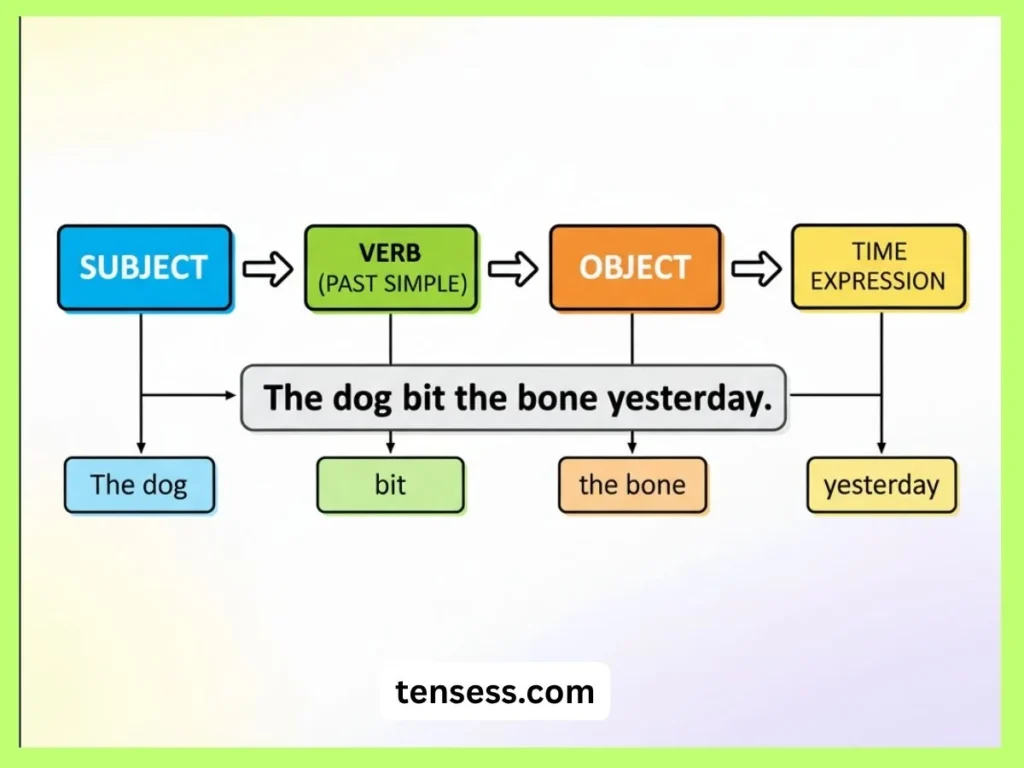
A past tense sentence with bite typically follows this structure:
Subject + bit + object (optional) + time expression (optional).
For example:
- “I bit the sandwich.”
- “The dog bit the bone yesterday.”
The sentence can include adverbs or additional details, like “She bit into the fruit eagerly.” No helping verbs are needed for simple past tense sentences with bit, as it’s a standalone verb that conveys a completed action.
Formation of the Past Tense of Bite
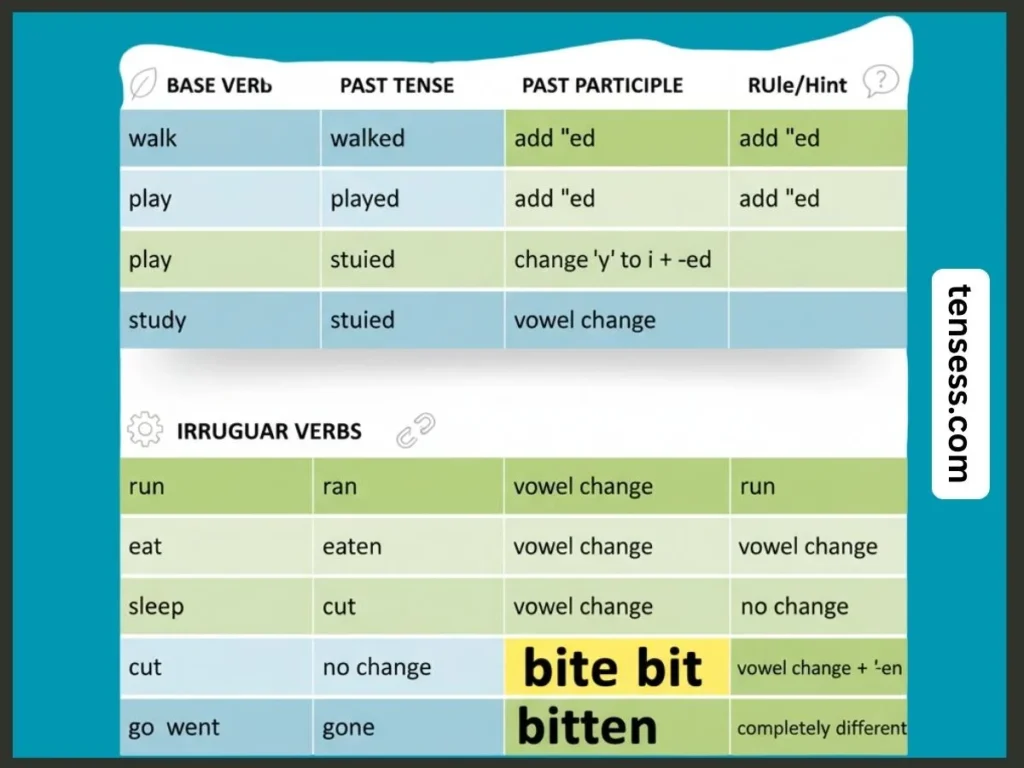
The past tense of bite is formed by changing the base verb bite to bit. Unlike regular verbs that add “-ed” (e.g., walk → walked), bite is irregular, so it transforms directly to bit for all subjects. For example:
- Present: I bite an apple.
- Past: I bit an apple.
No additional endings or modifications are required. The past participle, bitten, is used with helping verbs for perfect tenses (e.g., “I have bitten the apple”), but for simple past, bit is sufficient.
Verbs
The verb bite belongs to the category of irregular verbs, which don’t follow standard conjugation rules. Its forms are:
- Base: bite
- Past: bit
- Past Participle: bitten
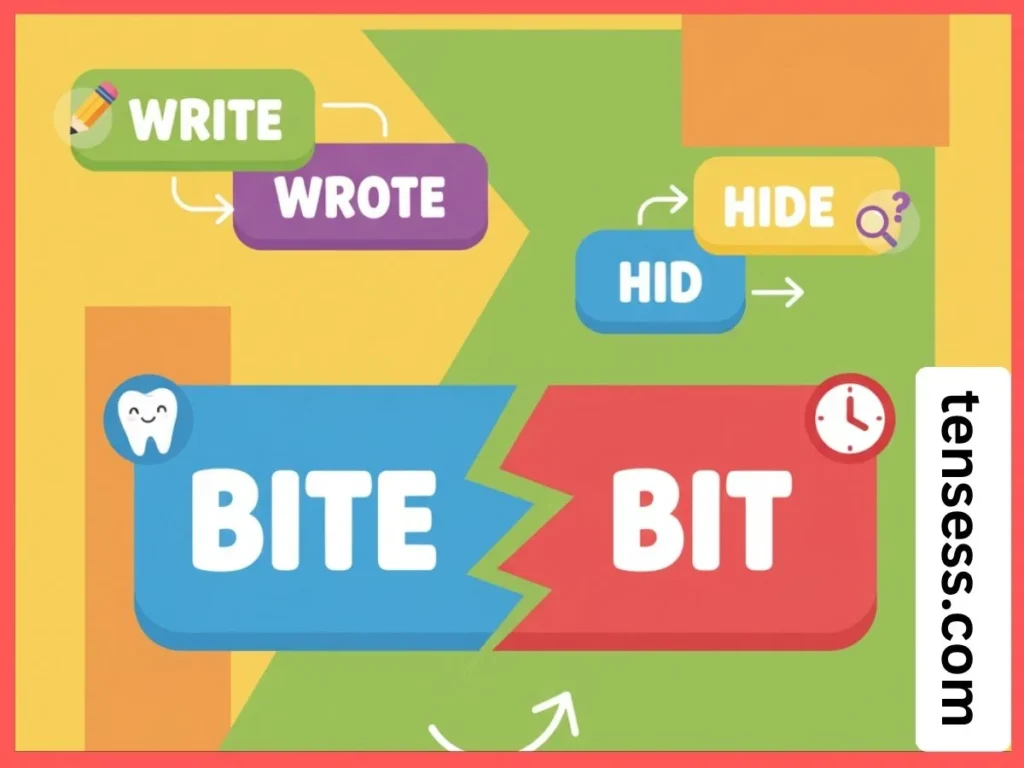
Other irregular verbs with similar patterns include write (wrote, written) and hide (hid, hidden). Understanding these patterns helps learners predict and master the past tense of bite.
Helping Verbs
In the simple past tense, bite doesn’t require helping verbs like “have” or “had.” For example, “He bit the apple” is complete without auxiliaries. However, in past perfect or past perfect continuous tenses, helping verbs like had or had been are used with bitten (e.g., “She had bitten the fruit before lunch”). For simple past tense sentences, focus solely on bit without additional verbs.
Explanation of Some Verbs with Reference to Past Tense of Bite
Several irregular verbs share similar conjugation patterns to bite. For example:
- Write: Present (write), Past (wrote), Past Participle (written).
- Hide: Present (hide), Past (hid), Past Participle (hidden).
Like bite, these verbs change their vowel sounds in the past tense and use a different form for the past participle. Understanding these patterns helps learners apply the past tense of bite correctly by recognizing how irregular verbs deviate from regular “-ed” endings.
Table of Some Regular or Irregular Verbs in Past Tense
| Base Verb | Past Tense | Past Participle | Regular/IrJulian? |
| Bite | Bit | Bitten | Irregular |
| Write | Wrote | Written | Irregular |
| Hide | Hid | Hidden | Irregular |
| Take | Took | Taken | Irregular |
| Walk | Walked | Walked | Regular |
| Talk | Talked | Talked | Regular |
| Run | Ran | Run | Irregular |
| Sing | Sang | Sung | Irregular |
| Drink | Drank | Drunk | Irregular |
| Jump | Jumped | Jumped | Regular |
Simple Sentence Examples
- I bit into a juicy apple yesterday.
- She bit her lip nervously during the meeting.
- He bit the cookie in half.
- We bit into the pizza eagerly.
- They bit the bait and got caught.
- The dog bit the toy aggressively.
- You bit off a large piece of chocolate.
- It bit me on the leg last summer.
- The child bit his sandwich slowly.
- The horse bit the carrot from my hand.
Negative Sentence Examples
- I didn’t bite the apple because it was sour.
- She didn’t bite her nails yesterday.
- He didn’t bite the bait during the fishing trip.
- We didn’t bite into the stale bread.
- They didn’t bite the candy because it was too hard.
- The dog didn’t bite the stranger.
- You didn’t bite the sandwich properly.
- It didn’t bite me this time.
- The child didn’t bite his food quickly.
- The horse didn’t bite the apple I offered.
Interrogative Sentence Examples
- Did I bite the apple too hard?
- Did she bite her lip during the speech?
- Did he bite the cookie first?
- Did we bite into the pizza too soon?
- Did they bite the bait quickly?
- Did the dog bite the toy aggressively?
- Did you bite off more than you could chew?
- Did it bite you on the arm?
- Did the child bite his sandwich?
- Did the horse bite the carrot?
Negative and Interrogative Sentence Examples
- Didn’t I bite the apple correctly?
- Didn’t she bite her lip nervously?
- Didn’t he bite the cookie too soon?
- Didn’t we bite into the pizza eagerly?
- Didn’t they bite the bait during the trip?
- Didn’t the dog bite the toy yesterday?
- Didn’t you bite the sandwich properly?
- Didn’t it bite me last week?
- Didn’t the child bite his food?
- Didn’t the horse bite the carrot?
How to Conjugate the Past Tense of Bite
The past tense of bite is bit for all subjects, making conjugation simple. Here’s how it works:
- Use bit for all pronouns (I, you, he, she, it, we, they).
- No auxiliary verbs are needed for simple past tense.
- Add time expressions for clarity (e.g., “yesterday”).
- Use bit in affirmative sentences (e.g., “I bit the apple”).
- For negative sentences, add “didn’t” before bite (e.g., “I didn’t bite it”).
- For questions, use “did” + subject + bite (e.g., “Did you bite it?”).
- Ensure the context indicates a past event.
- Avoid using bitten in simple past (it’s for perfect tenses).
- Practice with different subjects for fluency.
- Check for irregular verb patterns in similar verbs.
Conjugation Table for Past Tense of Bite
| Subject | Past Tense Conjugation |
| I | Bit |
| You | Bit |
| He | Bit |
| She | Bit |
| It | Bit |
| We | Bit |
| They | Bit |
Spelling Changes or Irregularities
The verb bite is irregular, so it doesn’t follow the regular “-ed” ending. Instead, it changes to bit in the past tense and bitten in the past participle. There are no spelling changes for different subjects, making it consistent. However, learners often confuse bit with bitten, using the latter incorrectly in simple past sentences. Always use bit for simple past and reserve bitten for perfect tenses with helping verbs like have or had.
Sentence Examples with Different Subjects
- I bit the apple with enthusiasm.
- You bit into the sandwich hungrily.
- He bit his tongue by accident.
- She bit her lip while thinking.
- It bit me on the ankle yesterday.
- We bit into the fresh bread.
- They bit the bait during fishing.
- I bit off a piece of chocolate.
- You bit the cookie too hard.
- He bit into the juicy peach.
- She bit the carrot with a crunch.
- It bit the toy aggressively.
- We bit into the pizza together.
- They bit their nails nervously.
- I bit the fruit cautiously.
Common Mistakes with Past Tense of Bite
- Using bitten instead of bit (e.g., “I bitten the apple”).
- Fix: Use bit for simple past, bitten for perfect tenses.
- Adding “-ed” to bite (e.g., “I bited the apple”).
- Fix: Memorize bite as an irregular verb.
- Forgetting time indicators for past tense clarity.
- Fix: Add words like “yesterday” or “last week.”
- Incorrect negative form (e.g., “I no bit“).
- Fix: Use “didn’t bite” for negatives.
- Wrong question structure (e.g., “Bit you the apple?”).
- Fix: Use “Did you bite the apple?”
- Mixing tenses (e.g., “I bit the apple tomorrow”).
- Fix: Ensure past tense aligns with past time.
- Using bit in present tense contexts.
- Fix: Use bite for present, bit for past.
- Overusing helping verbs unnecessarily.
- Fix: Simple past needs no auxiliaries.
- Confusing bit with similar-sounding verbs.
- Fix: Practice bite’s forms specifically.
- Incorrect subject-verb agreement (rare with bit).
- Fix: Bit works with all subjects.
Related Verbs and Synonyms for Past Tense of Bite
Synonyms for bite include nibble, chomp, chew, and snap. Related irregular verbs include:
- Write (wrote, written).
- Take (took, taken).
Sentence comparisons: - “I bit the apple” vs. “I nibbled the apple” (gentler action).
- “She bit her lip” vs. “She chomped her lip” (more aggressive).
Common confusion arises with nibble (regular verb, nibbled) and bite (irregular, bit). Always check the verb’s irregularity when conjugating.
Tips to Practice Using Past Tense of Bite
- Write 10 sentences using bit with different subjects.
- Read books and highlight past tense verbs like bit.
- Practice speaking sentences with bit aloud.
- Create flashcards for irregular verbs like bite.
- Use grammar apps to test past tense knowledge.
- Write a short story using bit multiple times.
- Practice negative sentences with didn’t bite.
- Ask a friend to quiz you on bit sentences.
- Watch English videos and note past tense usage.
- Review your writing for past tense accuracy.
Frequently Asked Questions
- What is the past tense of bite?
The past tense of bite is bit. - Is bite a regular or irregular verb?
Bite is an irregular verb. - What is the past participle of bite?
The past participle is bitten. - Can bit be used with all subjects?
Yes, bit is used for all subjects. - How do I form a negative sentence with bit?
Use “didn’t bite” (e.g., “I didn’t bite it”). - How do I ask a question with bit?
Use “Did + subject + bite?” (e.g., “Did you bite it?”). - Why is bitten incorrect for simple past?
Bitten is for perfect tenses, not simple past. - What are synonyms for bite?
Synonyms include nibble, chomp, and chew. - How can I practice bit correctly?
Write sentences and use grammar tools. - Are there spelling changes for bit?
No, bit is consistent for all subjects.
Exercises
- Write 5 sentences using bit correctly.
- Convert 5 present tense bite sentences to past tense.
- Create 3 negative sentences with didn’t bite.
- Write 3 interrogative sentences with bite.
- Identify bit in a short paragraph.
- Rewrite incorrect sentences (e.g., “I bited the apple”).
- Use bit in a story about a dog.
- Combine bit with time expressions in 3 sentences.
- Write a dialogue using bit 5 times.
- Practice bit with synonyms in 5 sentences.
Quizzes
- What is the past tense of bite? (Answer: Bit)
- Is bitten used in simple past? (Answer: No)
- What is the correct negative form of “I bit it”? (Answer: I didn’t bite it)
- What is the past participle of bite? (Answer: Bitten)
- Does bit change for different subjects? (Answer: No)
- What is a synonym for bite? (Answer: Nibble)
- Is bite regular or irregular? (Answer: Irregular)
- How do you form a question with bit? (Answer: Did + subject + bite)
- Can bit be used with “yesterday”? (Answer: Yes)
- What is a common mistake with bit? (Answer: Using bitten instead)
True or False
- The past tense of bite is bit. (True)
- Bitten is used in simple past tense. (False)
- Bit requires a helping verb in simple past. (False)
- Bite is a regular verb. (False)
- “Did you bite it?” is correct. (True)
- “I bited the apple” is correct. (False)
- Bit is used for all subjects. (True)
- Nibble is a synonym for bite. (True)
- Bit can be used with “yesterday.” (True)
- Bitten is used with “had” in past perfect. (True)
Conclusion
Mastering the past tense of bite is a valuable skill for students, language learners, and writers.
The irregular verb bite transforms into bit in the simple past tense, making it easy to use across all subjects.
This guide has covered the definition, sentence structure, conjugation, and common mistakes to help you use bit confidently.
With practical examples, exercises, and tips, you can practice forming accurate sentences and avoid pitfalls like confusing bit with bitten.
Keep practicing with real-life sentences, quizzes, and grammar tools to solidify your understanding.
Try writing a short story or using a grammar checker to refine your skills.
Share your favorite past tense of bite sentence in the comments or explore more grammar tips on our site to continue your learning journey!