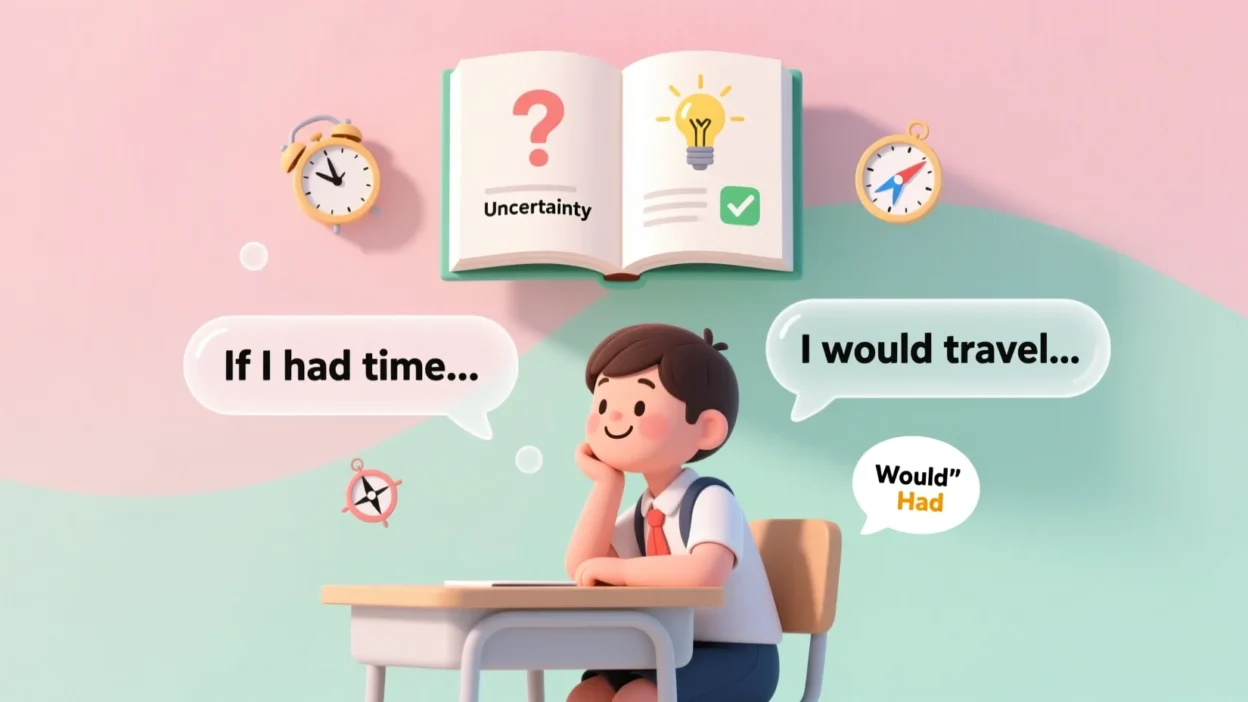
The conditional tense is a key part of English grammar, often used to express possibilities, hypothetical situations, or polite requests.
If you’re a student, language learner, writer, or grammar enthusiast, understanding how to use the conditional tense correctly can elevate your communication skills.
This tense allows you to talk about “what could happen” or “what might have been” in a clear and engaging way.
This beginner-friendly guide, we’ll break down the conditional tense, its structure, and how to use it effectively with real-life examples. Y
ou’ll find skimmable sections, practical tips, and exercises to help you master this versatile tense.
Let’s dive into the world of possibilities with the conditional tense and make grammar fun and approachable!
What Is the Conditional Tense?
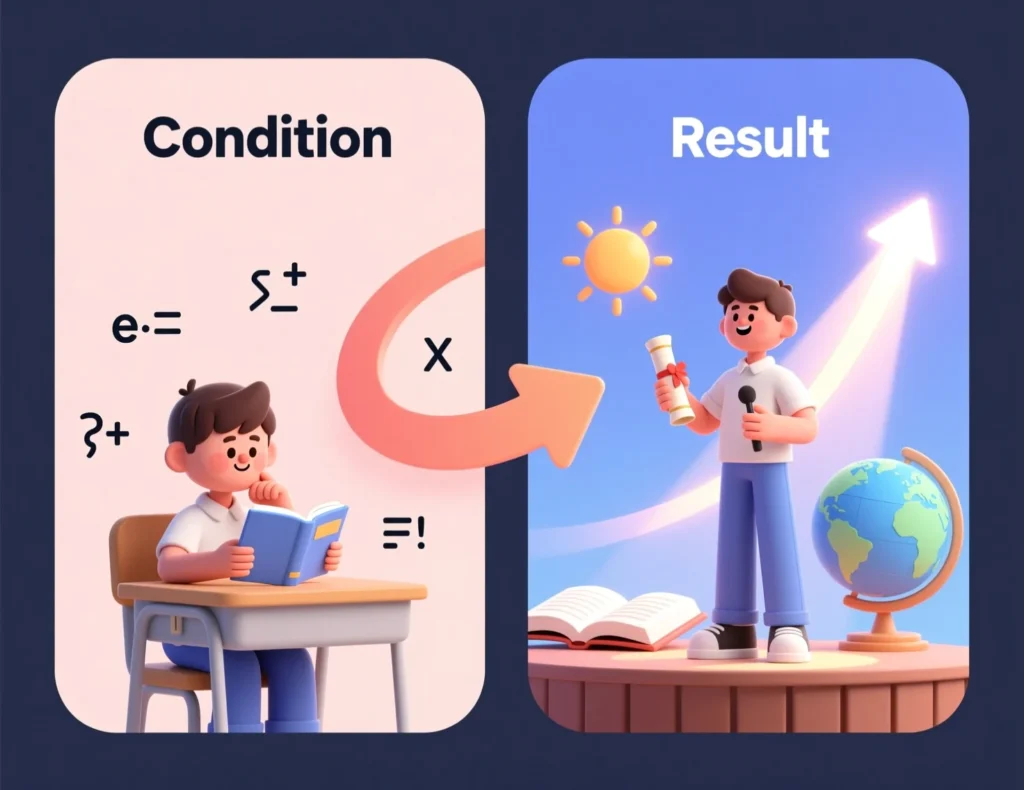
The conditional tense describes actions or events that depend on a condition. It’s used to express hypothetical scenarios, possibilities, or outcomes that rely on something else happening. For example, “I would go to the party if I had time.” Here, the action (going to the party) depends on a condition (having time). The conditional tense often conveys politeness, as in, “I would like to order coffee.” It’s common in discussions about the future, hypothetical past, or polite suggestions. Understanding the conditional tense helps you express nuanced ideas, making your speech or writing more dynamic and precise.
How to Recognize the Conditional Tense?
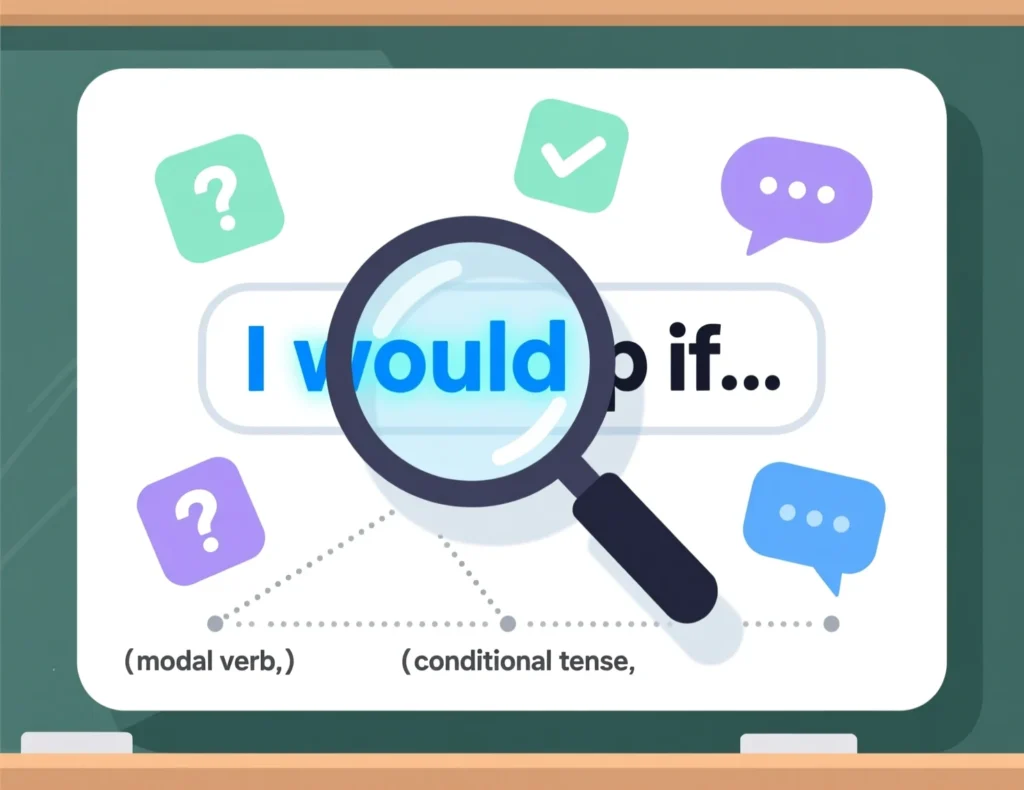
To spot the conditional tense, look for the helping verb would (or sometimes should or could) paired with a base verb. Sentences often include “if” clauses or imply a condition, like “She would travel if she had money.” The conditional tense appears in both formal and informal contexts, often signaling hypothetical or unreal situations. For example:
- Polite requests: “Would you help me?”
- Hypothetical scenarios: “If I were rich, I would buy a yacht.”
Pay attention to the structure and context to identify this tense in conversations or texts.
Structure of a Sentence in the Conditional Tense
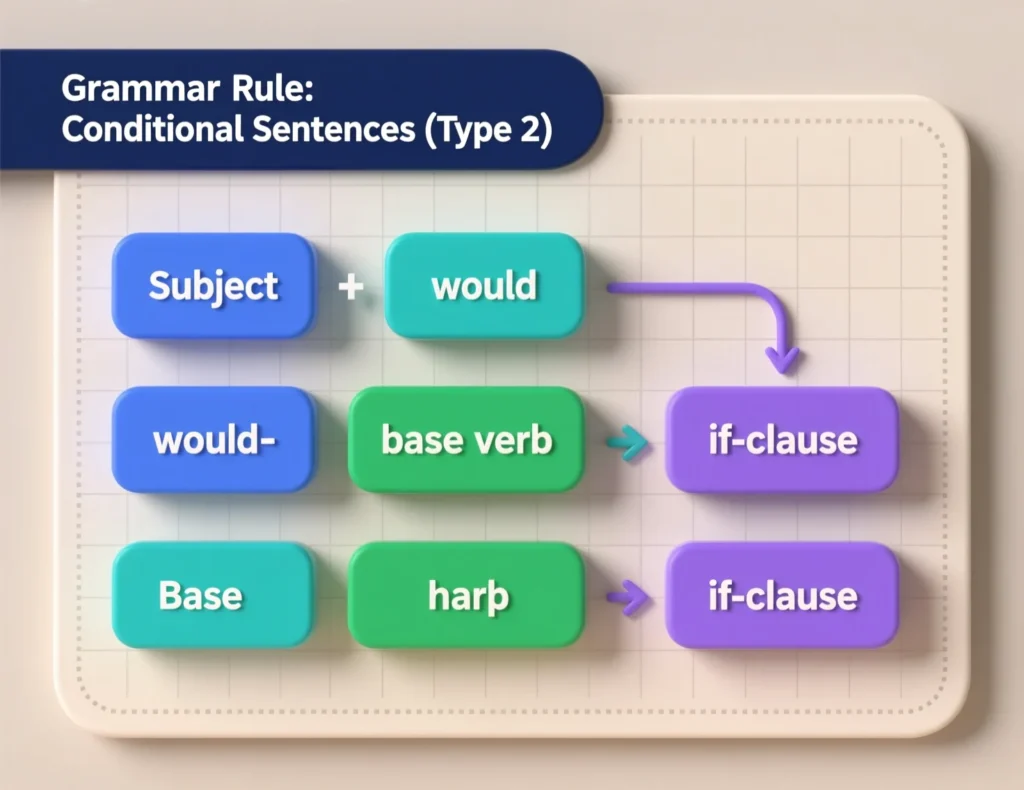
A conditional tense sentence typically follows this pattern:
- Subject + would + base verb (e.g., “I would sing”).
- For conditional clauses: If + subject + past tense, subject + would + base verb (e.g., “If I studied, I would pass”).
The “if” clause sets the condition, while the main clause shows the result. In formal writing, “were” is often used for all subjects in hypothetical situations (e.g., “If I were king…”).
Formation of the Conditional Tense
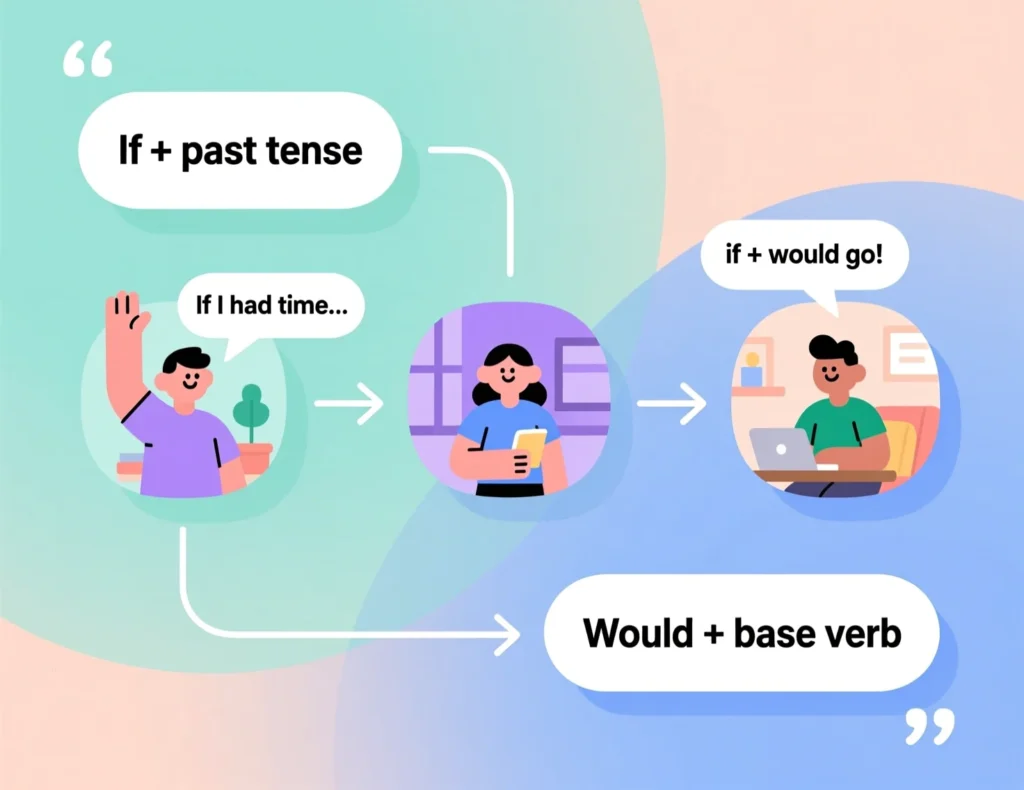
Forming the conditional tense is straightforward:
- Use would as the helping verb.
- Add the base form of the main verb (e.g., would + run = “I would run”).
- For conditional sentences, pair with an “if” clause in the past simple or past perfect for hypothetical past scenarios (e.g., “If I had known, I would have helped”).
No changes are needed for regular or irregular verbs in the main clause—just use the base form.
Verbs in the Conditional Tense
The conditional tense works with both regular and irregular verbs. The base verb remains unchanged after would. For example:
- Regular: “I would walk” (base: walk).
- Irregular: “I would go” (base: go).
The flexibility of the conditional tense makes it compatible with nearly all verbs, as long as they follow the would + base verb structure.
Helping Verbs in the Conditional Tense
The primary helping verb is would, but could and should can also appear in conditional contexts:
- Would: Expresses hypothetical actions (e.g., “I would eat pizza”).
- Could: Indicates possibility (e.g., “I could visit if I had time”).
- Should: Suggests advisability (e.g., “You should call if you need help”).
These helping verbs add nuance to the conditional tense, depending on the situation.
Explanation of Some Verbs in the Conditional Tense
Here’s how common verbs behave in the conditional tense:
- Go: “I would go to Paris if I had money.” (Hypothetical travel)
- Eat: “She would eat sushi every day if she could.” (Preference)
- Be: “If I were taller, I would play basketball.” (Unreal situation)
- Have: “We would have finished earlier if we started on time.” (Past hypothetical)
These verbs follow the same would + base verb rule, regardless of being regular or irregular.
Table of Some Regular and Irregular Verbs in the Conditional Tense
| Base Verb | Regular/Irregular | Conditional Form |
| Walk | Regular | would walk |
| Talk | Regular | would talk |
| Go | Irregular | would go |
| Eat | Irregular | would eat |
| Be | Irregular | would be |
| Have | Irregular | would have |
| See | Irregular | would see |
| Write | Regular | would write |
| Run | Regular | would run |
| Sing | Regular | would sing |
Simple Sentence Examples
- I would call you if I had your number.
- She would dance all night if she weren’t tired.
- We would visit the museum if it were open.
- He would study harder if he had more time.
- They would play soccer if the weather were nice.
- You would enjoy the movie if you watched it.
- It would rain if the clouds gathered.
- I would help if I knew how.
- She would sing if she had a microphone.
- We would travel if we won the lottery.
Negative Sentence Examples
- I wouldn’t call if I didn’t trust you.
- She wouldn’t dance if the music was bad.
- We wouldn’t visit if the place was crowded.
- He wouldn’t study if he felt unprepared.
- They wouldn’t play if the field was wet.
- You wouldn’t enjoy it if you were tired.
- It wouldn’t work if the battery died.
- I wouldn’t help if I were too busy.
- She wouldn’t sing if she felt shy.
- We wouldn’t travel if the tickets were expensive.
Interrogative Sentence Examples
- Would I call if I had your number?
- Would she dance if the music was good?
- Would we visit if the museum were free?
- Would he study if he had a tutor?
- Would they play if the weather improved?
- Would you watch the movie if I recommended it?
- Would it rain if the sky darkened?
- Would I help if you asked me?
- Would she sing if we clapped for her?
- Would we travel if we had more money?
Negative and Interrogative Sentence Examples
- Wouldn’t I call if I didn’t care?
- Wouldn’t she dance if she weren’t shy?
- Wouldn’t we visit if it weren’t so far?
- Wouldn’t he study if he weren’t distracted?
- Wouldn’t they play if the field weren’t muddy?
- Wouldn’t you watch it if it weren’t boring?
- Wouldn’t it work if we fixed it?
- Wouldn’t I help if I weren’t busy?
- Wouldn’t she sing if she weren’t nervous?
- Wouldn’t we travel if we weren’t broke?
How to Conjugate the Conditional Tense
Conjugating the conditional tense is simple:
- Use would for all subjects (I, you, he, she, it, we, they).
- Pair would with the base verb (e.g., would + read = “I would read”).
- No changes to the verb form, regardless of subject.
- For hypothetical past, use would have + past participle (e.g., “I would have gone”).
- Add “if” clauses for conditions (e.g., “If I were rich, I would buy…”).
- Use could for possibilities (e.g., “She could join if invited”).
- Use should for advice (e.g., “You should try if you want to succeed”).
- Keep the structure consistent across regular and irregular verbs.
- Ensure the “if” clause uses the correct tense (past simple or past perfect).
- Practice with different subjects to master conjugation.
Conjugation Table for All Subjects
| Subject | Base Verb: Go | Base Verb: Eat | Base Verb: Be |
| I | would go | would eat | would be |
| You | would go | would eat | would be |
| He/She/It | would go | would eat | would be |
| We | would go | would eat | would be |
| They | would go | would eat | would be |
Spelling Changes or Irregularities
The conditional tense is straightforward with no major spelling changes:
- Regular verbs: Add would + base verb (e.g., “I would walk”).
- Irregular verbs: Use the base form, not past forms (e.g., would go, not would went).
- The verb “be” uses “were” in “if” clauses for all subjects in hypothetical situations (e.g., “If I were rich”).
- No additional endings or changes are needed for the main verb.
10–15 Sentence Examples with Different Subjects
- I would learn Spanish if I had more time.
- You would love the beach if you visited.
- He would write a book if he had inspiration.
- She would cook dinner if she weren’t tired.
- It would fly if it had wings.
- We would hike if the trail were open.
- They would join us if they were free.
- I would have called if I had known.
- You would have won if you tried harder.
- She would have danced if the music played.
- He would have studied if he had a book.
- We would have traveled if we saved money.
- They would have helped if they were here.
- It would have worked if we fixed it.
- I would try again if I weren’t so tired.
Common Mistakes with the Conditional Tense
- Using will instead of would: “If I win, I will go” (incorrect; use would).
- Incorrect “if” clause tense: “If I will study, I would pass” (use studied).
- Mixing past and present: “If I was rich, I would buy” (use were for hypothetical).
- Omitting would: “I go if I had time” (incorrect; use would go).
- Using past participle alone: “I would gone” (use would have gone).
- Wrong verb form: “She would walks” (use would walk).
- Overusing could: “I could go if I want” (use would for hypotheticals).
- Ignoring subject-verb agreement in “if” clauses: “If they was here” (use were).
- Confusing would and should: “You would apologize” (use should for advice).
- Forgetting the condition: “I would travel” (add “if I had money”).
How to Avoid Common Mistakes
- Always use would for hypotheticals, not will.
- Pair “if” clauses with past simple or past perfect.
- Use “were” for all subjects in unreal “if” clauses.
- Ensure would is followed by the base verb.
- For past hypotheticals, use would have + past participle.
- Double-check verb forms to avoid incorrect endings.
- Use could for possibility, not hypotheticals.
- Verify subject-verb agreement in “if” clauses.
- Clarify when should is needed for advice.
- Always include the condition for clarity.
Related Verbs and Synonyms for the Conditional Tense
Verbs related to or confused with the conditional tense include:
- Will: Indicates future certainty, not hypotheticals (e.g., “I will go” vs. “I would go”).
- Could: Suggests possibility (e.g., “I could help” vs. “I would help”).
- Should: Implies obligation (e.g., “You should try” vs. “You would try”).
- Might: Indicates less certain possibility (e.g., “I might go” vs. “I would go”).
Sentence comparison: - Will: “If I save money, I will travel.” (Certain)
- Would: “If I saved money, I would travel.” (Hypothetical)
- Could: “If I saved money, I could travel.” (Possible)
- Might: “If I saved money, I might travel.” (Less likely)
Tips to Practice Using the Conditional Tense
- Write 5 hypothetical sentences daily using would.
- Create “if” clause scenarios (e.g., “If I were rich…”).
- Practice with different subjects (I, you, he, etc.).
- Use would have for past hypothetical situations.
- Read books or watch shows to spot conditional tense usage.
- Try rewriting will sentences as would sentences.
- Practice with a friend by discussing “what if” scenarios.
- Use flashcards to memorize irregular verb forms.
- Write a short story using the conditional tense.
- Check your sentences with a grammar tool for accuracy.
Frequently Asked Questions
- What is the conditional tense?
It expresses hypothetical or dependent actions using would + base verb. - When do we use the conditional tense?
For hypotheticals, polite requests, or possibilities (e.g., “I would help”). - What’s the difference between would and will?
Will is for certain futures; would is for hypotheticals. - Can I use could instead of would?
Yes, but could emphasizes possibility, not hypotheticals. - What tense is used in “if” clauses?
Past simple or past perfect for unreal situations. - Is “were” always used in conditional sentences?
Yes, for hypothetical “if” clauses (e.g., “If I were…”). - Can irregular verbs be used in the conditional tense?
Yes, they follow the same would + base verb rule. - What’s a common mistake with the conditional tense?
Using will instead of would in hypotheticals. - How do I make negative conditional sentences?
Add not after would (e.g., “I wouldn’t go”). - How can I practice the conditional tense?
Write hypothetical scenarios and check with grammar tools.
Exercises
- Write 5 simple conditional tense sentences.
- Convert 3 will sentences to would sentences.
- Create 3 negative conditional tense sentences.
- Write 3 interrogative conditional tense sentences.
- Combine “if” clauses with would have for past hypotheticals.
- Identify the conditional tense in a short paragraph.
- Rewrite a sentence using could instead of would.
- Create a dialogue using the conditional tense.
- Write a hypothetical story with 5 conditional tense sentences.
- Correct 3 incorrect conditional tense sentences.
Quizzes
- What is the correct form: “I __ go if I had time”?
a) will b) would c) could - Which is correct? “If I __ rich, I would buy a car.”
a) were b) was c) am - What’s wrong: “I would walks if I had shoes”?
a) walks should be walk b) Nothing c) would - Choose the negative form: “She __ sing if tired.”
a) wouldn’t b) won’t c) couldn’t - What tense is the “if” clause in “If I studied, I would pass”?
a) Present b) Past simple c) Future - Correct form: “They __ helped if they knew.”
a) would have b) will have c) would - Which uses the conditional tense?
a) I will go b) I would go c) I go - What’s wrong: “If I will study, I would pass”?
a) will study should be studied b) Nothing c) would - Choose the interrogative:
a) Would you help? b) You would help c) Help you - What’s the base verb in “I would run”?
a) run b) ran c) running
True or False
- The conditional tense uses would + base verb. (True)
- “Will” can replace “would” in hypotheticals. (False)
- “If I were rich” is correct for all subjects. (True)
- Irregular verbs change form in the conditional tense. (False)
- Could is the same as would in meaning. (False)
- “If” clauses always use the present tense. (False)
- Negative form is wouldn’t + base verb. (True)
- “I would have gone” is a past hypothetical. (True)
- The conditional tense is only for formal writing. (False)
- “Should” can be used in the conditional tense. (True)
Conclusion
Mastering the conditional tense opens up a world of possibilities in your writing and speaking.
By using would + base verb and pairing it with “if” clauses, you can express hypothetical scenarios, polite requests, and imaginative ideas with ease.
This guide has provided clear explanations, real-life examples, and practical exercises to help you confidently use the conditional tense.
If you’re a student, writer, or language learner, practicing this tense will enhance your grammar skills and make your communication more engaging.
Try writing a few conditional tense sentences today, or use a grammar checker to refine your work.
Share your examples in the comments or test your skills with our quizzes. Keep practicing, and soon the conditional tense will feel like second nature!