Learning Spanish verbs can feel overwhelming, but mastering the decir future tense is a key step for students, language learners, writers, and grammar enthusiasts.
The verb decir, meaning “to say” or “to tell,” is one of the most commonly used verbs in Spanish.
Its future tense allows you to talk about what will be said or told later, making it essential for everyday conversations, storytelling, and planning.
This beginner-friendly guide, we’ll break down the decir future tense, including its definition, structure, conjugation, and practical examples.
If you’re chatting with friends or writing a story, understanding how to use decir in the future tense will boost your confidence.
Let’s dive into this skimmable, easy-to-follow article packed with real-life examples, tips, and exercises to help you master this verb tense!
What Is the Decir Future Tense?
The decir future tense is used to describe actions that will happen in the future involving saying or telling. For example, you might use it to express what someone will say tomorrow or predict what a friend will tell you next week. This tense is part of Spanish’s simple future tense, which is formed by adding specific endings to the infinitive verb. For decir, an irregular verb, the future tense involves a stem change, making it unique but easy to learn with practice. It’s commonly used in promises, predictions, or plans, like “I will tell you a secret” or “She will say something funny.”
How to Recognize the Decir Future Tense?
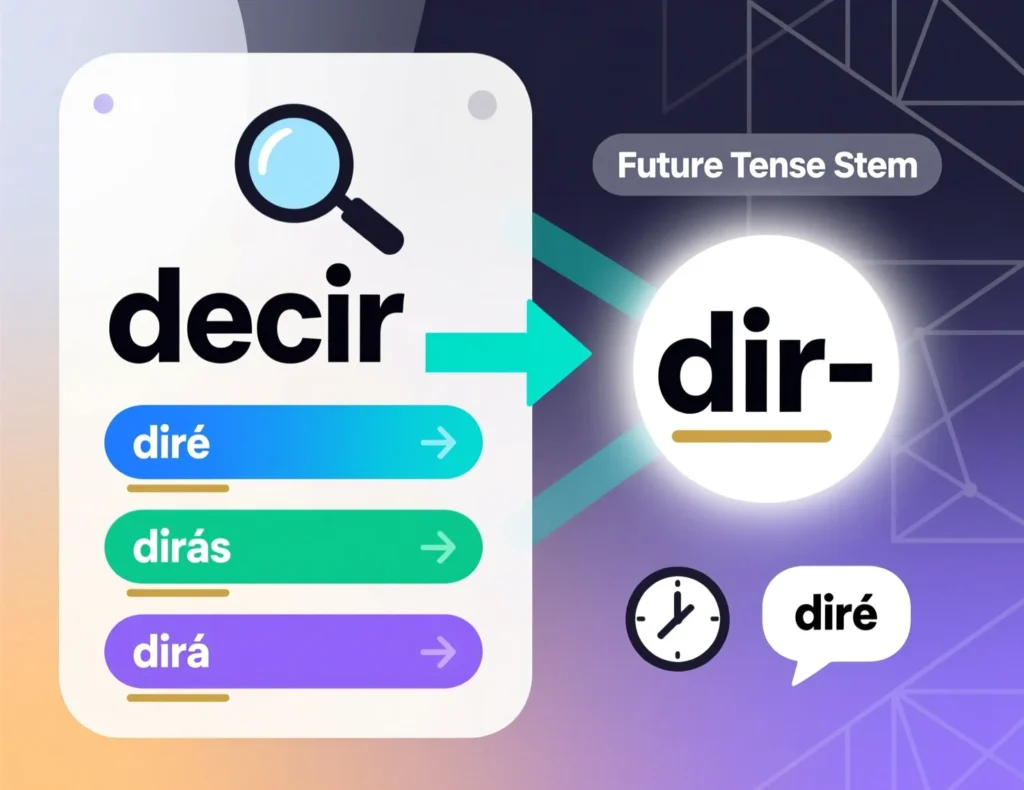
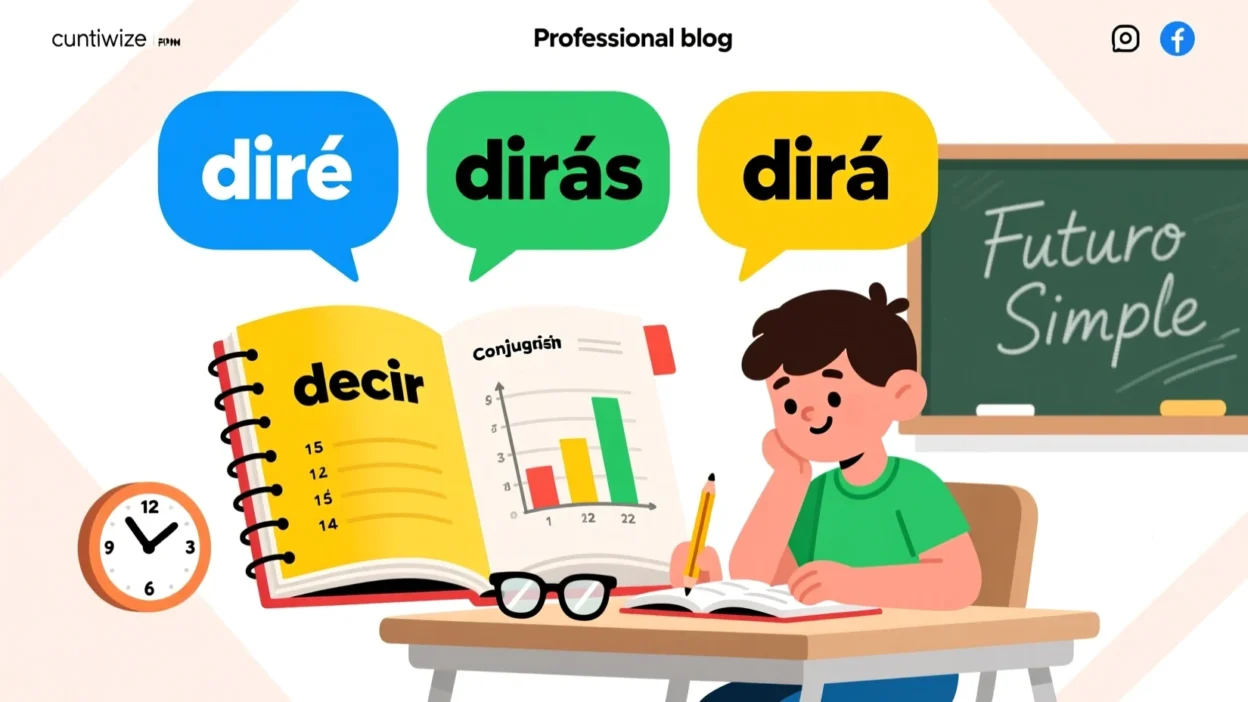
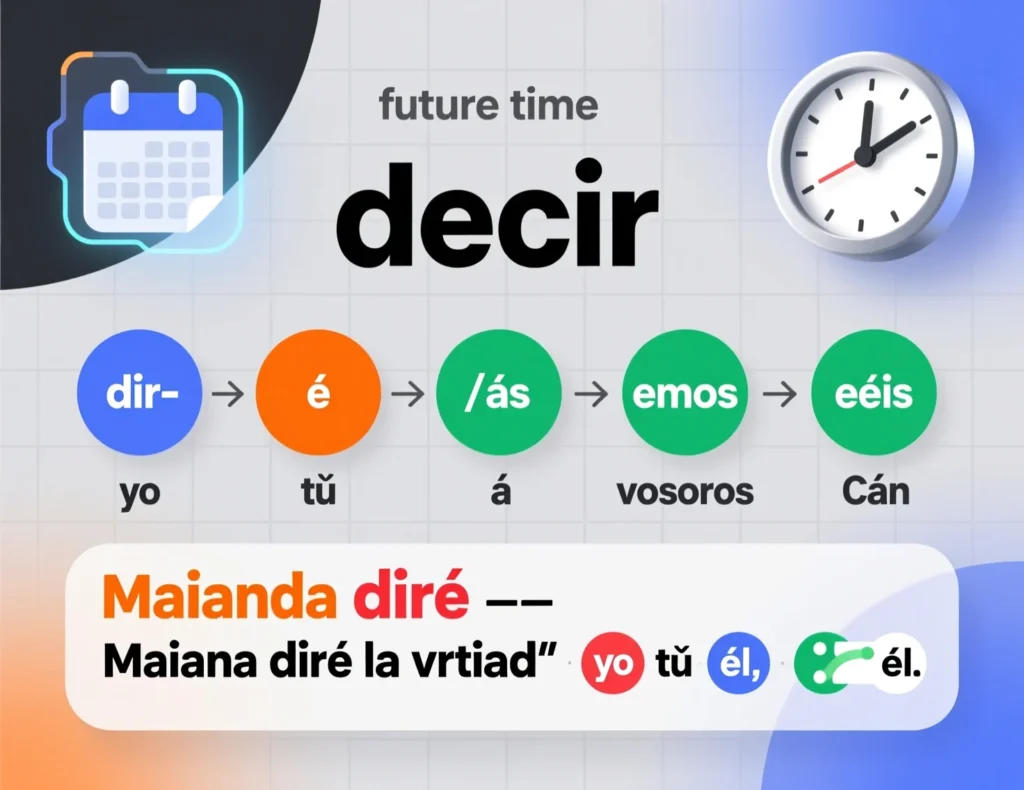
You can spot the decir future tense by its unique stem and endings. Unlike regular verbs, decir changes its stem from “dec-” to “dir-” in the future tense. Look for endings like -é, -ás, -á, -emos, -éis, or -án attached to this stem. For instance, “I will say” is diré, and “they will say” is dirán. These forms often appear in sentences about future intentions or predictions, such as “Mañana diré la verdad” (Tomorrow, I will tell the truth).
Structure of a Sentence in Decir Future Tense
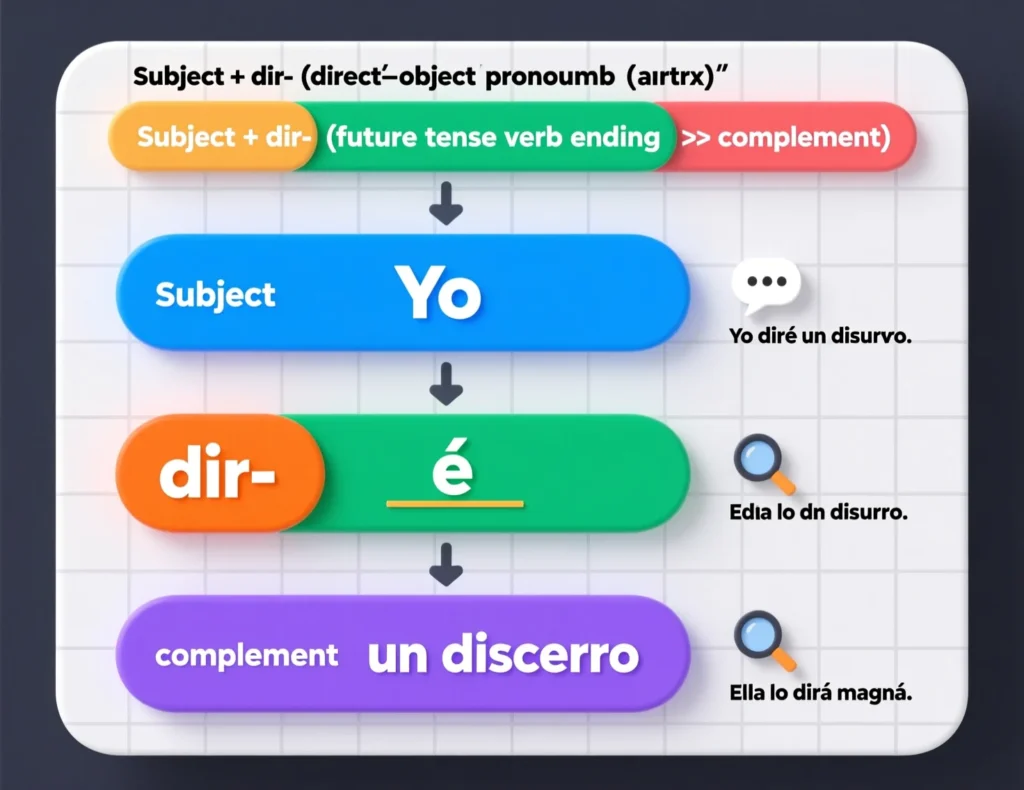
A typical sentence in the decir future tense follows this structure:
Subject + conjugated form of decir + object/complement.
For example:
- Yo diré un discurso (I will give a speech).
- Ellos dirán la verdad (They will tell the truth).
The sentence may include time markers like “mañana” (tomorrow) or “pronto” (soon) to indicate the future.
Formation of Decir Future Tense
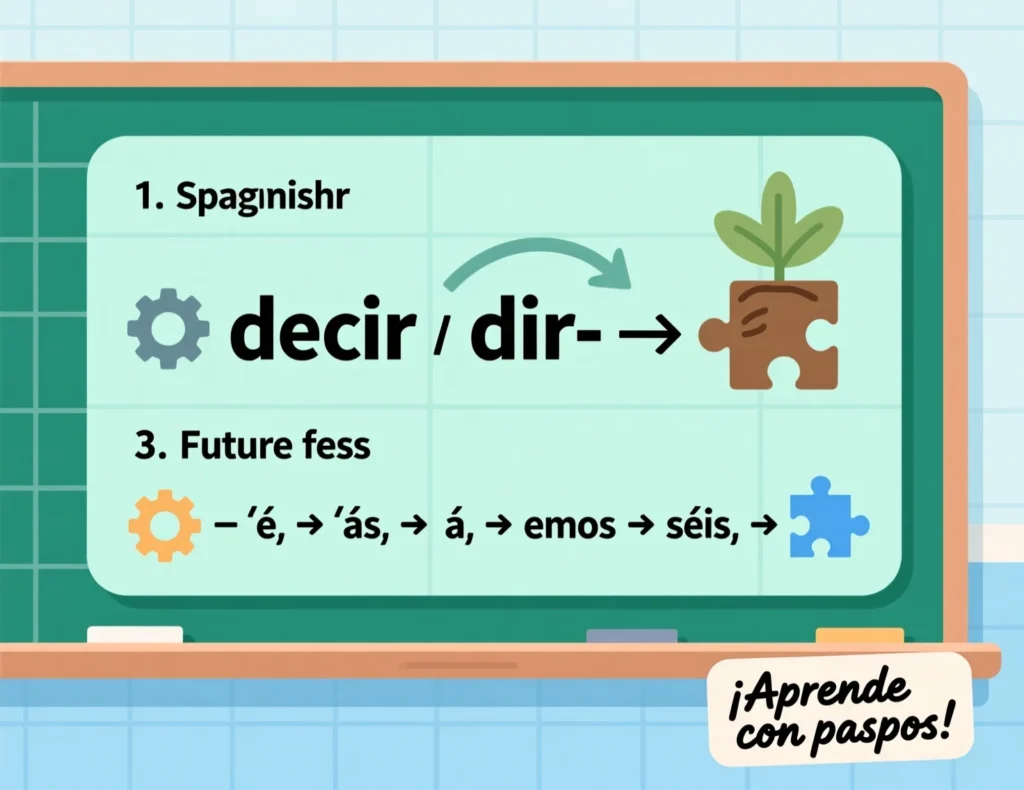
To form the decir future tense, follow these steps:
- Take the infinitive verb decir.
- Change the stem to dir- (irregular stem for future tense).
- Add the future tense endings: -é, -ás, -á, -emos, -éis, -án.
For example: diré (I will say), dirás (you will say).
Verbs and Helping Verbs
The decir future tense doesn’t require helping verbs like “will” in English because the future is built into the verb’s conjugation. Unlike English, where “will” is used (e.g., “I will say”), Spanish incorporates the future directly into the verb form (e.g., diré). However, decir can pair with other verbs in compound sentences, like “quiero que digas” (I want you to say).
Explanation of Some Verbs with Reference to Decir Future Tense
Decir is irregular, like other verbs with stem changes in the future tense. Related verbs include:
- Hacer (to do/make) → har- (e.g., haré – I will do).
- Poder (to be able) → podr- (e.g., podré – I will be able).
- Tener (to have) → tendr- (e.g., tendré – I will have).
These verbs follow a similar pattern of stem change and future tense endings, making them easier to learn alongside decir.
Table of Regular and Irregular Verbs in Decir Future Tense
| Verb | Stem | Yo Form | Example Sentence |
| Decir | dir- | diré | Diré la verdad (I will tell the truth). |
| Hacer | har- | haré | Haré mi tarea (I will do my homework). |
| Poder | podr- | podré | Podré ayudarte (I will be able to help). |
| Tener | tendr- | tendré | Tendré tiempo (I will have time). |
| Venir | vendr- | vendré | Vendré mañana (I will come tomorrow). |
Simple Sentence Examples
- Yo diré un secreto mañana (I will tell a secret tomorrow).
- Tú dirás algo gracioso (You will say something funny).
- Él dirá la verdad (He will tell the truth).
- Ella dirá su opinión (She will give her opinion).
- Nosotros diremos las reglas (We will state the rules).
- Vosotros diréis un discurso (You all will give a speech).
- Ellos dirán una historia (They will tell a story).
- Usted dirá algo importante (You will say something important).
- Nosotras diremos la noticia (We will share the news).
- Ellas dirán un poema (They will recite a poem).
Negative Sentence Examples
- Yo no diré nada (I won’t say anything).
- Tú no dirás mentiras (You won’t tell lies).
- Él no dirá el secreto (He won’t reveal the secret).
- Ella no dirá la respuesta (She won’t give the answer).
- Nosotros no diremos la verdad (We won’t tell the truth).
- Vosotros no diréis nada malo (You all won’t say anything bad).
- Ellos no dirán su plan (They won’t share their plan).
- Usted no dirá eso (You won’t say that).
- Nosotras no diremos rumores (We won’t spread rumors).
- Ellas no dirán chismes (They won’t gossip).
Interrogative Sentence Examples
- ¿Diré yo algo gracioso? (Will I say something funny?)
- ¿Dirás tú la verdad? (Will you tell the truth?)
- ¿Dirá él su opinión? (Will he give his opinion?)
- ¿Dirá ella un discurso? (Will she give a speech?)
- ¿Diremos nosotros las reglas? (Will we state the rules?)
- ¿Diréis vosotros algo importante? (Will you all say something important?)
- ¿Dirán ellos una historia? (Will they tell a story?)
- ¿Dirá usted la noticia? (Will you share the news?)
- ¿Diremos nosotras un poema? (Will we recite a poem?)
- ¿Dirán ellas la respuesta? (Will they give the answer?)
Negative and Interrogative Sentence Examples
- ¿No diré yo nada malo? (Won’t I say anything bad?)
- ¿No dirás tú el secreto? (Won’t you reveal the secret?)
- ¿No dirá él mentiras? (Won’t he tell lies?)
- ¿No dirá ella la verdad? (Won’t she tell the truth?)
- ¿No diremos nosotros rumores? (Won’t we spread rumors?)
- ¿No diréis vosotros chismes? (Won’t you all gossip?)
- ¿No dirán ellos su plan? (Won’t they share their plan?)
- ¿No dirá usted eso? (Won’t you say that?)
- ¿No diremos nosotras nada? (Won’t we say anything?)
- ¿No dirán ellas la noticia? (Won’t they share the news?)
How to Conjugate Decir Future Tense
To conjugate decir in the future tense:
- Start with the irregular stem dir-.
- Add the appropriate ending based on the subject:
- Yo: diré
- Tú: dirás
- Él/Ella/Usted: dirá
- Nosotros: diremos
- Vosotros: diréis
- Ellos/Ellas/Ustedes: dirán
- Ensure the context matches a future action, like plans or predictions.
- Practice with different subjects to get comfortable.
- Use time markers like “mañana” for clarity.
- Double-check the stem change from dec- to dir-.
- Avoid confusing it with other tenses like the present (digo).
- Pair with objects like “la verdad” (the truth) for complete sentences.
- Memorize the endings as they apply to all future tense verbs.
- Practice regularly to build fluency.
Conjugation Table for Decir Future Tense
| Subject | Conjugation | Example Sentence |
| Yo | diré | Diré un secreto (I will tell a secret). |
| Tú | dirás | Dirás la verdad (You will tell the truth). |
| Él/Ella/Usted | dirá | Dirá su opinión (they will give their opinion). |
| Nosotros | diremos | Diremos las reglas (We will state the rules). |
| Vosotros | diréis | Diréis un discurso (You all will give a speech). |
| Ellos/Ellas/Ustedes | dirán | Dirán una historia (They will tell a story). |
Spelling Changes or Irregularities
The decir future tense is irregular because the stem changes from dec- to dir-. Unlike regular verbs like hablar (to speak), which keep their infinitive stem (hablaré), decir drops the “e” and “c” to form dir-. This irregularity is shared with other verbs like hacer (har-) and poder (podr-). There are no additional spelling changes in the endings, which follow the standard future tense pattern (-é, -ás, -á, etc.).
Sentence Examples with Different Subjects
- Yo diré la noticia mañana (I will share the news tomorrow).
- Tú dirás algo especial (You will say something special).
- Él dirá un chiste (He will tell a joke).
- Ella dirá su plan (She will share her plan).
- Nosotros diremos la verdad (We will tell the truth).
- Vosotros diréis un poema (You all will recite a poem).
- Ellos dirán las reglas (They will state the rules).
- Usted dirá algo importante (You will say something important).
- Nosotras diremos un secreto (We will tell a secret).
- Ellas dirán su opinión (They will give their opinion).
- Tú dirás lo que piensas (You will say what you think).
- Él dirá algo gracioso (He will say something funny).
- Nosotros diremos una historia (We will tell a story).
- Vosotros diréis la respuesta (You all will give the answer).
- Ellos dirán un discurso (They will give a speech).
Common Mistakes with Decir Future Tense
- Using the wrong stem: Saying deciré instead of diré. Always use dir-.
- Forgetting the accent: Writing dire instead of diré. Accents matter!
- Confusing with present tense: Using digo (I say) instead of diré (I will say).
- Incorrect endings: Saying dirá for “we” instead of diremos. Match the subject.
- Ignoring irregularity: Treating decir like a regular verb (deciré is wrong).
- Misplacing time markers: Saying “Diré mañana la verdad” instead of “Mañana diré la verdad.”
- Overusing helping verbs: Adding unnecessary words like voy a (e.g., voy a diré is incorrect).
- Mixing with conditional tense: Using diría (I would say) instead of diré (I will say).
- Incorrect negation: Saying no diré no instead of no diré nada.
- Forgetting context: Using diré without a future context, confusing listeners.
How to Avoid Common Mistakes
- Memorize the stem dir- for decir in the future tense.
- Practice accent placement (e.g., diré, dirás).
- Compare with present tense forms (digo vs. diré) to avoid confusion.
- Use the correct ending for each subject (e.g., -emos for nosotros).
- Review irregular verbs like hacer and poder to reinforce patterns.
- Place time markers like “mañana” at the start of sentences for clarity.
- Avoid mixing with voy a constructions; use diré for simple future.
- Practice conditional vs. future forms (diría vs. diré) in context.
- Use nada or specific objects in negative sentences (e.g., no diré nada).
- Write practice sentences with clear future contexts to build confidence.
Related Verbs and Synonyms for Decir Future Tense
Synonyms for decir include:
- Hablar (to speak): Used for general speech (e.g., hablaré – I will speak).
- Contar (to tell): Used for stories or accounts (e.g., contaré – I will tell).
- Expresar (to express): Used for opinions (e.g., expresaré – I will express).
Sentence Comparisons:
- Diré un secreto (I will tell a secret) vs. Contaré un secreto (I will tell a secret).
- Dirá su opinión (She will give her opinion) vs. Expresará su opinión (She will express her opinion).
Decir is often confused with contar when telling stories, but decir is more general.
Future Tense Spanish Decir
The future tense of the Spanish verb decir allows you to talk about what someone will say or tell later. Unlike English, where “will” is used with the verb, Spanish future tense is built into the verb itself. Decir is irregular, so its stem changes from dec- to dir- in the future.
To form the future tense, add the endings -é, -ás, -á, -emos, -éis, or -án to this stem. For example, “I will tell” translates to diré, and “they will say” is dirán. This tense is essential for expressing future plans, predictions, promises, or intentions.
Using time markers like mañana (tomorrow) or pronto (soon) clarifies that the action is in the future. Regular practice with conjugations and example sentences will make using the decir future tense natural in conversation or writing.
Decir in Future Tense / Decir Future Tense Conjugation
To use decir in the future tense, start with its irregular stem dir- and attach the standard future endings. Here’s a full conjugation: yo diré (I will say), tú dirás (you will say), él/ella/usted dirá (they/you formal will say), nosotros diremos (we will say), vosotros diréis (you all will say), ellos/ellas/ustedes dirán (they/you all formal will say).
These forms are used when expressing promises, predictions, or plans. Unlike English, no auxiliary verb like “will” is needed; the future is built into the verb. Pair decir with objects like la verdad (the truth) or un secreto (a secret) to form complete sentences.
Example: Mañana diré la verdad (Tomorrow I will tell the truth). Practice by creating questions, negative sentences, and predictions to master this tense.
Decir Conjugation / How to Conjugate Decir
Decir is an irregular Spanish verb meaning “to say” or “to tell.” It has different conjugation patterns depending on tense. In the present tense, the yo form is digo. In the preterite, it becomes dije, while in the imperfect, it’s decía.
For the future tense, use the stem dir- plus endings: -é, -ás, -á, -emos, -éis, -án. For example, yo diré (I will say), tú dirás (you will tell). The verb also appears in subjunctive, present perfect, and commands (e.g., di for tú).
Learning these forms helps you accurately convey speech or communication in Spanish. Pair with objects or contexts like questions, storytelling, or instructions to use conjugations naturally.
Decir Future Tense Example
A decir future tense example demonstrates how to talk about what someone will say in the future. For instance: Yo diré un secreto mañana (I will tell a secret tomorrow). Other examples include Ella dirá su opinión (She will give her opinion) and Nosotros diremos las reglas (We will state the rules).
These sentences highlight the irregular stem dir- and the proper future endings. Adding time markers like mañana (tomorrow) or pronto (soon) clarifies that the action is in the future.
Using multiple examples with different subjects helps learners practice and memorize the conjugation while expressing real-life intentions or predictions confidently.
What is the Future Tense of Decir?
The future tense of decir uses the irregular stem dir- combined with standard future endings. Examples include diré (I will say), dirás (you will say), dirá (they will say), diremos (we will say), diréis (you all will say), and dirán (they/you all formal will say).
This tense expresses actions or statements that will happen later, such as promises, predictions, or plans. Using this form allows you to convey future intentions clearly without needing auxiliary verbs like “will” in English.
Adding time indicators like mañana or pronto helps clarify future context. Practicing sentences for all pronouns builds confidence in using decir correctly.
What are the Conjugations of Decir?
Decir conjugations vary by tense. In the present: yo digo, tú dices, él dice. Preterite: yo dije, tú dijiste, él dijo. Imperfect: yo decía, tú decías, él decía.
Future: yo diré, tú dirás, él dirá. Present perfect: he dicho, has dicho, ha dicho. Subjunctive: yo diga, tú digas. Command forms: di (tú), diga (usted). Knowing each conjugation lets you express what someone says, said, or will say accurately.
Using these forms in sentences, questions, or negatives ensures proper Spanish grammar and clear communication.
How do you say “to tell” using “decir”?
In Spanish, decir is the verb used for “to say” or “to tell.” For example, “I will tell a story” translates to Diré una historia, while “She says the truth” is Ella dice la verdad.
The verb changes depending on tense: digo (present), dije (preterite), diré (future). Pair decir with objects like la verdad, un secreto, or su opinión to complete sentences.
It’s versatile for everyday conversations, storytelling, or expressing information. Remember, “to tell” is context-dependent: for narrating events, contar may also be used.
What’s the Difference Between “Decir” and “Contar”?
Both decir and contar mean “to tell,” but their usage differs. Decir is more general and refers to saying or telling something directly, e.g., Ella dirá la verdad (She will tell the truth).
Contar is often used for stories, events, or detailed narratives, e.g., Contaré una historia (I will tell a story). While decir can be used in everyday conversations, commands, and short statements, contar implies narration or recounting experiences.
Choosing the correct verb depends on context: brief statements use decir, storytelling or detailed recounting uses contar. Practicing examples with both verbs helps learners understand subtle differences and use them naturally.
Decir Preterite / Decir in Preterite / Decir Preterite Conjugation
The preterite tense of decir is used to describe actions that were completed in the past. It is irregular and changes the stem from dec- to dij-. The full conjugation is: yo dije (I said), tú dijiste (you said), él/ella/usted dijo (they/you formal said), nosotros dijimos (we said), vosotros dijisteis (you all said), and ellos/ellas/ustedes dijeron (they/you all formal said).
This tense is commonly used when narrating past events, sharing stories, or recounting conversations.
Example: Ayer dije la verdad (Yesterday I told the truth). Knowing the preterite forms ensures correct communication in past contexts. Pairing decir with objects like un secreto or una historia helps create complete sentences.
Practice across all pronouns to master the irregular preterite stem and avoid confusion with the imperfect or future tenses.
Decir Present Perfect
The present perfect tense of decir expresses actions that have been said or told at some point before now. It combines the present tense of haber with the past participle dicho. For example:
He dicho la verdad (I have told the truth), Has dicho algo importante (You have said something important). This tense is ideal for talking about experiences, recent events, or actions with relevance to the present. It’s irregular because the past participle is dicho, not formed regularly from the infinitive.
Practicing this tense helps learners discuss completed actions without specifying exact time, making conversations more fluent. Remember to match the auxiliary haber with the subject (he, has, ha, hemos, habéis, han) for accurate sentences.
Decir Subjunctive
The subjunctive form of decir expresses doubt, desire, suggestions, or hypothetical situations. In the present subjunctive, the conjugation is: yo diga, tú digas, él/ella/usted diga, nosotros digamos, vosotros digáis, ellos/ellas/ustedes digan.
Use it in phrases like Espero que digas la verdad (I hope you tell the truth) or Es importante que diga su opinión (It’s important that they tells their opinion). The subjunctive is essential for polite requests, uncertainty, or expressions of emotion.
Unlike the indicative, it does not state facts but conveys attitude or hypothetical scenarios. Learning subjunctive forms of decir allows learners to communicate more nuanced ideas confidently in both written and spoken Spanish.
Decir Present Tense / Decir Yo Form
The present tense of decir describes actions happening now or regularly. Its irregular yo form is digo. Full conjugation: yo digo, tú dices, él/ella/usted dice, nosotros decimos, vosotros decís, ellos/ellas/ustedes dicen.
Example: Yo digo la verdad (I tell the truth). This tense is essential for everyday conversations, commands, and expressing opinions. Pair with objects like la verdad, algo importante, or un secreto to form complete sentences.
Regular practice with all pronouns ensures correct use and avoids confusion with past or future tenses.
Decir Imperfect
The imperfect tense of decir describes habitual actions in the past or ongoing past situations. Its conjugation is: yo decía, tú decías, él/ella/usted decía, nosotros decíamos, vosotros decíais, ellos/ellas/ustedes decían.
Example: Cuando era niño, decía la verdad siempre (When I was a child, I always told the truth). Use the imperfect when focusing on repeated or continuous actions in the past, unlike the preterite, which focuses on completed events.
Pair with time expressions like siempre (always) or a menudo (often) to give context.
Decir Tú Command
The tú command of decir is used to tell someone directly what to say. The affirmative command is di, while the negative is no digas.
Example: Di la verdad (Tell the truth) and No digas mentiras (Don’t tell lies). Commands are crucial for instructions, advice, or requests.
Remember that affirmative and negative forms differ in the subjunctive: negative commands use the present subjunctive form, while affirmative uses the informal imperative. Practice commands with objects like un secreto or algo importante for clarity.
Decir Past Tense / Decir in English
Decir past tense can refer to the preterite (dije) or imperfect (decía) forms.
Example preterite: Ayer dije la verdad (Yesterday I told the truth). Example imperfect: Cuando era niño, decía siempre la verdad (When I was a child, I always told the truth).
Decir in English translates as “to say” or “to tell,” depending on context. Use it to describe speech, statements, or storytelling. Knowing both past tenses ensures learners express past actions accurately.
Cómo Decir Hola en Inglés
The phrase “cómo decir hola en inglés” translates simply as “how to say hello in English.” The word hola means hello, a greeting used when meeting someone.
Example: Hola, ¿cómo estás? → Hello, how are you? Learning basic greetings like hola helps Spanish learners communicate politely and start conversations confidently.
Remember, tone and context matter: hello is formal enough in most situations, while hi is casual.
Qué Decir Cuando Alguien Fallece / Se Muere
When asking qué decir cuando alguien fallece or se muere, it means “what to say when someone dies.” Common expressions in Spanish include Lo siento mucho (I’m very sorry), Mis condolencias (My condolences), or Estoy aquí para ti (I’m here for you).
These phrases offer sympathy and comfort. Avoid casual or overly personal comments unless you know the person well. Expressing empathy with calm, respectful language is key.
Using decir in these contexts ensures the message is appropriate and heartfelt.
Qué Quiere Decir Resiliencia / CEO / Audiencia Preliminar / Qué Quiere Decir
The phrase “qué quiere decir” asks “what does it mean?”
- Resiliencia → resilience, the ability to recover from challenges.
- CEO → Chief Executive Officer, the head of a company.
- Audiencia preliminar → preliminary hearing in legal terms.
This structure helps learners ask for definitions, clarify meanings, and understand vocabulary in Spanish. - Example: ¿Qué quiere decir CEO? → ¿Qué significa CEO? Using decir here allows polite inquiries about meaning or explanation in conversation or formal situations.
Qué Decir en Una Entrevista de Trabajo
Qué decir en una entrevista de trabajo translates to “what to say in a job interview.” Use polite, professional language and positive phrasing.
Common expressions include Me considero responsable y proactivo (I consider myself responsible and proactive), Tengo experiencia en… (I have experience in…), and Estoy motivado para contribuir (I’m motivated to contribute).
Use decir to frame responses about skills, achievements, or goals. Practicing these phrases helps build confidence and ensures clear, professional communication in Spanish interviews.
Floor and Decir
The query “floor and decir” likely refers to the use of decir in formal or structured speech contexts, such as giving instructions or statements in public or parliamentary settings, often called “floor” in English.
For example, someone might decir su opinión en el piso (express their opinion on the floor). Using decir in these situations means “to say” or “to tell” formally, emphasizing clarity and proper phrasing.
Practice with phrases like Deciré mi propuesta (I will state my proposal) to convey ideas clearly. Understanding context ensures you use decir appropriately in both casual and formal speech, especially when addressing a group or during debates.
Qué Quiere Decir / Qué Decir
The phrases qué quiere decir and qué decir are essential for asking “what does it mean?” or “what should I say?” in Spanish. Use qué quiere decir to inquire about definitions or explanations, e.g., ¿Qué quiere decir resiliencia? (What does resilience mean?).
Qué decir is used for guidance in social situations, like Qué decir en una entrevista de trabajo (What to say in a job interview) or Qué decir cuando alguien se muere (What to say when someone dies).
These expressions use decir to frame questions or advice politely, making communication more precise and culturally appropriate. Practicing these phrases helps learners respond correctly in conversations, formal discussions, or emotional situations.
Cómo Decir / Que Quiere Decir / Qué Decir Examples
Using cómo decir (how to say) helps learners ask for correct phrasing: ¿Cómo decir hola en inglés? → “How to say hello in English.” Similarly, qué quiere decir asks for meaning: ¿Qué quiere decir CEO? → “What does CEO mean?”
Finally, qué decir guides responses: Qué decir cuando alguien fallece → “What to say when someone passes away.” These phrases allow learners to ask questions about meaning, pronunciation, or proper speech.
Incorporating them in daily practice ensures understanding of context, vocabulary, and proper verb usage in Spanish.
Tips to Practice Using Decir Future Tense
- Write 5 daily sentences using diré with different objects.
- Practice with a friend, predicting what you’ll say tomorrow.
- Use flashcards to memorize dir- and its endings.
- Read Spanish news and identify future tense verbs.
- Create a dialogue using decir in the future tense.
- Record yourself saying diré, dirás, etc., to practice pronunciation.
- Use apps like Duolingo to reinforce verb conjugation.
- Write a short story predicting what characters will say.
- Practice negative sentences like no diré nada.
- Quiz yourself on irregular stems like dir-, har-, and podr-.
Frequently Asked Questions
- What is the stem for decir in the future tense? The stem is dir-.
- Is decir regular in the future tense? No, it’s irregular with a stem change to dir-.
- How do I say “I will not say”? Use no diré.
- Can I use “voy a” with decir? Yes, but it’s different (e.g., voy a decir vs. diré).
- What’s the difference between diré and diría? Diré is future; diría is conditional.
- Are the endings the same for all future tense verbs? Yes, -é, -ás, -á, etc.
- How do I make a question with decir? Use ¿diré…? for “Will I say…?”
- What’s a synonym for decir? Contar or expresar.
- Does decir need a helping verb? No, the future is built into the conjugation.
- How do I practice decir effectively? Write sentences and use flashcards.
Exercises
- Conjugate decir for “tú” in the future tense.
- Write a sentence using diré with “mañana.”
- Form a negative sentence with dirán.
- Create a question using dirá for “ella.”
- Combine decir with “un secreto” in a future tense sentence.
- Translate: “They will tell a story.”
- Write a sentence with diremos and “las reglas.”
- Make a negative question with diréis.
- Conjugate decir for “ustedes.”
- Write a sentence comparing decir and contar in the future tense.
Quizzes
- What is the correct conjugation of decir for “yo”? (Diré)
- What is the stem of decir in the future tense? (Dir-)
- True or False: Decir is a regular verb in the future tense. (False)
- How do you say “We will say”? (Diremos)
- What’s the ending for “ellos” in the future tense? (-án)
- Translate: Dirás la verdad. (You will tell the truth.)
- What’s wrong with deciré? (Wrong stem; should be diré.)
- Form a question with decir for “tú.” (¿Dirás…?)
- What’s a synonym for decir? (Contar or expresar)
- Conjugate decir for “vosotros.” (Diréis)
True or False
- The stem for decir in the future tense is dec-. (False)
- Diré means “I will say.” (True)
- Decir uses the same endings as regular verbs in the future tense. (True)
- Diría is the future tense of decir. (False)
- You need a helping verb for decir in the future tense. (False)
- Dirán is used for “ellos/ellas.” (True)
- Decir is irregular in the future tense. (True)
- No diré nada is a correct negative sentence. (True)
- The future tense of decir can express predictions. (True)
- Dirás is for “nosotros.” (False)
Conclusion
Mastering the decir future tense is a game-changer for Spanish learners, allowing you to express future plans, predictions, and promises with confidence.
By understanding its irregular stem (dir-), memorizing the standard future tense endings, and practicing with real-life examples, you’ll soon use decir like a native speaker.
Avoid common mistakes like using the wrong stem or confusing tenses, and try exercises like writing sentences or quizzing yourself to reinforce your skills.
With consistent practice, the decir future tense will become second nature. Ready to take your Spanish to the next level?
Practice forming sentences with diré, dirás, and more, or use a grammar checker to polish your work.
Share your favorite decir sentence in the comments, and keep learning!