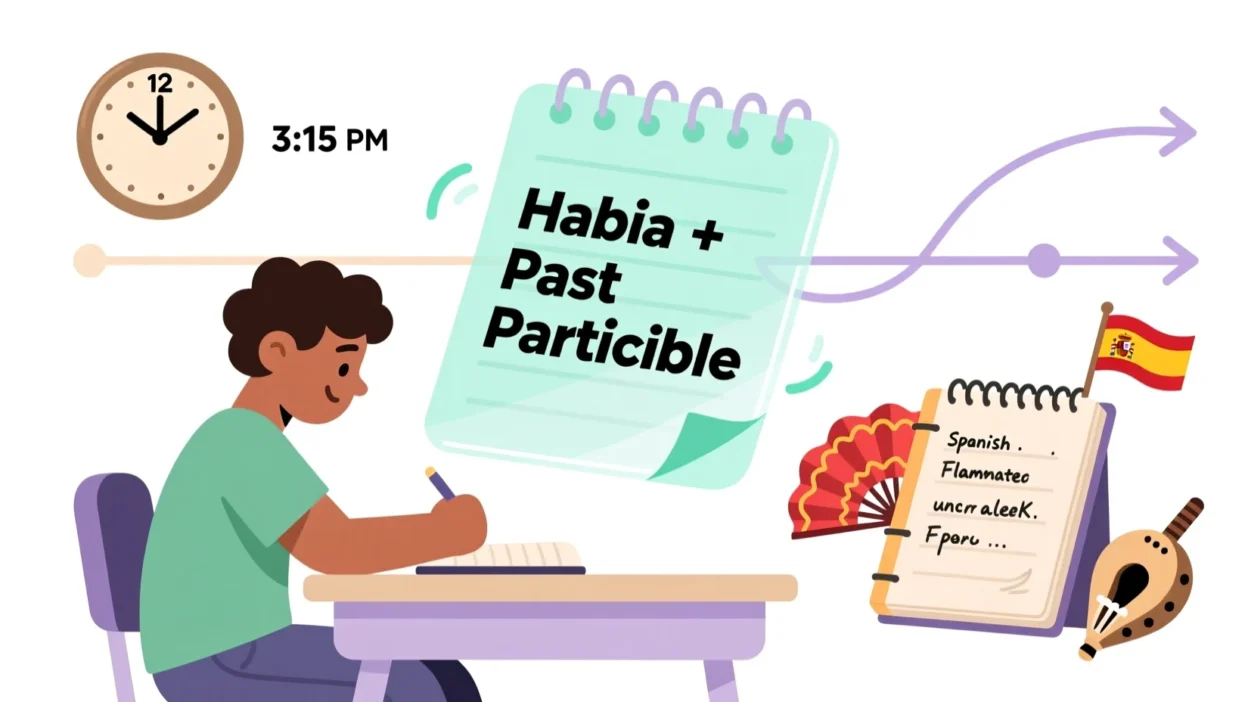
The Spanish past perfect tense, or pluscuamperfecto, is a powerful tool for expressing actions that happened before another past event.
If you’re a student, language learner, writer, or grammar enthusiast, mastering the past perfect tense can elevate your Spanish fluency.
It’s used to describe what “had” happened before something else in the past, like saying, “I had finished my homework before dinner.”
This beginner-friendly guide, we’ll break down the Spanish past perfect tense, its formation, conjugation, and usage with clear examples.
You’ll also find tips, common mistakes, and practice exercises to help you use this tense confidently.
If you’re crafting stories or chatting with native speakers, understanding the pluscuamperfecto will make your Spanish more precise and natural.
Let’s dive into this verb tense and explore how to use it effectively!
What Is the “Had in Spanish Past Tense”?
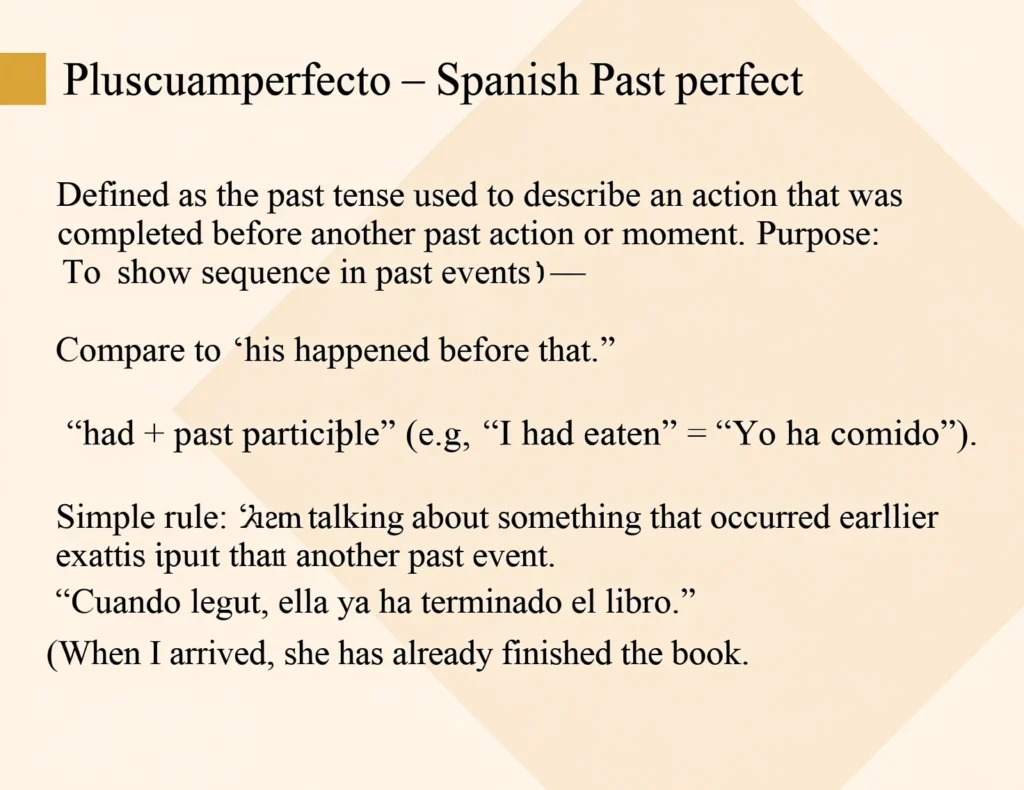
The Spanish past perfect tense (pluscuamperfecto) describes actions completed before another point in the past. It’s equivalent to the English “had + past participle” (e.g., “had eaten”). In Spanish, it’s formed using the imperfect tense of the auxiliary verb haber plus the past participle of the main verb. For example, “Había comido” means “I had eaten.” This tense sets the stage for storytelling or explaining sequences of past events, like “She had left before I arrived.” It’s essential for nuanced communication in Spanish, especially in formal writing or complex narratives.
How to Recognize the Spanish Past Perfect Tense?
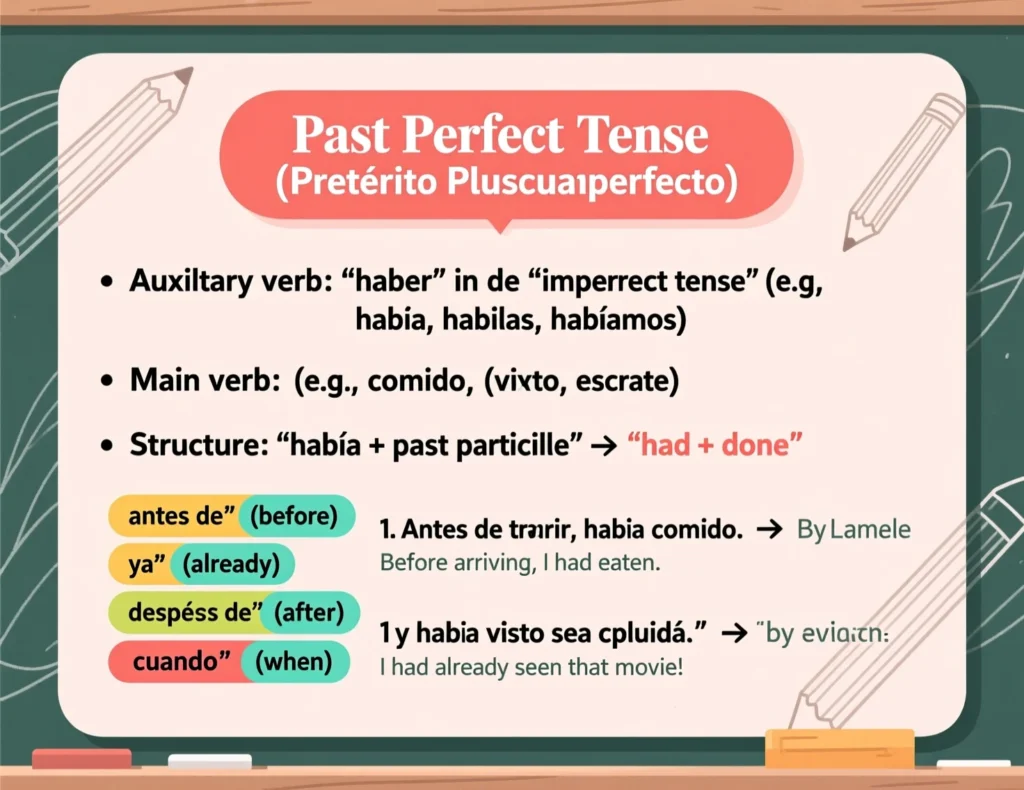
You can spot the past perfect tense by looking for haber in the imperfect tense (e.g., había, habías, habían) followed by a past participle (e.g., comido, vivido). It’s often used with time markers like antes de (before), ya (already), or después de que (after). For instance, in “Ya habían terminado cuando llegué” (“They had already finished when I arrived”), the structure signals an action completed before another past event. Look for contexts describing cause-and-effect or sequential past actions.
Structure of a Sentence
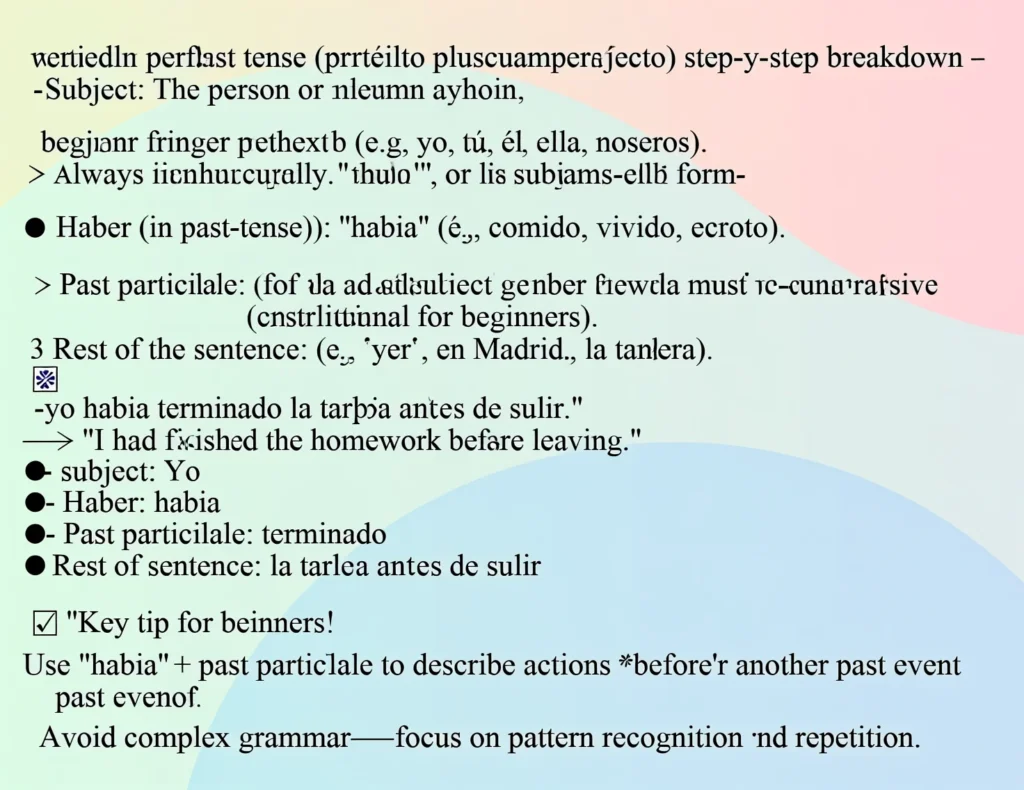
A Spanish past perfect sentence follows this structure:
Subject + haber (imperfect tense) + past participle + rest of sentence.
Example: Yo había estudiado antes del examen (“I had studied before the exam”).
- Subject: Who performed the action (e.g., yo, tú, ella).
- Haber: Auxiliary verb in the imperfect tense (e.g., había, habías).
- Past Participle: The main verb’s past form (e.g., estudiado, comido).
- Rest of Sentence: Provides context, like time or additional details.
Formation
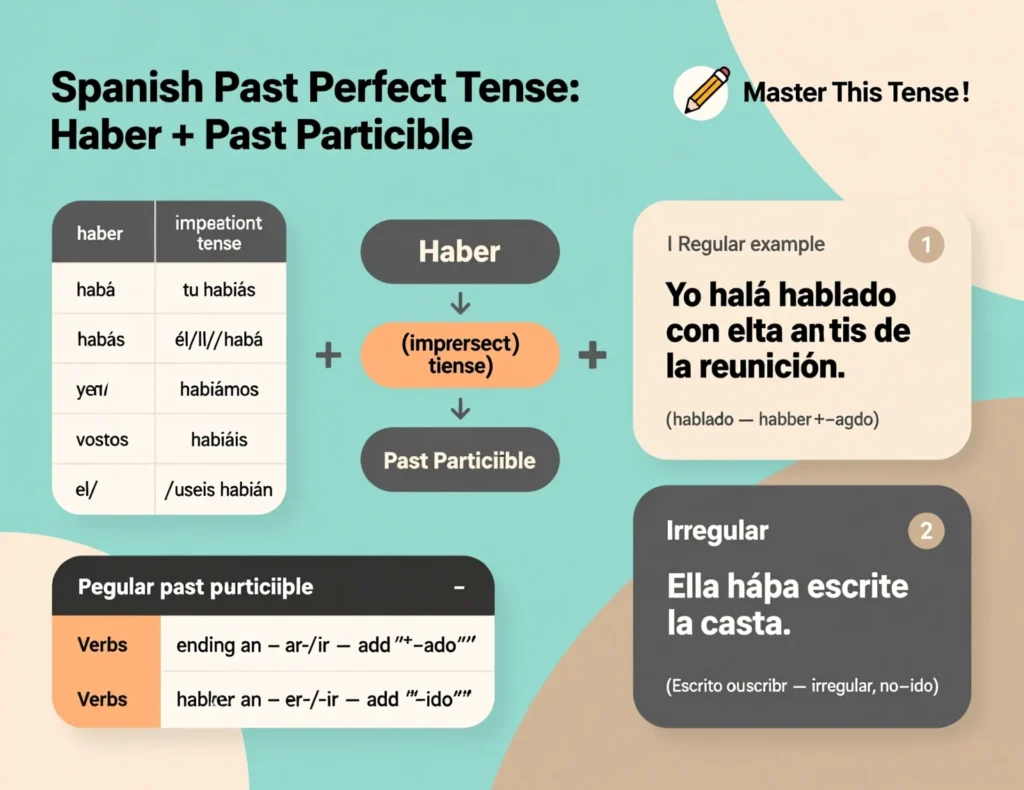
To form the past perfect tense, combine:
- Imperfect tense of haber: había, habías, había, habíamos, habíais, habían.
- Past participle of the main verb: Regular verbs end in -ado (for -ar verbs) or -ido (for -er/-ir verbs). For example, comer → comido, vivir → vivido.
Example: Nosotros habíamos trabajado (“We had worked”). Irregular past participles, like abierto (abrir) or escrito (escribir), must be memorized.
Verbs
The past perfect tense works with any Spanish verb, regular or irregular, as long as you know its past participle. Common verbs include:
- Regular: hablar (hablado), comer (comido), vivir (vivido).
- Irregular: hacer (hecho), decir (dicho), ver (visto).
The auxiliary verb haber is always required to form this tense.
Helping Verbs
The only helping verb in the Spanish past perfect is haber, conjugated in the imperfect tense. It pairs with the main verb’s past participle to indicate the action occurred before another past event. No other auxiliary verbs are used in this tense.
Explanation of Some Verbs with Reference to “Had in Spanish Past Tense”
Certain verbs are frequently used in the past perfect tense to describe completed actions:
- Comer (to eat): Había comido (“I had eaten”) shows eating happened before another event.
- Llegar (to arrive): Habían llegado (“They had arrived”) indicates arrival before something else.
- Escribir (to write): Habías escrito (“You had written”) emphasizes writing completed in the past.
These verbs follow the same structure but may have irregular past participles, like escrito for escribir.
Table of Some Regular or Irregular Verbs in “Had in Spanish Past Tense”
| Verb | Past Participle | Example (Había + Participle) |
| Hablar | Hablado | Había hablado (I had spoken) |
| Comer | Comido | Había comido (I had eaten) |
| Vivir | Vivido | Había vivido (I had lived) |
| Hacer | Hecho | Había hecho (I had done) |
| Decir | Dicho | Había dicho (I had said) |
| Ver | Visto | Había visto (I had seen) |
| Abrir | Abierto | Había abierto (I had opened) |
| Escribir | Escrito | Había escrito (I had written) |
| Romper | Roto | Había roto (I had broken) |
| Poner | Puesto | Había puesto (I had put) |
Simple Sentence Examples
- Yo había estudiado antes del examen. (I had studied before the exam.)
- Tú habías terminado tu tarea. (You had finished your homework.)
- Él había comido antes de la reunión. (He had eaten before the meeting.)
- Ella había viajado a España. (She had traveled to Spain.)
- Nosotros habíamos jugado fútbol. (We had played soccer.)
- Vosotros habíais trabajado toda la mañana. (You all had worked all morning.)
- Ellos habían visto la película. (They had seen the movie.)
- Mi hermano había escrito una carta. (My brother had written a letter.)
- La profesora había explicado la lección. (The teacher had explained the lesson.)
- Yo había abierto la ventana antes de dormir. (I had opened the window before sleeping.)
Negative Sentence Examples
- No había estudiado para el examen. (I hadn’t studied for the exam.)
- Tú no habías terminado tu tarea. (You hadn’t finished your homework.)
- Él no había comido antes de la reunión. (He hadn’t eaten before the meeting.)
- Ella no había viajado a España. (She hadn’t traveled to Spain.)
- Nosotros no habíamos jugado fútbol. (We hadn’t played soccer.)
- Vosotros no habíais trabajado esa mañana. (You all hadn’t worked that morning.)
- Ellos no habían visto la película. (They hadn’t seen the movie.)
- Mi hermano no había escrito la carta. (My brother hadn’t written the letter.)
- La profesora no había explicado la lección. (The teacher hadn’t explained the lesson.)
- No había abierto la ventana. (I hadn’t opened the window.)
Interrogative Sentence Examples
- ¿Habías estudiado para el examen? (Had you studied for the exam?)
- ¿Habías terminado tu tarea? (Had you finished your homework?)
- ¿Había comido él antes de la reunión? (Had he eaten before the meeting?)
- ¿Había viajado ella a España? (Had she traveled to Spain?)
- ¿Habíamos jugado nosotros fútbol? (Had we played soccer?)
- ¿Habíais trabajado vosotros esa mañana? (Had you all worked that morning?)
- ¿Habían visto ellos la película? (Had they seen the movie?)
- ¿Había escrito mi hermano la carta? (Had my brother written the letter?)
- ¿Había explicado la profesora la lección? (Had the teacher explained the lesson?)
- ¿Habías abierto la ventana? (Had you opened the window?)
Negative and Interrogative Sentence Examples
- ¿No habías estudiado para el examen? (Hadn’t you studied for the exam?)
- ¿No habías terminado tu tarea? (Hadn’t you finished your homework?)
- ¿No había comido él antes de la reunión? (Hadn’t he eaten before the meeting?)
- ¿No había viajado ella a España? (Hadn’t she traveled to Spain?)
- ¿No habíamos jugado nosotros fútbol? (Hadn’t we played soccer?)
- ¿No habíais trabajado vosotros esa mañana? (Hadn’t you all worked that morning?)
- ¿No habían visto ellos la película? (Hadn’t they seen the movie?)
- ¿No había escrito mi hermano la carta? (Hadn’t my brother written the letter?)
- ¿No había explicado la profesora la lección? (Hadn’t the teacher explained the lesson?)
- ¿No habías abierto la ventana? (Hadn’t you opened the window?)
How to Conjugate “Had in Spanish Past Tense” Tense
To conjugate the past perfect tense, follow these steps:
- Use haber in the imperfect tense: había, habías, había, habíamos, habíais, habían.
- Add the past participle of the main verb (e.g., comido, hablado).
- Ensure subject-verb agreement (e.g., yo había, nosotros habíamos).
- For regular -ar verbs, add -ado (e.g., hablar → hablado).
- For regular -er/-ir verbs, add -ido (e.g., comer → comido, vivir → vivido).
- Memorize irregular past participles (e.g., hacer → hecho).
- Place haber before the participle.
- Use time markers like antes de for context.
- Keep the participle unchanged regardless of subject.
- Practice with different verbs to master the structure.
Conjugation Table (for All Subjects)
| Subject | Haber (Imperfect) | Example: Comer (Past Participle: Comido) |
| Yo | Había | Había comido (I had eaten) |
| Tú | Habías | Habías comido (You had eaten) |
| Él/Ella/Ud. | Había | Había comido (He/She had eaten) |
| Nosotros | Habíamos | Habíamos comido (We had eaten) |
| Vosotros | Habíais | Habíais comido (You all had eaten) |
| Ellos/Uds. | Habían | Habían comido (They had eaten) |
Spelling Changes or Irregularities
- Regular verbs: Follow standard rules (-ar → -ado, -er/-ir → -ido).
- Irregular past participles: Some verbs don’t follow the standard pattern:
- Abrir → abierto
- Decir → dicho
- Escribir → escrito
- Hacer → hecho
- Ver → visto
- Verbs ending in -aer, -eer, or -oír often take -ído with an accent (e.g., leer → leído, oír → oído).
- No changes occur in haber; it remains in the imperfect tense.
Sentence Examples with Different Subjects
- Yo había bailado toda la noche. (I had danced all night.)
- Tú habías aprendido español rápido. (You had learned Spanish quickly.)
- Ella había cocinado una cena deliciosa. (She had cooked a delicious dinner.)
- Él había corrido una maratón. (He had run a marathon.)
- Nosotros habíamos viajado por Europa. (We had traveled through Europe.)
- Vosotros habíais cantado en el coro. (You all had sung in the choir.)
- Ellos habían trabajado en el proyecto. (They had worked on the project.)
- Mi amigo había escrito un libro. (My friend had written a book.)
- La niña había jugado en el parque. (The girl had played in the park.)
- Usted había abierto la tienda temprano. (You had opened the store early.)
- Nosotros habíamos visto el amanecer. (We had seen the sunrise.)
- Tú habías comprado un coche nuevo. (You had bought a new car.)
- Ellas habían estudiado toda la semana. (They had studied all week.)
- Él había dicho la verdad. (He had told the truth.)
- Yo había roto el jarrón por accidente. (I had broken the vase by accident.)
Common Mistakes with “Had in Spanish Past Tense” Tense
- Using pretérito perfecto (he comido) instead of pluscuamperfecto (había comido).
- Forgetting the auxiliary verb haber.
- Using the wrong form of haber (e.g., using present tense he).
- Incorrect past participles (e.g., saying comado instead of comido).
- Mixing up irregular participles (e.g., using hacido instead of hecho).
- Omitting accents on participles like leído or oído.
- Incorrect subject-verb agreement (e.g., yo habían instead of yo había).
- Using pluscuamperfecto when a simple past tense is needed.
- Misplacing no in negative sentences (e.g., había no comido).
- Confusing pluscuamperfecto with other compound tenses.
How to Avoid Common Mistakes
- Practice conjugating haber in the imperfect tense.
- Memorize irregular past participles like hecho, dicho, visto.
- Double-check the sequence of events to ensure pluscuamperfecto is appropriate.
- Use a grammar checker to catch participle errors.
- Write practice sentences with time markers like antes de.
- Read Spanish texts to see pluscuamperfecto in context.
- Avoid translating directly from English; focus on Spanish structure.
- Review subject-verb agreement for haber.
- Practice negative and interrogative forms to master word order.
- Quiz yourself on regular vs. irregular verbs.
Related Verbs and Synonyms for “Had in Spanish Past Tense”
The past perfect tense doesn’t have direct synonyms, but verbs like tener (to have) or poseer (to possess) are sometimes confused with haber.
- Haber: Used as an auxiliary for pluscuamperfecto (e.g., había comido).
- Tener: Refers to possession (e.g., tenía un libro, “I had a book”).
- Poseer: Also means possession but is more formal (e.g., poseía una casa).
Sentence Comparison: - Había comido antes de salir. (I had eaten before leaving.)
- Tenía hambre antes de comer. (I had hunger before eating.)
Tips to Practice Using “Had in Spanish Past Tense” Tense
- Write a short story using pluscuamperfecto to describe past events.
- Practice with a language app like Duolingo or Babbel.
- Create flashcards for irregular past participles.
- Translate English “had” sentences into Spanish.
- Read Spanish novels and highlight pluscuamperfecto examples.
- Practice speaking with a native speaker.
- Use time markers like antes de in sentences.
- Complete grammar exercises online.
- Watch Spanish movies and listen for past perfect tense.
- Join a language study group to practice.
Frequently Asked Questions
- What is the Spanish past perfect tense? It describes actions completed before another past event, using haber + past participle.
- When do I use pluscuamperfecto? Use it for actions that happened before another past action.
- How do I form the past perfect tense? Combine haber (imperfect) + past participle.
- What are irregular past participles? Examples include hecho, dicho, visto.
- Can I use pluscuamperfecto in questions? Yes, e.g., ¿Habías comido?
- What’s the difference between haber and tener? Haber is for tenses; tener is for possession.
- How do I make negative sentences? Add no before haber (e.g., no había comido).
- Are there spelling changes in past participles? Yes, like leído or oído.
- Can I use pluscuamperfecto in informal speech? It’s more common in writing or formal contexts.
- How do I practice this tense? Write sentences, read, and use exercises.
Exercises
- Conjugate vivir in the past perfect for all subjects.
- Write 5 sentences using haber + comido.
- Translate: “She had written a letter.”
- Create a negative sentence with estudiar.
- Form an interrogative sentence with viajar.
- Identify the past perfect in a Spanish paragraph.
- Combine antes de with a pluscuamperfecto sentence.
- Correct: Yo habían visto la película.
- Write a sentence with an irregular participle (e.g., hecho).
- Practice conjugating decir in pluscuamperfecto.
Quizzes
- What is the past participle of hacer? (Answer: hecho)
- Conjugate comer for nosotros in pluscuamperfecto. (Answer: habíamos comido)
- Is había comido negative or positive? (Answer: Positive)
- What’s the correct form: había escribido or había escrito? (Answer: había escrito)
- Translate: Habían jugado. (Answer: They had played)
- What tense is habías viajado? (Answer: Past perfect)
- Form a question with estudiar. (Answer: ¿Habías estudiado?)
- Correct: No había comido no. (Answer: No había comido)
- What’s the past participle of abrir? (Answer: abierto)
- Combine haber + visto for ella. (Answer: Había visto)
True or False
- The past perfect uses haber in the present tense. (False)
- Había comido means “I had eaten.” (True)
- All verbs have regular past participles. (False)
- No habías estudiado is a negative sentence. (True)
- Pluscuamperfecto describes future actions. (False)
- Habían visto uses an irregular participle. (True)
- Tener is used in the past perfect tense. (False)
- ¿Habías trabajado? is an interrogative sentence. (True)
- Leído needs an accent on the í. (True)
- You can use pluscuamperfecto without haber. (False)
Conclusion
The Spanish past perfect tense (pluscuamperfecto) is a key grammar tool for expressing actions that happened before another past event.
By mastering haber in the imperfect tense and past participles, you can describe complex sequences with ease.
This guide covered formation, conjugation, examples, and common mistakes to help you use the pluscuamperfecto confidently.
Whether you’re a student, writer, or language enthusiast, practicing this tense will enhance your Spanish fluency.
Try writing your own sentences, use the exercises and quizzes provided, or explore Spanish media to spot the tense in action.
For extra help, consider using a grammar checker or joining a language group.
Start practicing the past perfect tense today to make your Spanish more precise and engaging!