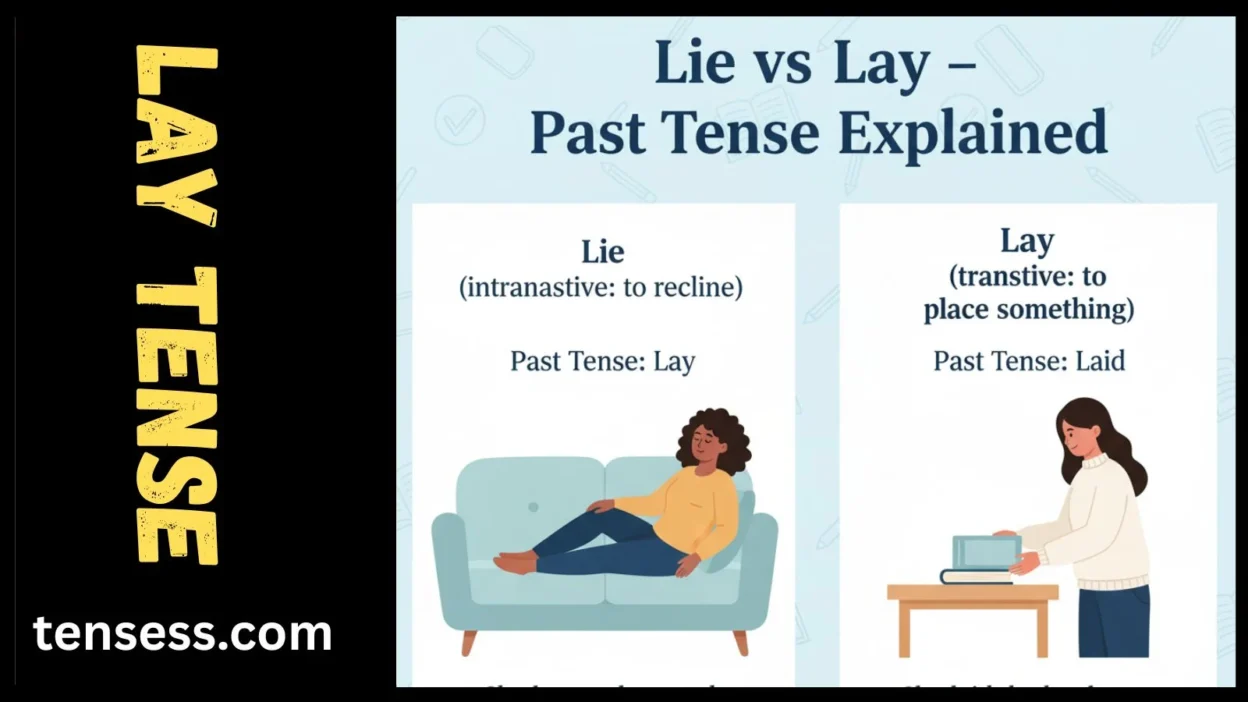
The past tense of lie, which is lay, is a fascinating yet often confusing aspect of English grammar.
As a verb, “lie” can mean to recline or to tell an untruth, but in this article, we’ll focus on its meaning as “to recline” (e.g., “I lie on the bed”).
The past tense, lay, trips up even native speakers because it’s identical to the present tense of the verb “lay” (to place something).
This article is designed for students, language learners, writers, and grammar enthusiasts who want to master the past tense of lie.
We’ll break down its definition, usage, sentence structure, and conjugation, with plenty of verb tense examples to make it beginner-friendly.
If you’re brushing up on grammar or learning English as a second language, this guide will help you confidently use lay in everyday communication.
Let’s dive in and explore how to use the past tense of lie correctly!
What Is the Past Tense of Lie?
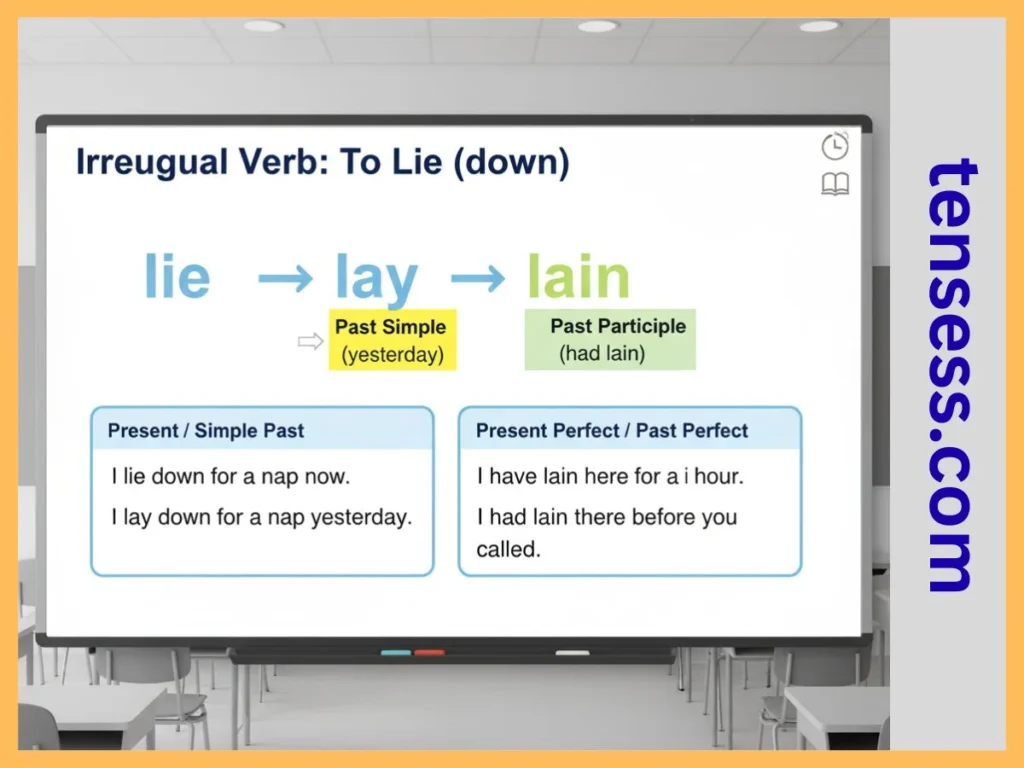
Unlike regular verbs that add “-ed” to form the past tense, lie changes to lay in the past. For example, “Yesterday, I lay on the couch all day.” It’s important to distinguish lie (recline) from lay (to place), as the latter’s past tense is laid. Confusing these two is a common mistake, but we’ll clarify how to use lay correctly as the past tense of lie throughout this article.
How to Recognize the Past Tense of Lie?
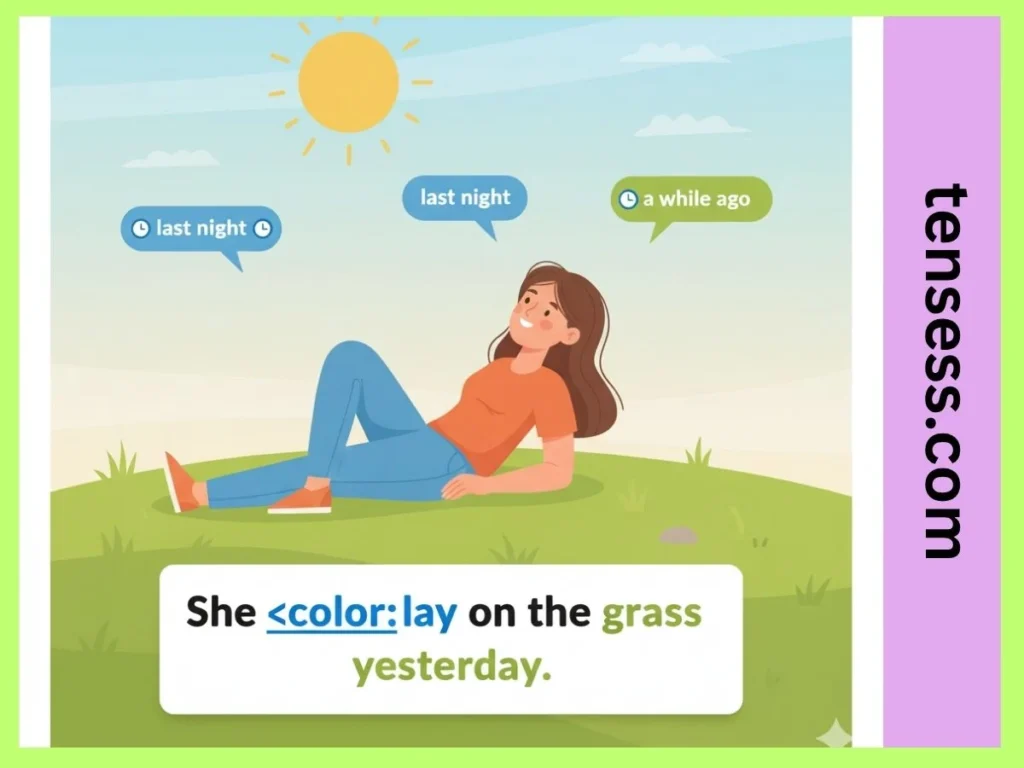
The verb lay will often appear with a subject performing the action of lying down, without a direct object. For example:
- “She lay on the grass yesterday” indicates a past action of reclining.
- Compare this to “She laid the book on the table,” where laid is the past tense of lay (to place).
Key indicators include time expressions like “yesterday,” “last night,” or “in 2020,” signaling the past tense.
Structure of a Sentence
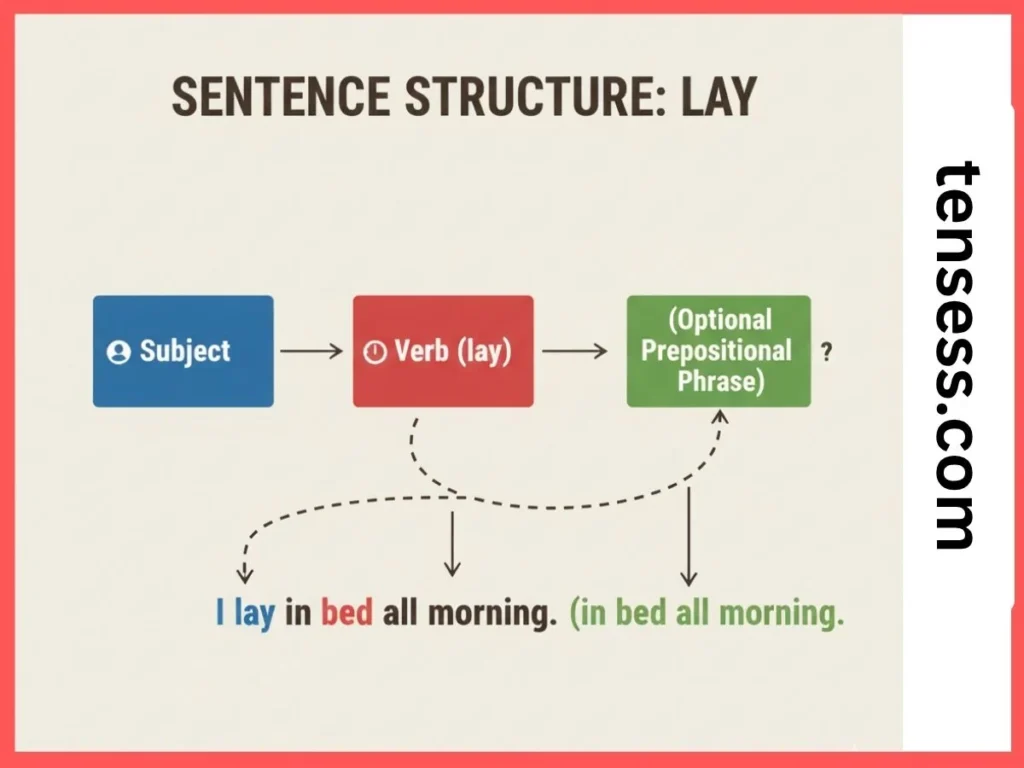
In the past tense of lie, sentences typically follow this structure:
- Subject + lay + (optional prepositional phrase or adverb).
- Example: “I lay in bed all morning.”
- No direct object is needed, as lie is an intransitive verb (unlike lay, which is transitive and requires an object).
Formation
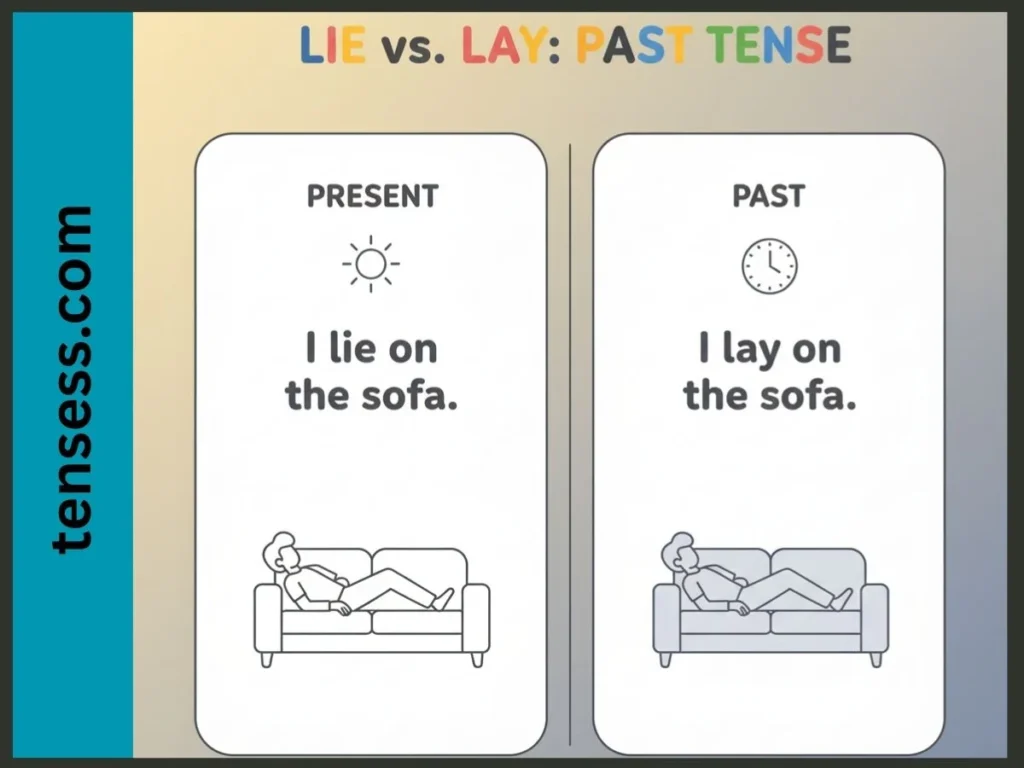
. For example:
- Present: “I lie on the sofa.”
- Past: “I lay on the sofa.”
Verbs
The verb lie (to recline) is irregular, meaning it doesn’t follow the standard “-ed” rule for past tense. Its forms are:
- Present: lie
- Past: lay
- Past Participle: lain
- Present Participle: lying
Helping Verbs
In simple past tense, lay doesn’t require helping verbs. However, in perfect tenses, have or had is used with the past participle lain:
- Present Perfect: “I have lain in bed all day.”
- Past Perfect: “I had lain there before she arrived.”
Explanation of Some Verbs with Reference to the Past Tense of Lie
The verb lie is often confused with lay (to place). Here’s how they differ:
- Lie (recline, intransitive): No object is needed. Past tense is lay.
- Example: “He lay on the beach.”
- Lay (place, transitive): Requires an object. Past tense is laid.
- Example: “He laid the towel on the sand.”
Other related verbs include rest or recline, which share similar meanings but have regular past tense forms (e.g., rested, reclined).
Table of Some Regular or Irregular Verbs in Past Tense
| Verb | Present | Past | Type |
| Lie (recline) | Lie | Lay | Irregular |
| Lay (place) | Lay | Laid | Irregular |
| Rest | Rest | Rested | Regular |
| Recline | Recline | Reclined | Regular |
| Sit | Sit | Sat | Irregular |
| Sleep | Sleep | Slept | Irregular |
| Stand | Stand | Stood | Irregular |
| Walk | Walk | Walked | Regular |
| Run | Run | Ran | Irregular |
| Write | Write | Wrote | Irregular |
Simple Sentence Examples
Here are 10 simple sentence examples using the past tense of lie:
- I lay in bed until noon yesterday.
- She lay on the hammock all afternoon.
- They lay on the grass, watching the stars.
- He lay quietly on the couch last night.
- We lay on the beach during our vacation.
- The dog lay under the tree all day.
- You lay on the floor during the movie.
- It lay in the shade to stay cool.
- The kids lay on blankets at the picnic.
- My cat lay on the windowsill yesterday.
Negative Sentence Examples
To form negative sentences, add did not (didn’t) + lie (base form):
- I didn’t lie in bed all day.
- She didn’t lie on the couch yesterday.
- They didn’t lie on the grass last night.
- He didn’t lie on the hammock during the party.
- We didn’t lie on the beach this time.
Interrogative Sentence Examples
For questions, use Did + subject + lie:
- Did you lie in bed all morning?
- Did she lie on the sofa yesterday?
- Did they lie on the grass last night?
- Did he lie on the hammock?
- Did we lie on the beach during the trip?
Negative and Interrogative Sentence Examples
Combine for negative questions:
- Didn’t you lie in bed yesterday?
- Didn’t she lie on the couch last night?
- Didn’t they lie on the grass during the picnic?
- Didn’t he lie on the hammock all day?
- Didn’t we lie on the beach last summer?
How to Conjugate the Past Tense of Lie
The past tense of lie is lay for all subjects in the simple past. For perfect tenses, use lain with helping verbs.
Conjugation Table
| Subject | Simple Past | Present Perfect | Past Perfect |
| I | Lay | Have lain | Had lain |
| You | Lay | Have lain | Had lain |
| He/She/It | Lay | Has lain | Had lain |
| We | Lay | Have lain | Had lain |
| They | Lay | Have lain | Had lain |
| John | Lay | Has lain | Had lain |
| The dog | Lay | Has lain | Had lain |
| The kids | Lay | Have lain | Had lain |
| You (pl) | Lay | Have lain | Had lain |
| My cat | Lay | Has lain | Had lain |
Spelling Changes or Irregularities
- Lie is irregular, so it becomes lay in the past tense, not “lied.”
- The past participle is lain, not lay or laid.
- No spelling changes occur for subjects; lay remains consistent.
Sentence Examples
- I lay on the couch all evening.
- You lay on the bed during the storm.
- She lay on the grass in the park.
- He lay under the tree yesterday.
- It lay in the shade all afternoon.
- We lay on the beach last summer.
- They lay on blankets during the concert.
- John lay on the hammock last night.
- The dog lay by the fire.
- My cat lay on the rug all day.
- The kids lay on the floor during the movie.
- You (plural) lay on the grass at the picnic.
- I have lain in bed all week due to illness.
- She has lain on the sofa since morning.
- They had lain on the beach before the rain started.
Common Mistakes with the Past Tense of Lie
Here are 10 frequent errors and how to avoid them:
- Using “laid” instead of “lay”: “I laid in bed” is incorrect. Use lay for the past tense of lie (recline).
- Confusing “lie” with “lay”: Lay (place) requires an object; lie does not.
- Using “lied” for reclining: “Lied” is the past tense of lie (to deceive), not recline.
- Incorrect past participle: Use lain, not lay, in perfect tenses (e.g., “I have lain”).
- Adding “-ed” to lie: Lie is irregular, so “lied” is wrong for reclining.
- Forgetting intransitive nature: Lay (past of lie) doesn’t take an object.
- Mixing tenses: “Yesterday, I lie in bed” should be lay.
- Overusing helping verbs: Simple past lay doesn’t need did.
- Confusing with synonyms: Rest or recline have different forms.
- Ignoring context: Ensure lay refers to reclining, not placing.
Related Verbs and Synonyms for the Past Tense of Lie
Here are 10 related verbs or synonyms, with sentence comparisons:
- Rest: Regular verb, past tense “rested.”
- Lie: “I lay on the bed.” Rest: “I rested on the bed.”
- Recline: Regular, past tense “reclined.”
- Lie: “She lay on the sofa.” Recline: “She reclined on the sofa.”
- Lay (place): Past tense “laid.”
- Lie: “He lay on the grass.” Lay: “He laid a blanket on the grass.”
- Sleep: Irregular, past tense “slept.”
- Lie: “They lay in bed.” Sleep: “They slept in bed.”
- Lounge: Regular, past tense “lounged.”
- Lie: “We lay on the beach.” Lounge: “We lounged on the beach.”
- Sprawl: Regular, past tense “sprawled.”
- Lie: “The dog lay on the rug.” Sprawl: “The dog sprawled on the rug.”
- Rest: Another sense, meaning to relax.
- Lie: “I lay in the hammock.” Rest: “I rested in the hammock.”
- Nap: Regular, past tense “napped.”
- Lie: “She lay on the couch.” Nap: “She napped on the couch.”
- Lie (deceive): Past tense “lied.”
- Lie (recline): “He lay on the bed.” Lie (deceive): “He lied about his age.”
- Repose: Regular, past tense “reposed.”
- Lie: “They lay on the grass.” Repose: “They reposed on the grass.”
Tips to Practice Using the Past Tense of Lie
- Write 5 sentences daily using lay correctly.
- Read books and highlight instances of lie and lay.
- Practice with a friend by describing past activities.
- Use flashcards to memorize lie (lay, lain) vs. lay (laid, laid).
- Watch English movies and note past tense usage.
- Try online grammar quizzes focused on irregular verbs.
- Create a journal entry using lay in different contexts.
- Teach someone else the difference between lie and lay.
- Use a grammar app to check your sentences.
- Record yourself speaking sentences with lay and review.
Frequently Asked Questions
- What is the past tense of lie?
The past tense of lie (recline) is lay. - How is it different from laid?
Laid is the past tense of lay (to place). - Is lie regular or irregular?
Lie (recline) is irregular: lie, lay, lain. - Can I say “I lied in bed”?
No, use lay for reclining; lied is for deception. - What’s the past participle of lie?
It’s lain, used with have or had. - Does lay need an object?
No, lay (past of lie) is intransitive. - How do I form questions with lay?
Use Did + subject + lie: “Did you lie in bed?” - Why is lay confusing?
It’s the same as the present tense of lay (place). - Can I use lay in perfect tenses?
No, use lain: “I have lain in bed.” - How can I practice lay?
Write sentences, take quizzes, or use grammar apps.
Exercises
- Write a sentence using lay with “I” as the subject.
- Convert “I lie on the couch” to past tense.
- Create a negative sentence with lay.
- Form a question using Did and lie.
- Use lain in a present perfect sentence.
- Write a sentence with lay and a prepositional phrase.
- Combine lay with “yesterday” in a sentence.
- Write a sentence with they and lay.
- Change “She lies on the bed” to past tense.
- Create a sentence with lay and “the dog.”
Quizzes
- What is the past tense of lie (recline)?
a) Lied b) Lay c) Laid
Answer: b) Lay - What is the past participle of lie?
a) Lay b) Lain c) Lied
Answer: b) Lain - Is lie regular or irregular?
a) Regular b) Irregular
Answer: b) Irregular - Which is correct?
a) I laid in bed b) I lay in bed
Answer: b) I lay in bed - What’s the negative of “She lay on the sofa”?
a) She didn’t lay b) She didn’t lie
Answer: b) She didn’t lie - What’s the past tense of lay (place)?
a) Lay b) Laid c) Lain
Answer: b) Laid - Which uses lain?
a) I lay in bed b) I have lain in bed
Answer: b) I have lain in bed - Is lay transitive or intransitive?
a) Transitive b) Intransitive
Answer: b) Intransitive - What’s the question form of “They lay on the grass”?
a) Did they lie on the grass? b) Did they lay on the grass?
Answer: a) Did they lie on the grass? - Which is a synonym for lie (recline)?
a) Run b) Recline
Answer: b) Recline
True or False
- The past tense of lie (recline) is lay. True
- Laid is the past tense of lie. False
- Lie is a regular verb. False
- Lay requires an object in the past tense. False
- Lain is used with have or had. True
- “I lied in bed” is correct for reclining. False
- Did you lie is the correct question form. True
- Lay can mean both recline and place. False
- Rest is a synonym for lie. True
- Lie (deceive) has the same past tense as lie (recline). False
Conclusion
Mastering the past tense of lie—lay—is a key step for students, language learners, and writers aiming to improve their English grammar.
By understanding its conjugation, sentence structure, and common pitfalls, you can confidently use lay in everyday writing and conversation.
The distinction between lie (recline) and lay (place) is crucial, and with practice, you’ll avoid mixing them up.
Try incorporating lay into your daily sentences, use grammar apps, or take our quizzes to reinforce your skills.
For more practice, write a short story using lay or check your sentences with a grammar checker.
Keep practicing, and soon the past tense of lie will feel second nature! Share your progress or questions in the comments, and happy learning!