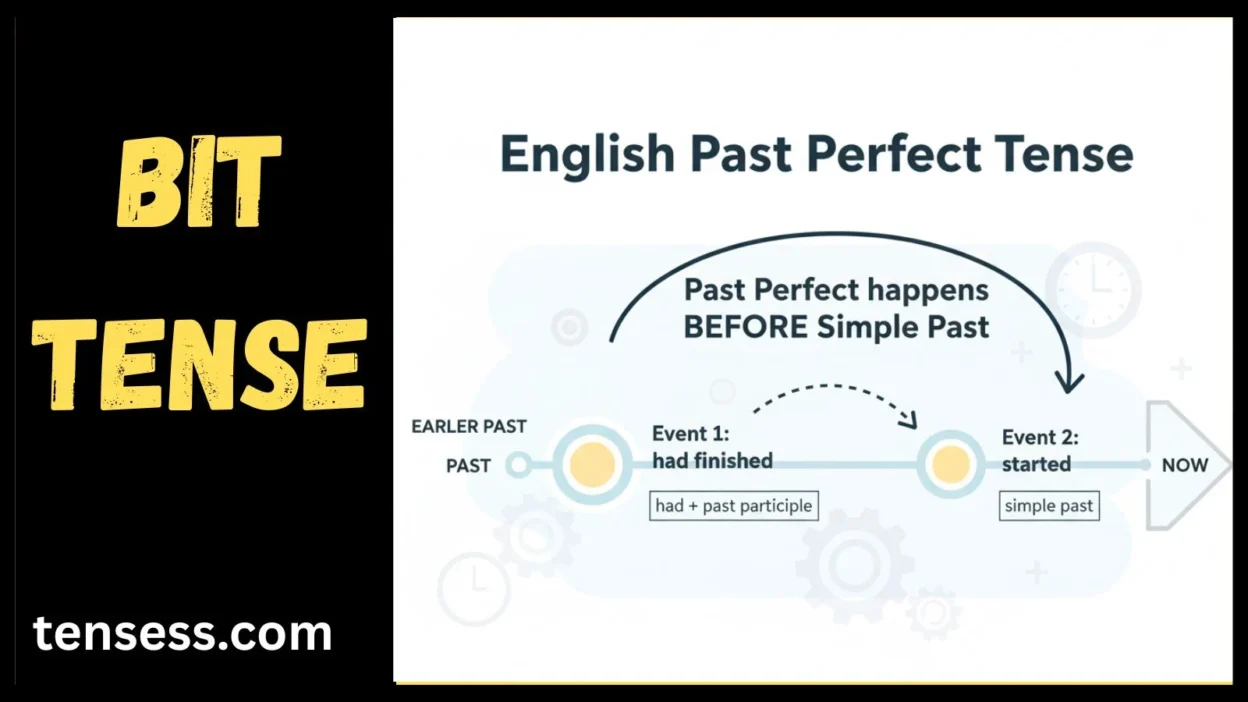
The past perfect tense is a powerful tool for anyone learning English or refining their writing skills.
It helps describe actions that were completed before another point in the past, adding depth to storytelling and clarity to communication.
If you’re a student, language learner, writer, or grammar enthusiast, mastering the past perfect tense can elevate your language skills.
This article breaks down the past perfect tense with easy explanations, real-life examples, and practical tips to make it approachable.
From sentence structure to common mistakes, we’ll cover everything you need to know to use this tense confidently.
Let’s dive into the world of past perfect tense and explore how it works in everyday language!
What Is the Past Perfect Tense?
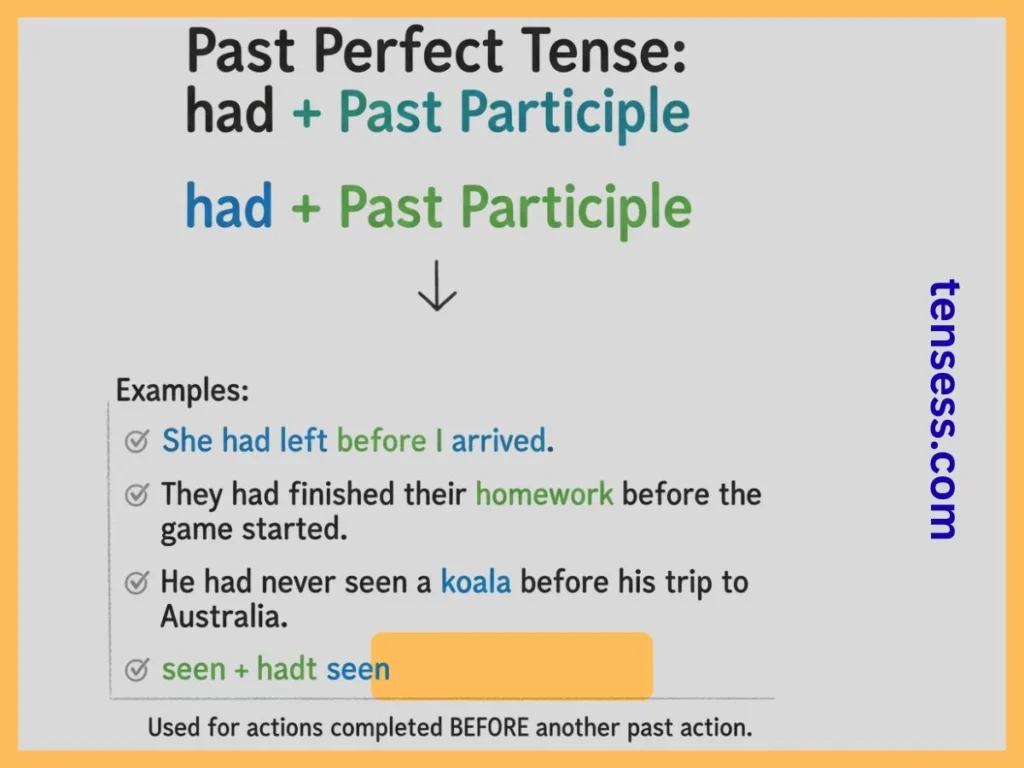
The past perfect tense describes actions that were completed before another past event. It sets the timeline in a sentence, showing which action happened first. For example, “I had finished my homework before the movie started.” Here, finishing the homework happened before the movie began. This tense is often used in storytelling, academic writing, or when explaining cause-and-effect in the past. It’s formed with the helping verb had plus the past participle of the main verb. Understanding this tense helps you create clear, chronological narratives.
How to Recognize the Past Perfect Tense?
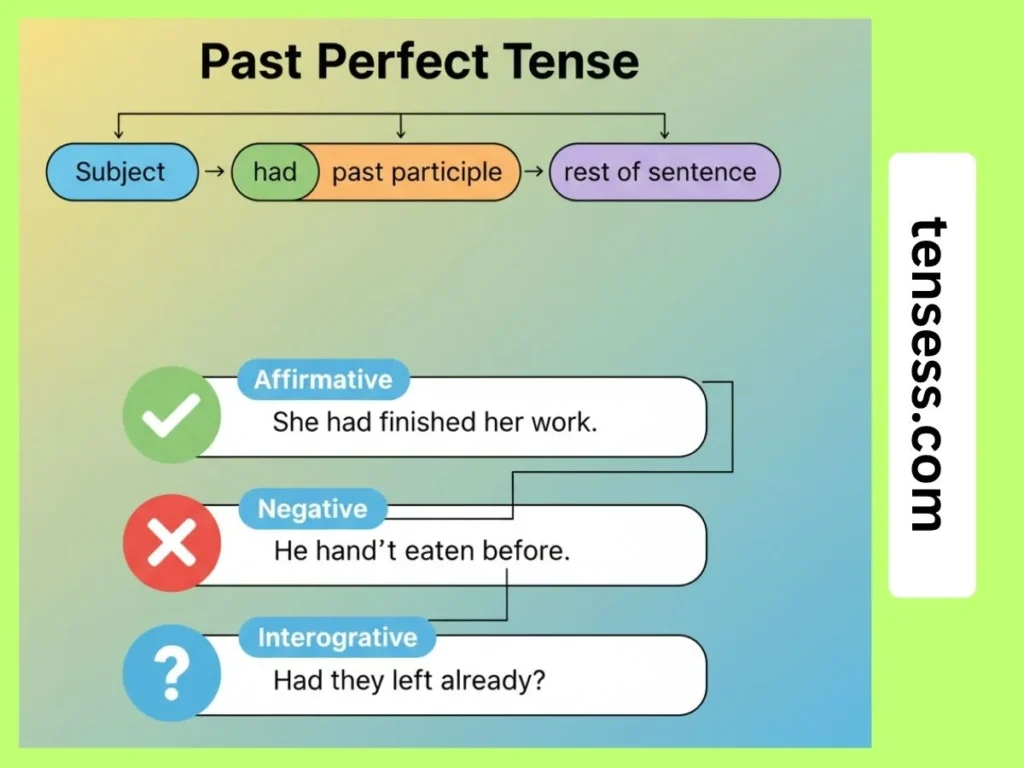
To spot the past perfect tense, look for the structure had + past participle. The word had signals the tense, and the past participle (e.g., written, eaten, gone) indicates the completed action. It often appears in sentences with time markers like before, after, by the time, or when. For instance, “She had left before I arrived.” The past perfect tense is distinct from the simple past (e.g., “She left”) because it emphasizes an action completed earlier in the past.
Structure of a Past Perfect Sentence
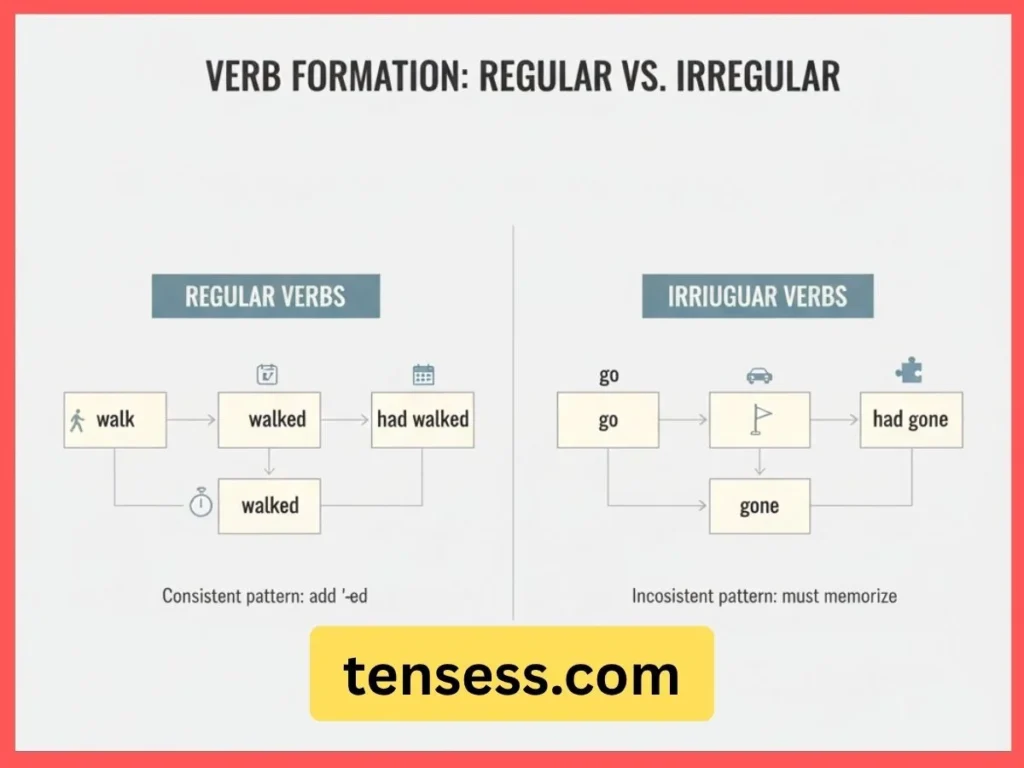
The past perfect tense follows a simple structure:
- Subject + had + past participle + rest of the sentence.
Example: “They had studied for hours before the test began.” - Negative: Subject + had + not + past participle. Example: “I had not finished my work.”
- Interrogative: Had + subject + past participle? Example: ” Had you seen the movie before?”
Formation of the Past Perfect Tense
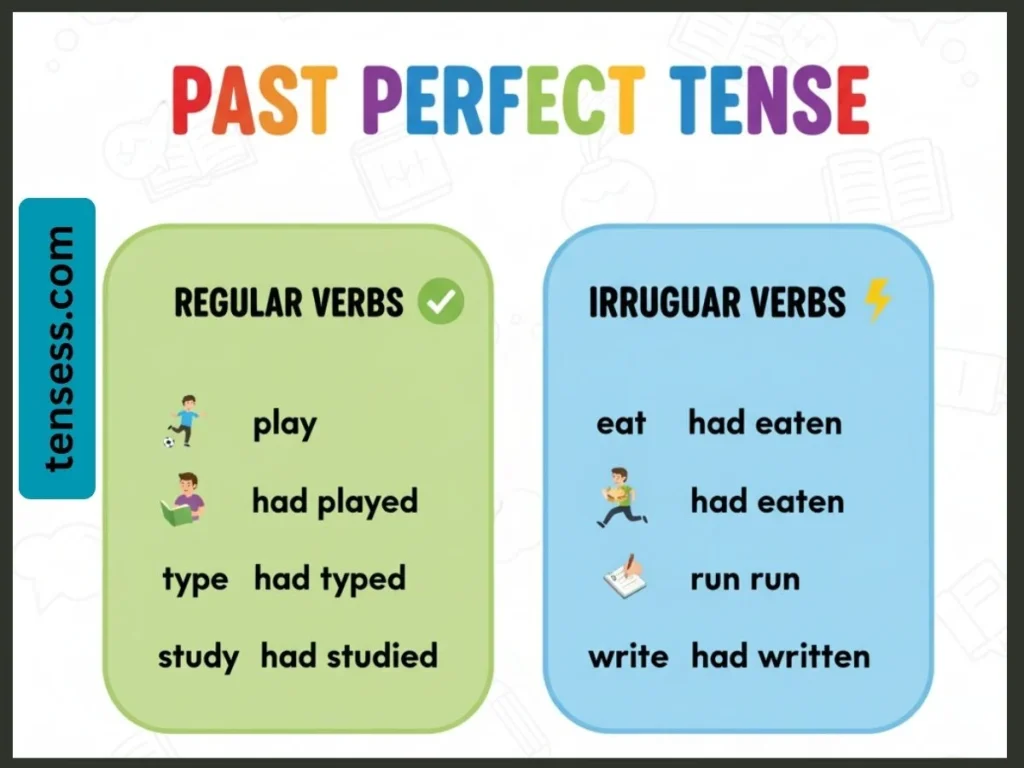
To form the past perfect tense, combine:
- The helping verb had (used for all subjects).
- The past participle of the main verb (e.g., walked, sung, gone).
For regular verbs, the past participle is formed by adding -ed (e.g., walked, played). For irregular verbs, the past participle varies (e.g., go → gone, eat → eaten). Example: “We had walked to the park before it rained.”
Verbs in the Past Perfect Tense
The past perfect tense works with both regular and irregular verbs. Regular verbs take -ed for their past participle, while irregular verbs have unique forms. For example:
- Regular: “She had danced all night.”
- Irregular: “He had drunk coffee before the meeting.”
Helping Verbs in the Past Perfect Tense
The past perfect tense relies on one helping verb: had. It’s used for all subjects (I, you, he, she, it, we, they). Unlike other tenses that might use have, has, or will, the past perfect tense consistently uses had to indicate an action completed before another past event.
Explanation of Some Verbs with Reference to Past Perfect Tense
Here’s how common verbs work in the past perfect tense:
- Go: Past participle is gone. Example: “I had gone to the store before lunch.”
- Eat: Past participle is eaten. Example: “We had eaten dinner before the guests arrived.”
- Write: Past participle is written. Example: “She had written a letter before calling.”
Table of Some Regular and Irregular Verbs in Past Perfect Tense
| Base Verb | Past Participle | Past Perfect Example |
| Walk | Walked | Had walked |
| Play | Played | Had played |
| Eat | Eaten | Had eaten |
| Go | Gone | Had gone |
| Write | Written | Had written |
| Sing | Sung | Had sung |
| Drink | Drunk | Had drunk |
| Run | Run | Had run |
| See | Seen | Had seen |
| Take | Taken | Had taken |
Simple Sentence Examples
- I had finished my homework before dinner.
- She had left the party before midnight.
- We had visited Paris before the pandemic.
- He had painted the house before moving in.
- They had played soccer before the rain started.
- You had studied English before the exam.
- It had stopped raining before we went outside.
- The dog had eaten its food before the walk.
- John had written a book before turning 30.
- The team had practiced before the match.
Negative Sentence Examples
- I had not finished my project before the deadline.
- She had not seen the movie before last night.
- We had not traveled abroad before 2020.
- He had not cleaned the room before guests arrived.
- They had not eaten lunch before the meeting.
- You had not called me before the event.
- It had not snowed before January.
- The cat had not slept before the noise started.
- Mary had not written the email before noon.
- The kids had not played outside before dark.
Interrogative Sentence Examples
- Had you finished your work before leaving?
- Had she gone to the store before dinner?
- Had we met before the conference?
- Had he driven the car before the trip?
- Had they studied for the test before class?
- Had I called you before the meeting?
- Had it rained before the picnic started?
- Had the dog eaten before the walk?
- Had John written the report before the deadline?
- Had the team practiced before the game?
Negative and Interrogative Sentence Examples
- Hadn’t you finished your homework before the show?
- Hadn’t she left before the party ended?
- Hadn’t we visited the museum before it closed?
- Hadn’t he painted the fence before the storm?
- Hadn’t they played before the rain began?
- Hadn’t I told you about the plan earlier?
- Hadn’t it stopped snowing before we left?
- Hadn’t the cat eaten before the vet visit?
- Hadn’t Mary written the letter before calling?
- Hadn’t the kids slept before the trip?
How to Conjugate Past Perfect Tense
Conjugating the past perfect tense is straightforward since had is used for all subjects:
- Identify the subject (I, you, he, she, it, we, they).
- Use had as the helping verb.
- Add the past participle of the main verb.
- For regular verbs, add -ed (e.g., walked, talked).
- For irregular verbs, use the correct past participle (e.g., gone, eaten).
- Form negative sentences with had not or hadn’t.
- Form questions by starting with Had.
- Ensure the sentence includes a past event for context (e.g., before, after).
- Check for spelling irregularities in irregular verbs.
- Practice with varied subjects for fluency.
Conjugation Table for Past Perfect Tense
| Subject | Affirmative Example | Negative Example | Interrogative Example |
| I | I had eaten | I had not eaten | Had I eaten? |
| You | You had walked | You had not walked | Had you walked? |
| He | He had written | He had not written | Had he written? |
| She | She had gone | She had not gone | Had she gone? |
| It | It had rained | It had not rained | Had it rained? |
| We | We had played | We had not played | Had we played? |
| They | They had sung | They had not sung | Had they sung? |
Spelling Changes or Irregularities
- Regular verbs: Add -ed (e.g., walk → walked, play → played).
- Irregular verbs: Use unique past participles (e.g., go → gone, eat → eaten, see → seen).
- Verbs ending in -y (after a consonant): Change -y to -ied (e.g., study → studied).
- Verbs with one syllable ending in a consonant: Double the consonant (e.g., stop → stopped).
- Some irregular verbs have identical past and past participle forms (e.g., run → run).
Sentence Examples with Different Subjects
- I had finished my book before the library closed.
- You had traveled to Japan before college.
- He had cooked dinner before the guests arrived.
- She had written a poem before the contest.
- It had stopped snowing before we went skiing.
- We had visited the zoo before it rained.
- They had played chess before bedtime.
- The dog had barked before the mail arrived.
- John had painted the room before moving in.
- Mary had sung at the event before leaving.
- I hadn’t seen the movie before last night.
- You hadn’t called before the meeting started.
- She hadn’t finished her homework before class.
- We hadn’t eaten before the party began.
- They hadn’t traveled before the borders closed.
Common Mistakes with Past Perfect Tense
- Using had with simple past instead of past participle (e.g., had went instead of had gone).
- Forgetting the second past event for context (e.g., “I had finished” is incomplete without “before…”).
- Confusing past perfect with simple past (e.g., “I finished” vs. “I had finished“).
- Overusing had in a sentence, making it clunky.
- Using has/have instead of had (e.g., have eaten is present perfect).
- Incorrect irregular verb forms (e.g., had drinked instead of had drunk).
- Omitting had in questions (e.g., You finished? instead of Had you finished?).
- Mixing tenses in a sentence (e.g., “I had finished before I will go“).
- Not doubling consonants in regular verbs (e.g., stoped instead of stopped).
- Ignoring spelling changes for verbs ending in -y (e.g., studyed instead of studied).
How to Avoid Common Mistakes
- Always use had + past participle, not had + simple past.
- Include a second past event (e.g., before, after) for clarity.
- Compare with simple past to ensure correct tense usage.
- Simplify sentences to avoid overusing had.
- Use had, not has/have, for past perfect.
- Memorize irregular verb forms (e.g., drink → drunk, go → gone).
- Start questions with Had for correct interrogative form.
- Ensure tense consistency in storytelling.
- Check spelling rules for regular verbs (e.g., stop → stopped).
- Practice with a verb conjugation chart for accuracy.
Related Verbs and Synonyms for Past Perfect Tense
The past perfect tense doesn’t have direct synonyms, but it’s often confused with:
- Simple Past: Describes a single past action (e.g., “I ate” vs. “I had eaten“).
- Present Perfect: Focuses on present relevance (e.g., “I have eaten” vs. “I had eaten“).
- Related verbs: completed, finished, done (as past participles in context).
- Example comparison: “I ate dinner” (simple past) vs. “I had eaten dinner before the movie” (past perfect).
Tips to Practice Using Past Perfect Tense
- Write a short story using past perfect tense to describe earlier events.
- Practice with fill-in-the-blank exercises online.
- Create flashcards for irregular verb past participles.
- Use time markers like before or after in sentences.
- Read books and highlight past perfect tense examples.
- Speak with a partner, using past perfect in conversation.
- Write journal entries about past events using the tense.
- Watch movies and note past perfect tense in subtitles.
- Use grammar apps to practice conjugation.
- Review your writing with a grammar checker for accuracy.
Frequently Asked Questions
- What is the past perfect tense? It describes actions completed before another past event.
- How is it different from simple past? It emphasizes an earlier action with had + past participle.
- Can I use past perfect without a second event? No, context like before is needed.
- What’s the helping verb? Always had for all subjects.
- Are irregular verbs common in past perfect? Yes, like gone, eaten, seen.
- How do I form questions? Start with Had + subject + past participle.
- Can regular verbs be used? Yes, add -ed (e.g., walked, played).
- What are common time markers? Before, after, by the time.
- Why use past perfect in writing? To clarify the order of past events.
- How can I practice? Write sentences, read, or use grammar apps.
Exercises
- Convert: “I ate lunch.” → Past perfect: _______________
- Write a sentence using had gone before another past event.
- Form a negative sentence with study.
- Create a question with see.
- Combine had finished with before in a sentence.
- Use had written in a story context.
- Make a negative question with play.
- Write a sentence with had eaten and after.
- Convert a simple past sentence to past perfect.
- Use had sung in a question.
Quizzes
- What is the past participle of go? (A) Went (B) Gone (C) Going
- Which is correct? (A) I had saw (B) I had seen (C) I have seen
- What’s the helping verb in past perfect? (A) Have (B) Had (C) Has
- Is “I had finished” complete? (A) Yes (B) No
- What’s the past participle of write? (A) Wrote (B) Written (C) Writing
- Which uses past perfect? (A) I ate (B) I had eaten (C) I eat
- Form a question: ______ you ______ the movie? (Fill in the blanks)
- What’s wrong with “I had went”? (A) Wrong verb (B) Wrong tense (C) Correct
- Which time marker fits? (A) Before (B) Tomorrow (C) Now
- Correct form of study? (A) Studyed (B) Studied (C) Studying
True or False
- The past perfect uses had for all subjects. (True)
- “I had went” is correct. (False)
- Past perfect needs a second past event. (True)
- Regular verbs add -ing in past perfect. (False)
- Had + past participle is the structure. (True)
- “I have eaten” is past perfect. (False)
- Irregular verbs have unique past participles. (True)
- Questions start with had. (True)
- Past perfect is used for future events. (False)
- Before is a common time marker. (True)
Conclusion
Mastering the past perfect tense opens up new ways to express yourself clearly in English.
By understanding its structure—had + past participle—and practicing with real-life examples, you can confidently describe past events in a logical order.
If you’re writing a story, preparing for an exam, or improving your conversation skills, this tense adds precision and depth.
Avoid common mistakes, like incorrect verb forms, by memorizing irregular verbs and using time markers like before or after.
Try practicing with our exercises or quizzes, and consider using a grammar checker to polish your work.
Start crafting sentences with the past perfect tense today, and watch your language skills soar! Share your examples in the comments or explore more grammar tips on our site.