The past tense of wear is an essential grammar concept for students, language learners, writers, and grammar enthusiasts.
Understanding how to use wore, the past tense form of the verb wear, helps you describe actions that happened in the past, like what someone was dressed in or how something was used.
This article breaks down the past tense of wear in a beginner-friendly way, with clear explanations, real-life examples, and practical tips.
If you’re writing a story, studying for an exam, or improving your English, mastering wore will boost your confidence.
We’ll cover its definition, sentence structures, conjugation, common mistakes, and more.
By the end, you’ll know how to use wore correctly and avoid pitfalls. Let’s dive into the past tense of wear and make grammar fun and approachable!
What Is the Past Tense of Wear?
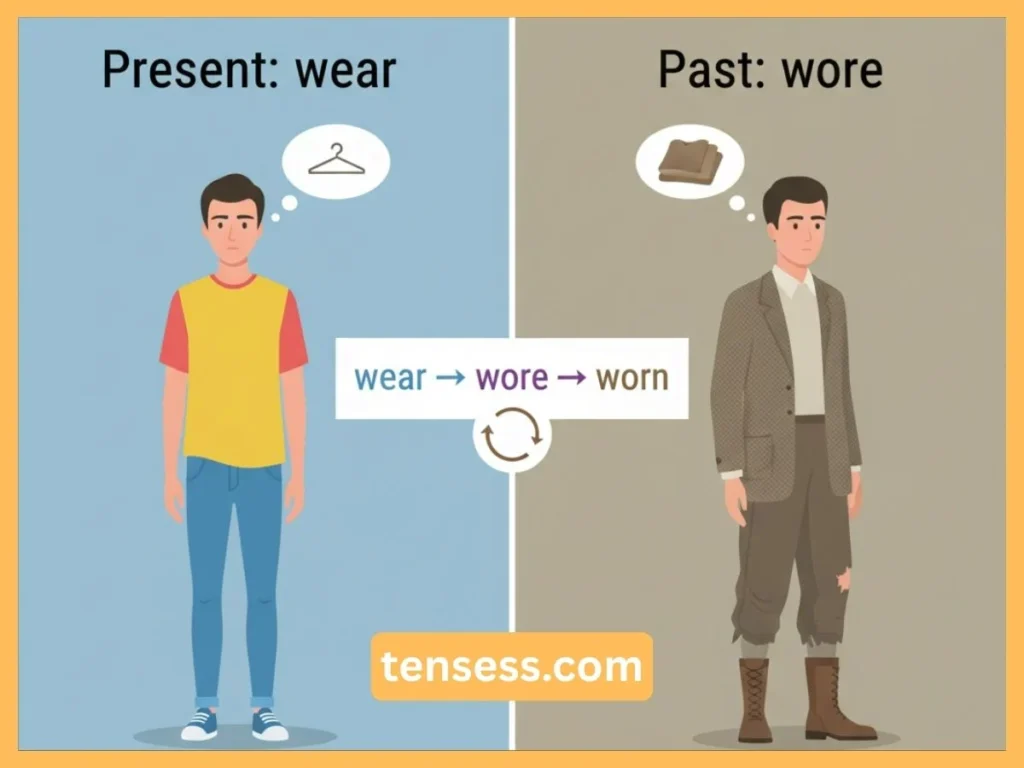
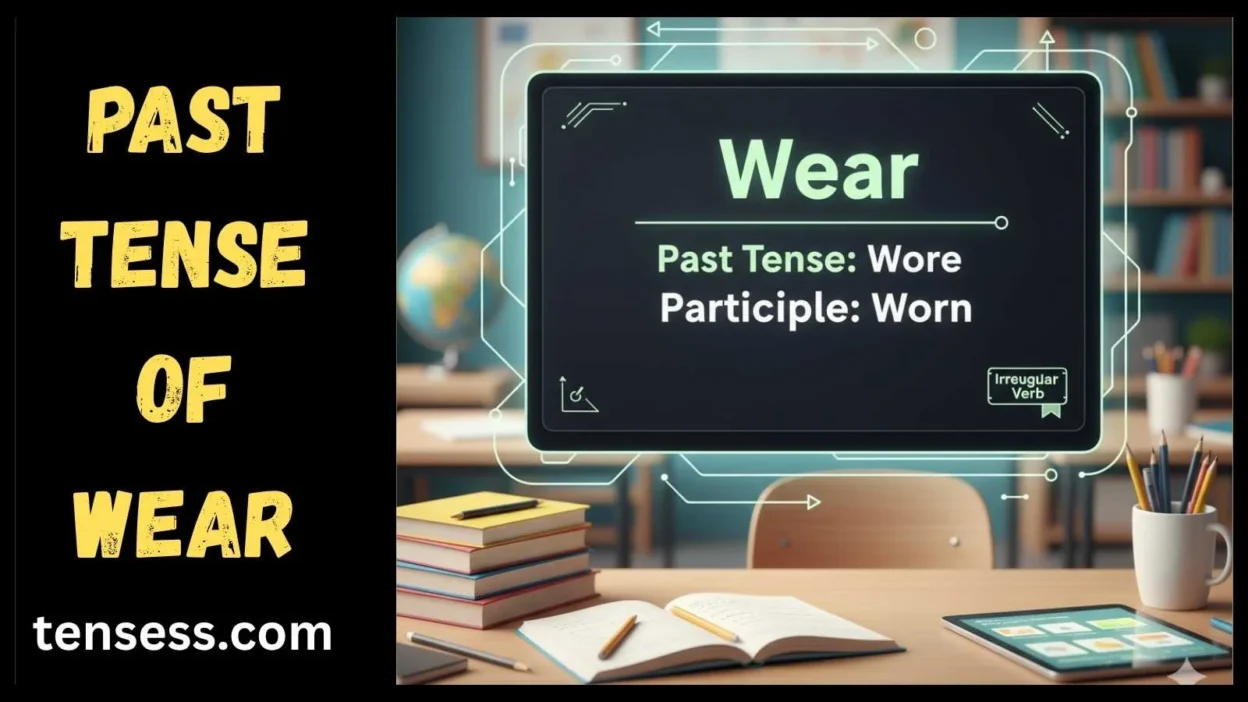
The past tense of wear is wore. It’s used to describe actions or states related to wearing something (like clothes or accessories) that occurred in the past. For example, “She wore a red dress to the party.” The verb wear is irregular, so it doesn’t follow the standard “-ed” ending for regular verbs like “walked.” Instead, wear changes to wore in the simple past tense and becomes worn in the past participle (used with helping verbs like “have”). Understanding this irregularity is key to using wore correctly in sentences.
How to Recognize the Past Tense of Wear?
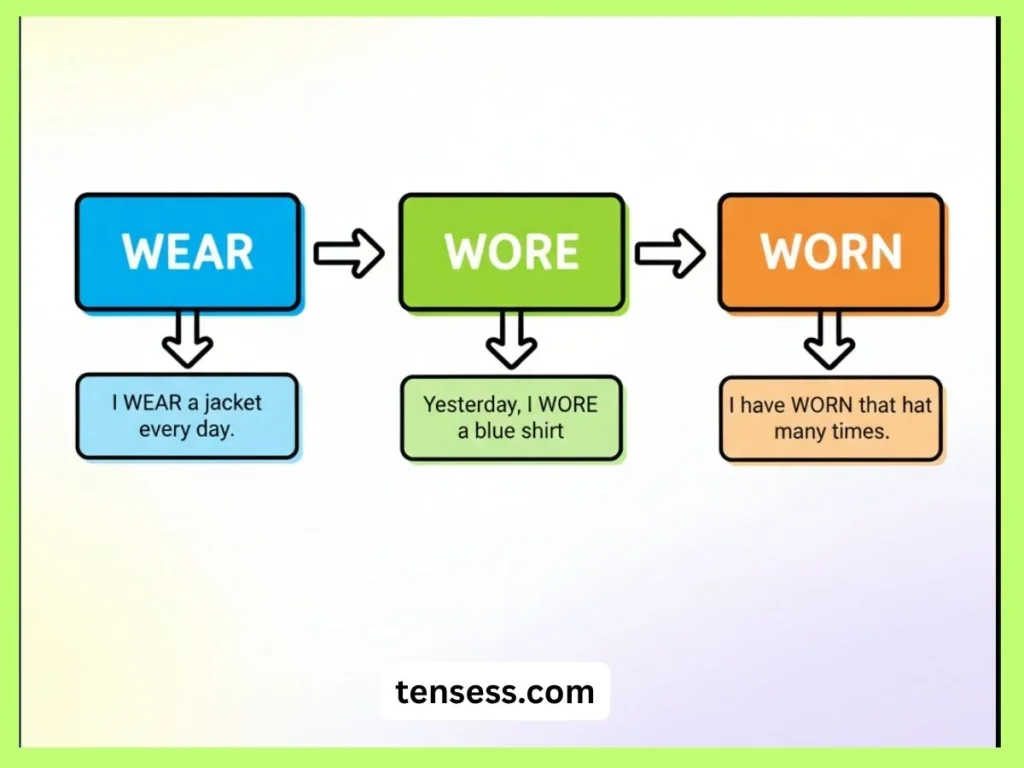
To identify the past tense of wear, look for wore in sentences describing past actions involving clothing, accessories, or figurative uses (e.g., “The tires wore thin”). It often appears in narratives or descriptions of events that already happened. For example:
- “He wore his favorite jacket yesterday.”
- “The shoes wore out after months of use.”
The context of a completed action and the presence of wore (or worn with helping verbs) signals the past tense.
Structure of Sentences in the Past Tense of Wear
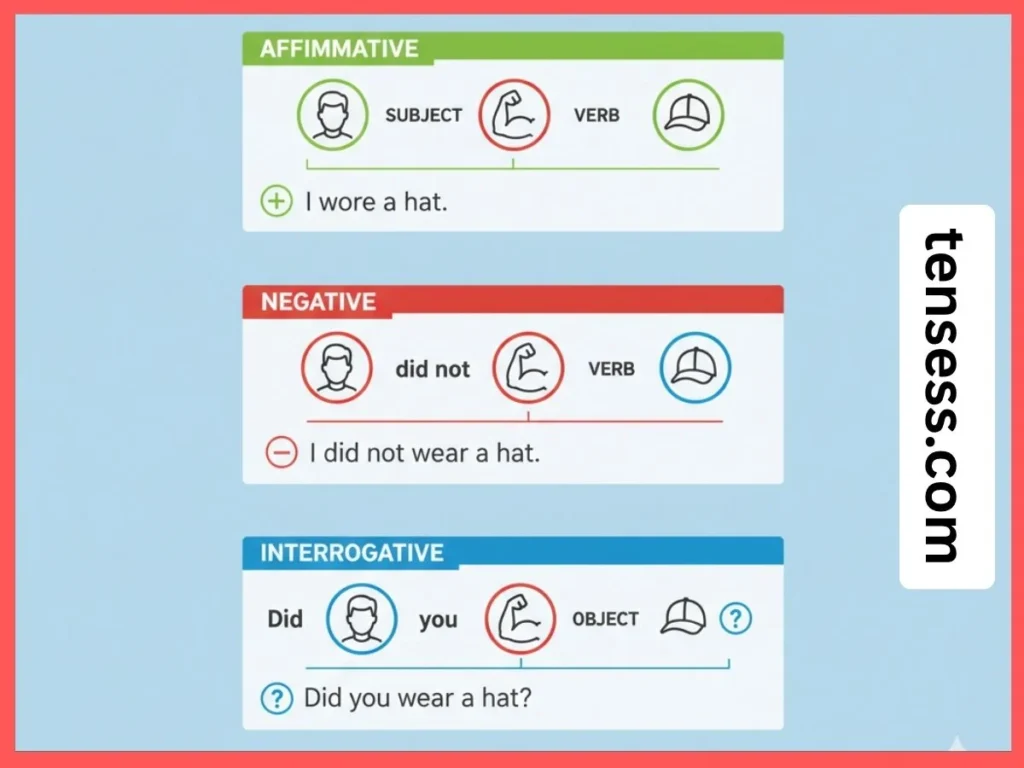
Sentences using wore follow a simple structure:
- Affirmative: Subject + wore + object/complement. E.g., “I wore a scarf.”
- Negative: Subject + did not + wear + object/complement. E.g., “She did not wear a hat.”
- Interrogative: Did + subject + wear + object/complement? E.g., “Did you wear gloves?”
Note that in negative and interrogative sentences, the base form wear is used with the helping verb did.
Formation of the Past Tense of Wear
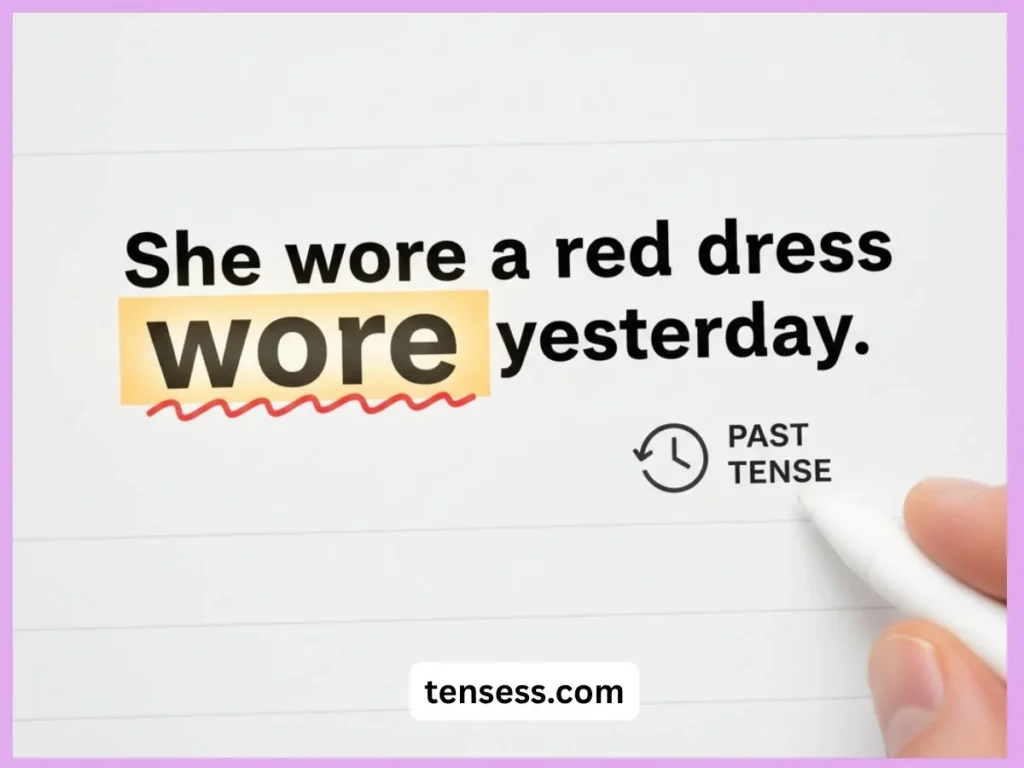
The past tense of wear is formed by replacing wear with wore for simple past sentences. For perfect tenses (e.g., past perfect), use had worn. Here’s how it works:
- Simple Past: Subject + wore. E.g., “They wore costumes.”
- Past Perfect: Subject + had + worn. E.g., “She had worn the dress before.”
No additional endings are needed for wore in the simple past, regardless of the subject.
Verbs Related to Wear
The verb wear belongs to a group of irregular verbs that change forms in the past tense. Related verbs include those describing actions of dressing or using items, like put on, dress, or carry. Unlike regular verbs (e.g., walk → walked), wear is irregular, so its past form is wore, and its past participle is worn.
Wear en Pasado Simple
El verbo wear en pasado simple se convierte en wore. Esta forma se usa para hablar de acciones que ya ocurrieron en el pasado, especialmente cuando describimos ropa, accesorios o situaciones donde algo fue usado anteriormente. Reconocer wore en una oración indica que la acción ya está completa y no ocurre en el presente.
Para identificar el pasado simple de wear, observa si la frase describe algo que sucedió en un momento específico del pasado, como ayer, la semana pasada o durante un evento pasado. También suele aparecer en historias, descripciones o recuerdos.
Por ejemplo:
- “She wore a red dress at the party last night.”
- “He wore glasses when he was younger.”
- “They wore traditional clothes during the festival.”
Recuerda que wore se usa solo en pasado simple, mientras que worn aparece con verbos auxiliares como has, have o had para formar tiempos perfectos.
Helping Verbs with the Past Tense of Wear
Helping verbs like had (for past perfect) or did (for negatives and questions) are used with wear:
- Had: Used in past perfect. E.g., “I had worn the jacket before it tore.”
- Did: Used in negative or interrogative sentences. E.g., “Did she wear a coat?” or “He did not wear boots.”
Explanation of Some Verbs with Reference to the Past Tense of Wear
Some verbs are often confused with wear:
- Put on: Refers to the act of dressing. E.g., “She put on a sweater” vs. “She wore a sweater all day.”
- Dress: General term for clothing oneself. E.g., “He dressed nicely” vs. “He wore a suit.”
- Carry: Can imply holding something, not wearing. E.g., “She carried a bag” vs. “She wore a necklace.”
Wore specifically describes the state of having something on the body or its condition after use.
Wear Past Tense/Past Form of Wear
The past tense of wear describes an action that already happened in the past. The verb “wear” changes form depending on whether you are talking about simple past events or actions completed before another past moment.
Wore: Used as the simple past form of wear. It explains something someone used or had on in the past.
Example: “She wore a blue dress to the party.”
Worn: Used as the past participle form of wear and usually appears with helping verbs like has, have, or had.
Example: “They had worn warm jackets during the trip.”
Understanding these forms helps you use the past tense correctly in both casual conversation and formal writing.
Wear Verb Forms V1, V2, V3
The verb “wear” has three main forms:
- V1 (base form): wear – used for present tense, e.g., “I wear a scarf every day.”
- V2 (simple past): wore – used for past actions, e.g., “She wore a red dress yesterday.”
- V3 (past participle): worn – used with helping verbs for perfect tenses, e.g., “They have worn these jackets all winter.”
Spanish Explanation:
El verbo “wear” tiene tres formas principales:
- V1 (forma base): wear – para presente. Ej.: “I wear a scarf every day.”
- V2 (pasado simple): wore – para acciones pasadas. Ej.: “She wore a red dress yesterday.”
- V3 (participio pasado): worn – se usa con verbos auxiliares para tiempos perfectos. Ej.: “They have worn these jackets all winter.”
Perfect Tense of Wear
The perfect tense uses a helping verb (has, have, or had) with worn.
- Present perfect: “She has worn that necklace before.”
- Past perfect: “He had worn his uniform all day.”
- Future perfect: “By tomorrow, they will have worn the new shoes.”
Spanish Explanation:
El tiempo perfecto usa un verbo auxiliar (has, have, had) con worn:
- Presente perfecto: “She has worn that necklace before.”
- Pasado perfecto: “He had worn his uniform all day.”
- Futuro perfecto: “By tomorrow, they will have worn the new shoes.”
Past Tense of Wear Out
“Wear out” means something becomes damaged or unusable from use. Its past tense is wore out.
- “My shoes wore out after a year of daily use.”
- “The rope wore out quickly under heavy weight.”
Spanish Explanation:
“Wear out” significa que algo se desgasta o deja de funcionar por uso. Su pasado es wore out.
- Ej.: “My shoes wore out after a year of daily use.”
- Ej.: “The rope wore out quickly under heavy weight.”
Wear Past Perfect Tense
The past perfect shows that an action occurred before another past action. It uses had + worn.
- Example: “She had worn her new jacket before the party started.”
Spanish Explanation:
El pasado perfecto indica que una acción ocurrió antes de otra acción pasada. Se forma con had + worn.
- Ej.: “She had worn her new jacket before the party started.”
Past Tense of Wear Examples
Examples using wore:
- “He wore a suit to the meeting.”
- “They wore casual clothes at the picnic.”
- “I wore my new shoes yesterday.”
Spanish Explanation:
Ejemplos usando wore:
- “He wore a suit to the meeting.”
- “They wore casual clothes at the picnic.”
- “I wore my new shoes yesterday.”
Past Tense of Wear Synonym
Synonyms for wore include:
- Dressed in: “She dressed in a blue gown for the ceremony.”
- Put on: “He put on his jacket before leaving.”
- Carried: “She carried a scarf around her neck.”
Spanish Explanation:
Sinónimos de wore incluyen:
- Dressed in: “She dressed in a blue gown for the ceremony.”
- Put on: “He put on his jacket before leaving.”
- Carried: “She carried a scarf around her neck.”
Past Tense of Wear in a Sentence
- Affirmative: “I wore a hat to protect myself from the sun.”
- Negative: “She did not wear gloves during the hike.”
- Interrogative: “Did you wear your uniform yesterday?”
Spanish Explanation:
- Afirmativa: “I wore a hat to protect myself from the sun.”
- Negativa: “She did not wear gloves during the hike.”
- Interrogativa: “Did you wear your uniform yesterday?”
Future Tense of Wear
- “I will wear a new dress to the party tomorrow.”
- “They will wear safety helmets on the site.”
Spanish Explanation:
- “I will wear a new dress to the party tomorrow.”
- “They will wear safety helmets on the site.”
Which Is Correct: Wore or Worn?
- Wore: simple past, e.g., “She wore a hat yesterday.”
- Worn: past participle, e.g., “She has worn that hat before.”
Spanish Explanation:
- Wore: pasado simple, ej.: “She wore a hat yesterday.”
- Worn: participio pasado, ej.: “She has worn that hat before.”
What Is Wear in Past Tense?
The past tense of “wear” is wore.
- “He wore a jacket last night.”
- “They wore matching uniforms for the event.”
Spanish Explanation:
El pasado de “wear” es wore.
- “He wore a jacket last night.”
- “They wore matching uniforms for the event.”
Should Have Wore or Worn?
The correct form is should have worn.
- Example: “You should have worn a coat; it’s cold outside.”
Spanish Explanation:
La forma correcta es should have worn.
- Ej.: “You should have worn a coat; it’s cold outside.”
Is It I Haven’t Worn or Wore?
The correct form is I haven’t worn.
- Example: “I haven’t worn these shoes in months.”
Spanish Explanation:
La forma correcta es I haven’t worn.
- Ej.: “I haven’t worn these shoes in months.”
Table of Some Regular and Irregular Verbs in Past Tense
| Verb | Base Form | Past Tense | Past Participle |
| Wear | Wear | Wore | Worn |
| Put on | Put on | Put on | Put on |
| Dress | Dress | Dressed | Dressed |
| Walk | Walk | Walked | Walked |
| Tear | Tear | Tore | Torn |
| Carry | Carry | Carried | Carried |
| Take off | Take off | Took off | Taken off |
| Choose | Choose | Chose | Chosen |
| Break | Break | Broke | Broken |
| Use | Use | Used | Used |
Simple Sentence Examples
- I wore a blue shirt yesterday.
- She wore sunglasses to the beach.
- He wore a tie to the meeting.
- We wore costumes for Halloween.
- They wore jackets in the cold.
- You wore a hat during the hike.
- It wore out after years of use.
- The team wore red uniforms.
- My friend wore a scarf last winter.
- The actor wore a wig for the role.
Negative Sentence Examples
- I did not wear a coat today.
- She did not wear her new shoes.
- He did not wear a helmet.
- We did not wear gloves in the snow.
- They did not wear uniforms to school.
- You did not wear a tie to the event.
- It did not wear out quickly.
- The kids did not wear jackets.
- My sister did not wear earrings.
- He did not wear his glasses.
Interrogative Sentence Examples
- Did I wear a scarf yesterday?
- Did she wear a dress to the party?
- Did he wear boots in the rain?
- Did we wear costumes for the play?
- Did they wear hats at the game?
- Did you wear a jacket last night?
- Did it wear out after one use?
- Did the team wear new uniforms?
- Did she wear her necklace?
- Did he wear a suit to the interview?
Negative and Interrogative Sentence Examples
- Didn’t I wear a tie last time?
- Didn’t she wear a hat to the park?
- Didn’t he wear gloves during the game?
- Didn’t we wear scarves in the cold?
- Didn’t they wear costumes for the event?
- Didn’t you wear your new shoes?
- Didn’t it wear out too soon?
- Didn’t the team wear blue jerseys?
- Didn’t she wear her earrings?
- Didn’t he wear a jacket yesterday?
How to Conjugate the Past Tense of Wear
The past tense of wear is straightforward because wore is used for all subjects in the simple past. Here’s how to conjugate it:
- Use wore for all subjects (I, you, he, she, it, we, they).
- No additional endings are needed.
- For past perfect, use had worn for all subjects.
- In negative sentences, use did not wear.
- In questions, use did + subject + wear.
- Ensure the context is past (e.g., yesterday, last week).
- Use worn with had for past perfect tenses.
- Avoid using wore in present or future contexts.
- Check for irregular verb patterns in related verbs.
- Practice with different subjects to master usage.
Conjugation Table for Past Tense of Wear
| Subject | Simple Past | Past Perfect | Negative | Interrogative |
| I | Wore | Had worn | Did not wear | Did I wear? |
| You | Wore | Had worn | Did not wear | Did you wear? |
| He/She/It | Wore | Had worn | Did not wear | Did he/she/it wear? |
| We | Wore | Had worn | Did not wear | Did we wear? |
| They | Wore | Had worn | Did not wear | Did they wear? |
Spelling Changes or Irregularities
The verb wear is irregular, so it doesn’t follow the regular “-ed” ending. Key points:
- Base form: Wear
- Simple past: Wore
- Past participle: Worn (used with had or have)
There are no spelling changes within wore itself, but learners must remember the shift from wear to wore and worn depending on the tense.
Pasado de Wear
El pasado de wear se refiere a cómo cambia este verbo en inglés cuando hablamos de acciones que ocurrieron anteriormente. Es importante conocer sus formas en pasado para usarlo correctamente en oraciones y conversaciones.
Wore: Es el pasado simple de wear y se usa para describir algo que alguien llevaba o usó en un momento específico del pasado.
Ejemplo: “She wore a red jacket yesterday.”
Worn: Es el participio pasado y normalmente se utiliza con verbos auxiliares como has, have, o had.
Ejemplo: “He has worn that hat many times.”
Aprender estas formas ayuda a expresar acciones pasadas con claridad y precisión en inglés.
Sentence Examples with Different Subjects
- I wore a red coat to the festival.
- You wore sneakers to the gym.
- He wore a tuxedo to the gala.
- She wore a necklace her mom gave her.
- It (the fabric) wore thin after washing.
- We wore matching shirts for the event.
- They wore boots in the mud.
- John wore glasses during the meeting.
- The team wore new jerseys.
- My dog wore a tiny sweater.
- You all wore hats to the beach.
- The kids wore costumes for Halloween.
- She wore earrings to the party.
- He wore a scarf in the cold.
- I wore my old jacket yesterday.
Wear Past Tense Examples (Sentence Examples with Different Subjects)
I wore my favorite hoodie yesterday.
You wore formal shoes to the interview.
He wore a blue jacket during the trip.
She wore a beautiful dress at the wedding.
It (the material) wore out after years of use.
We wore matching outfits for the photoshoot.
They wore helmets while riding bikes.
Ali wore sunglasses on a sunny day.
The players wore white uniforms in the match.
My cat wore a small collar.
You all wore traditional clothes for the celebration.
The students wore badges during the event.
She wore gloves in the winter.
He wore a watch gifted by his father.
I wore comfortable clothes while traveling.
Common Mistakes with the Past Tense of Wear
- Using weared instead of wore. (Incorrect: “I weared a hat.”)
- Confusing wore with worn without had. (Incorrect: “I worn it.”)
- Forgetting did in negative sentences. (Incorrect: “I not wore it.”)
- Using wear in past contexts. (Incorrect: “She wear a dress yesterday.”)
- Mixing up put on and wore. (Incorrect: “I wore on my shoes.”)
- Omitting the object. (Incorrect: “She wore yesterday.”)
- Using wore in present tense. (Incorrect: “I wore a shirt now.”)
- Incorrect question structure. (Incorrect: “Wore you a hat?”)
- Misusing worn in simple past. (Incorrect: “They worn jackets.”)
- Ignoring irregular verb patterns. (Incorrect: “He weared boots.”)
How to Avoid Common Mistakes
- Always use wore for simple past, not weared.
- Use worn only with have or had.
- Include did in negative and interrogative sentences.
- Double-check the time context (past, not present).
- Practice wore vs. put on in sentences.
- Ensure an object follows wore (e.g., a shirt, not nothing).
- Memorize the irregular forms: wear, wore, worn.
- Use question structure: Did + subject + wear.
- Review examples to reinforce correct usage.
- Read aloud to catch errors in verb tense.
Related Verbs and Synonyms for the Past Tense of Wear
- Put on: Act of dressing. E.g., “She put on a coat” vs. “She wore a coat.”
- Dress: General dressing. E.g., “He dressed casually” vs. “He wore jeans.”
- Adorn: Decorative wearing. E.g., “She adorned herself with jewels” vs. “She wore jewels.”
- Sport: Informal wearing. E.g., “He sported a hat” vs. “He wore a hat.”
- Bear: Carrying or enduring. E.g., “She bore a heavy load” vs. “She wore a backpack.”
Sentence comparison: - “I put on my shoes” (action) vs. “I wore my shoes all day” (state).
- “She dressed elegantly” (general) vs. “She wore a gown” (specific).
Tips to Practice Using the Past Tense of Wear
- Write 10 sentences using wore with different subjects.
- Describe what you wore yesterday in a paragraph.
- Create a story using wore in past tense.
- Practice negative sentences with did not wear.
- Form questions using Did + subject + wear.
- Read books and highlight wore in past tense contexts.
- Use flashcards to memorize wear, wore, worn.
- Speak aloud sentences with wore to friends.
- Correct incorrect sentences like “I weared a hat.”
- Take online quizzes on irregular verbs.
Frequently Asked Questions
- What is the past tense of wear? It’s wore.
- Is wear a regular or irregular verb? It’s irregular.
- What’s the difference between wore and worn? Wore is simple past; worn is past participle with have/had.
- Can I say “I weared”? No, it’s incorrect; use wore.
- How do I form a negative sentence? Use did not wear.
- What’s the past perfect of wear? It’s had worn.
- Is wore used for all subjects? Yes, for I, you, he, etc.
- Can wore describe objects? Yes, like “The tires wore out.”
- What’s a synonym for wear? Sport or dress.
- How do I practice wore? Write and speak sentences daily.
Exercises
- Fill in: She ___ a hat yesterday. (Answer: wore)
- Correct: I weared a jacket. (Answer: I wore a jacket.)
- Write a sentence with wore and shoes.
- Make a negative sentence with wear and gloves.
- Form a question: ___ you ___ a tie? (Answer: Did you wear)
- Use had worn in a sentence.
- Rewrite: He wear a suit. (Answer: He wore a suit.)
- Describe what you wore last weekend.
- Create a sentence with they and wore.
- Fix: They worn hats. (Answer: They wore hats.)
Quizzes
- What’s the past tense of wear? a) Weared b) Wore c) Worn (Answer: b)
- Is wear regular? a) Yes b) No (Answer: b)
- Choose: She ___ a dress. a) Wore b) Worn (Answer: a)
- Negative form: I ___ wear a hat. a) Did not b) Not (Answer: a)
- Question: ___ he wear boots? a) Did b) Does (Answer: a)
- Past perfect: I ___ worn it. a) Have b) Had (Answer: b)
- Correct: I weared shoes. a) True b) False (Answer: b)
- Synonym for wear: a) Run b) Sport (Answer: b)
- Subject for wore: a) I b) Future (Answer: a)
- Fix: She worn a scarf. a) She wore b) She wear (Answer: a)
True or False
- Wore is the past tense of wear. (True)
- Weared is correct for past tense. (False)
- Worn is used without had. (False)
- Did not wear is a negative form. (True)
- Wore changes based on subject. (False)
- Had worn is past perfect. (True)
- Wear is regular. (False)
- Wore can describe objects. (True)
- Put on means the same as wore. (False)
- Did you wear is a correct question. (True)
Conclusion
Mastering the past tense of wear is a valuable skill for clear communication, whether you’re a student, writer, or language learner.
By understanding how to use wore in simple past and worn in past perfect, you can describe past events with confidence.
This guide covered the definition, sentence structures, conjugation, and common mistakes to avoid, along with practical examples and exercises.
Regular practice with wore in sentences, quizzes, and real-life contexts will solidify your grammar skills.
Try writing a short story or describing what you wore last week to practice. For extra help, consider using a grammar checker or joining a language learning community.
Keep practicing, and soon using the past tense of wear will feel natural! Share your sentences in the comments or test your skills with our quizzes.