
Quick Reply: Learn the correct usage of meet in past, present, and future tenses. Discover conjugation rules, common mistakes, pronunciation tips, and examples to master this irregular verb.
The past tense of meet is an essential grammar concept for students, language learners, writers, and grammar enthusiasts.
Understanding how to use met, the past tense form of the verb meet, allows you to describe past encounters accurately.
If you’re writing a story, crafting an essay, or speaking fluently, mastering this verb tense is key.
In this article, we’ll break down the past tense of meet, including its definition, structure, conjugation, and real-life examples.
We’ll also cover common mistakes, synonyms, and practice tips to help you use met confidently.
With a clear, beginner-friendly tone and skimmable sections, this guide will make learning the past tense of meet easy and engaging.
Let’s dive in and explore how to use this verb tense correctly!
Meet Past Tense/Meet Past Form
(Second Form of Meet/Past Form of Meet/Past Participle of Meet/Meet in Past Tense/ What Is the Past Tense of Meet?)
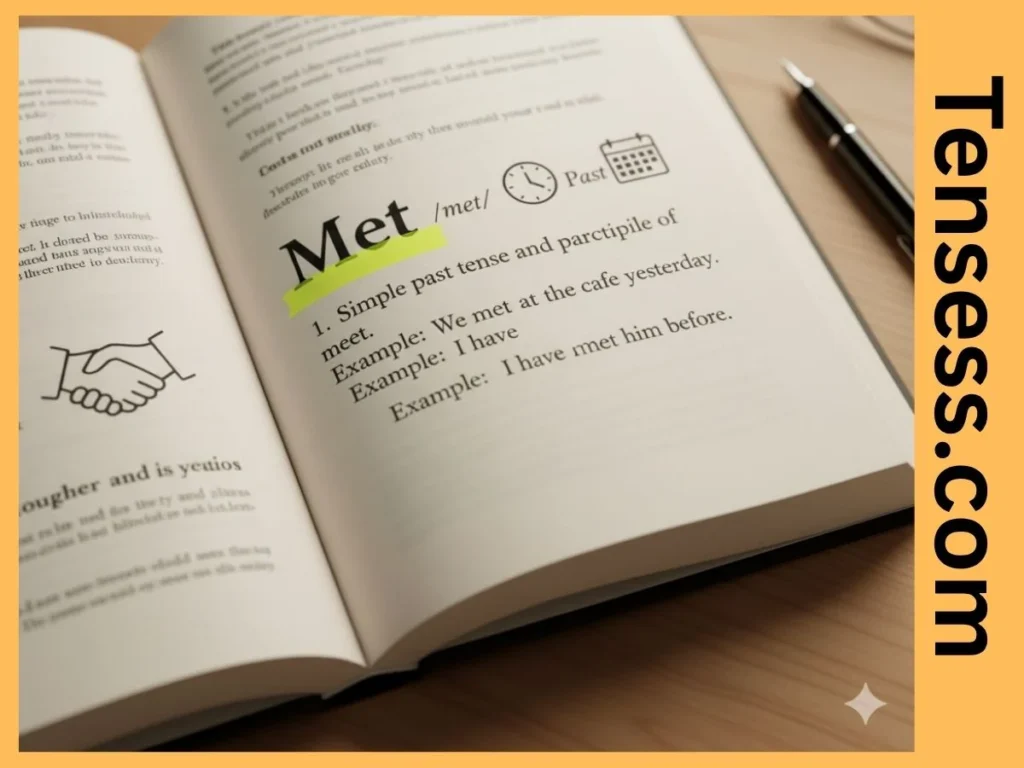
The past tense of meet is met. It’s used to describe an action that happened in the past, such as meeting someone or something at a specific time. For example, “I met my friend yesterday.” The verb meet is irregular, meaning it doesn’t follow the standard “-ed” ending for regular verbs. Instead, it changes to met for both the simple past and past participle forms. Understanding this irregular verb is crucial for proper verb conjugation in English.
How to Recognize the Past Tense of Meet?

To recognize the past tense of meet, look for the word met in sentences describing past events. It often appears with time indicators like “yesterday,” “last week,” or “in 2020.” For instance:
- “She met her teacher last month.”
- “We met at the park.”
The verb met doesn’t change based on the subject (I, you, he, she, etc.), making it straightforward to identify.
Structure of Sentences in Past Tense of Meet
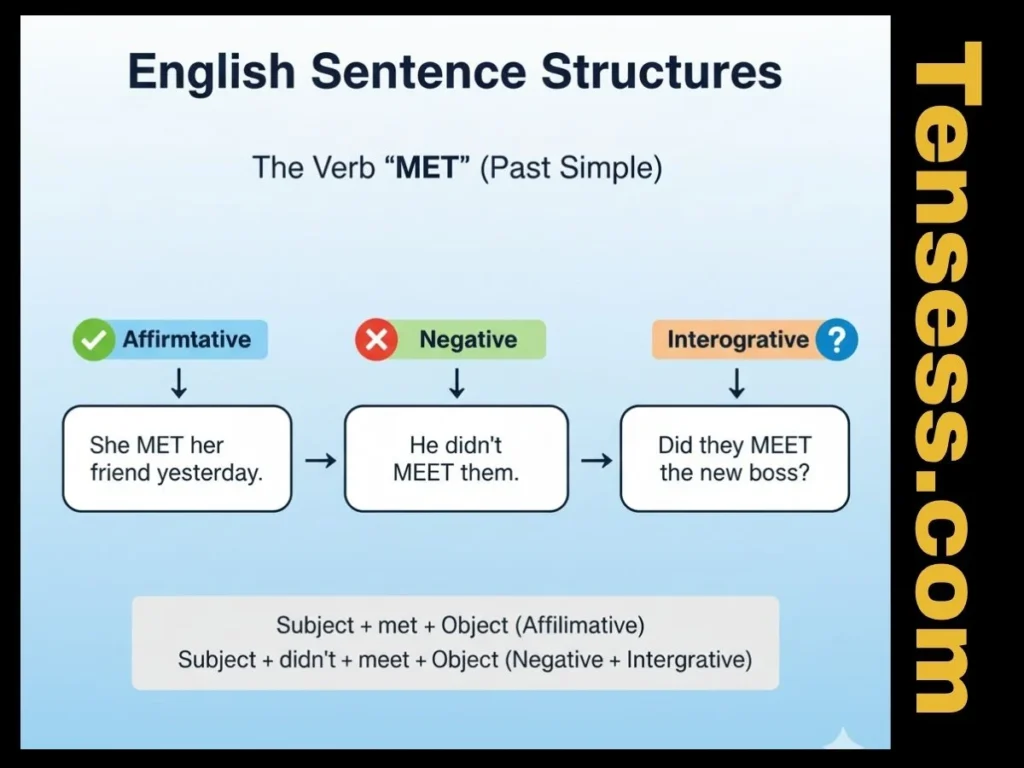
In the past tense, sentences with meet follow a simple structure:
- Affirmative: Subject + met + object. (e.g., “I met my boss.”)
- Negative: Subject + did not meet + object. (e.g., “I did not meet my boss.”)
- Interrogative: Did + subject + meet + object? (e.g., “Did I meet my boss?”)
- Negative Interrogative: Did + subject + not meet + object? (e.g., “Did I not meet my boss?”)
The base verb meet is used in negative and interrogative forms with the helping verb did.
Formation of the Past Tense of Meet
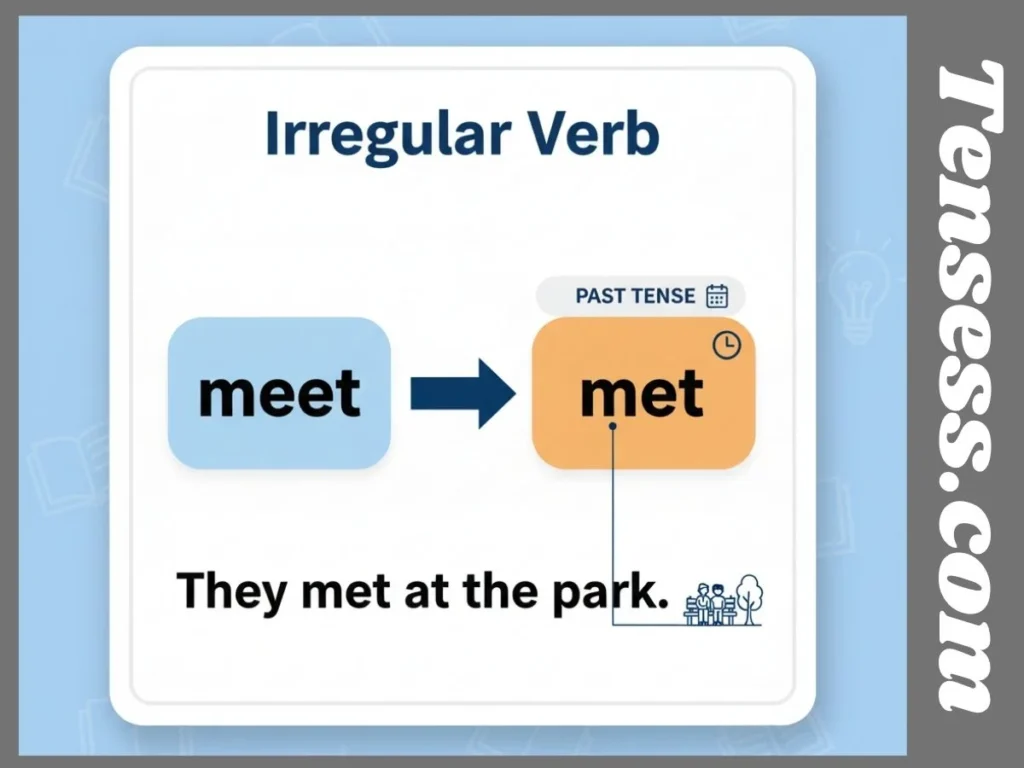
The past tense of meet is formed by using met for affirmative sentences. For negatives and questions, use did + meet. Here’s how it works:
- Affirmative: Replace meet with met (e.g., “They met at the party”).
- Negative: Use did not + meet (e.g., “They did not meet at the party”).
- Interrogative: Use Did + subject + meet (e.g., “Did they meet at the party?”).
Past, Present, and Future Tense of Meet
Past Tense: The past tense of meet is met. It describes an action that happened before now.
Example: “I met my friend at the park yesterday.”
Present Tense: The present tense of meet is meet (or meets for third-person singular). It’s used for actions happening now or regularly.
Example: “She meets her team every Monday.”
Future Tense: The future tense of meet is will meet. It describes an action that will happen later.
Example: “We will meet our new teacher tomorrow.”
Understanding these three tenses helps you use meet correctly in any context, whether talking about past experiences, current activities, or future plans.
Verbs Related to Meet
The verb meet belongs to the group of irregular verbs that change form in the past tense. Other related verbs include:
- See → Saw
- Know → Knew
- Get → Got
These verbs follow a similar irregular pattern, making them useful to study alongside meet.
Helping Verbs in Past Tense of Meet
In the past tense of meet, the helping verb did is used for:
- Negative sentences: “I did not meet him.”
- Interrogative sentences: “Did you meet her?”
- Emphasis: “I did meet her!”
No other helping verbs (like have or had) are typically used with the simple past tense of meet.
Explanation of Some Verbs with Reference to Past Tense of Meet
Some irregular verbs share similarities with meet in their past tense forms. For example:
- See (saw): Like met, it’s irregular and doesn’t take “-ed.” (e.g., “I saw her yesterday” vs. “I met her yesterday.”)
- Know (knew): Another irregular verb used for past familiarity. (e.g., “I knew her before we met.”)
These verbs are often confused with meet because they describe interactions or relationships in the past.
Table of Some Regular and Irregular Verbs in Past Tense
| Base Verb | Past Tense | Regular/Irregular |
| Meet | Met | Irregular |
| See | Saw | Irregular |
| Know | Knew | Irregular |
| Walk | Walked | Regular |
| Talk | Talked | Regular |
| Run | Ran | Irregular |
| Write | Wrote | Irregular |
| Read | Read | Irregular |
| Play | Played | Regular |
| Sing | Sang | Irregular |
Simple Sentence Examples
- I met my best friend at school.
- She met her cousin last weekend.
- He met the CEO yesterday.
- We met at the coffee shop.
- They met during the conference.
- You met the new teacher, right?
- It met the requirements perfectly.
- The team met to discuss the project.
- John met his neighbor at the park.
- The kids met their grandparents last summer.
Negative Sentence Examples
- I did not meet my friend yesterday.
- She did not meet her boss last week.
- He did not meet the deadline.
- We did not meet at the party.
- They did not meet the new manager.
- You did not meet her at the event.
- It did not meet our expectations.
- The group did not meet on Monday.
- Sarah did not meet her uncle.
- The students did not meet the principal.
Interrogative Sentence Examples
- Did I meet you at the concert?
- Did she meet her friend yesterday?
- Did he meet the client last week?
- Did we meet at the library?
- Did they meet the guest speaker?
- Did you meet the new neighbor?
- Did it meet the standards?
- Did the team meet last night?
- Did John meet his teacher?
- Did the kids meet their coach?
Negative and Interrogative Sentence Examples
- Did I not meet you before?
- Did she not meet her cousin?
- Did he not meet the manager?
- Did we not meet at the event?
- Did they not meet the deadline?
- Did you not meet the team?
- Did it not meet the criteria?
- Did the group not meet yesterday?
- Did Sarah not meet her friend?
- Did the students not meet the guest?
How to Conjugate the Past Tense of Meet
Since meet is an irregular verb, its past tense form (met) remains the same for all subjects. Here’s how to conjugate it:
- Use met for all subjects in affirmative sentences.
- Use did not meet for negative sentences.
- Use Did + subject + meet for questions.
- No additional endings are needed.
- The form doesn’t change for singular or plural subjects.
- Avoid adding “-ed” or other suffixes.
- Use met for both simple past and past participle.
- Combine with time expressions for clarity (e.g., “yesterday”).
- Ensure proper word order in questions.
- Practice with different subjects to master usage.
Conjugation Table for Past Tense of Meet
| Subject | Affirmative | Negative | Interrogative |
| I | I met | I did not meet | Did I meet? |
| You | You met | You did not meet | Did you meet? |
| He | He met | He did not meet | Did he meet? |
| She | She met | She did not meet | Did she meet? |
| It | It met | It did not meet | Did it meet? |
| We | We met | We did not meet | Did we meet? |
| They | They met | They did not meet | Did they meet? |
Spelling Changes or Irregularities
The verb meet is irregular, so it doesn’t follow the regular “-ed” ending. Key points:
- Base form: Meet
- Past tense: Met
- Past participle: Met
- No spelling changes occur for different subjects.
- The irregularity is consistent across all forms.
Meet en Pasado Simple
El pasado simple de meet es met. Se usa para describir encuentros o reuniones que ocurrieron en el pasado. Por ejemplo, “Yo met a mi amigo ayer.” El verbo meet es irregular, por lo que no sigue la regla normal de agregar -ed. La forma met se utiliza con todos los sujetos como I, you, he, she, we y they.
Past Tense of Meet Up
The past tense of meet up is met up. This phrasal verb is used when people gather or come together at a specific place. For example, “We met up at the café last night.” Just like the verb meet, meet up is irregular and changes to met up in the past tense.
Meet Past Tense and Past Participle
The past tense and past participle of meet are both met. This means the same form is used in the simple past and perfect tenses. For example, “I met her yesterday” uses the simple past, while “I have met her before” uses the past participle. Since meet is an irregular verb, both forms remain met.
Past Tense of Meet in a Sentence
The past tense of meet is met, and it is used to describe actions that happened earlier. For example, “She met her teacher last week.” The word met shows that the meeting took place in the past. This form is used for all subjects and does not change.
Past Tense of Meet Examples
The past tense of meet is met, and it appears in many everyday sentences. Here are some examples:
- I met my friend yesterday.
- She met her cousin at the park.
- We met during the conference.
- They met their new teacher last week.
- He met the manager in the office.
These examples show how met is used to describe completed actions in the past.
Past Tense of Meet Synonym
The past tense of meet is met, and some common synonyms include encountered, greeted, and saw. These words can sometimes replace met depending on the situation. For example, “I met her yesterday” can also be written as “I encountered her yesterday.” However, met usually suggests a personal interaction, while synonyms may have slightly different meanings.
Past Tense of Outrun
The past tense of outrun is outran. It describes the action of running faster than someone or something in the past. For example, “He outran his competitors in the race.” The verb outrun is irregular, and the past participle form is outrun.
What Is the Past Tense of Pay
The past tense of pay is paid. It is used to describe giving money or settling a cost in the past. For example, “She paid the bill yesterday.” The verb pay is irregular, so the correct past form is paid, not “payed” in most situations.
What Is Meet in Past Tense?
The past tense of meet is met. It is used when talking about a meeting or encounter that already happened. For example, “I met him at the station.” The form met stays the same for singular and plural subjects.
How Do You Say Meet in the Past?
To say meet in the past, you use the word met. This form is used to describe a meeting that took place earlier. For example, “We met last year.” Because meet is an irregular verb, the correct past form is met, not “meeted.”
What Is the 3 Form of Meet?
The third form (past participle) of meet is met. The three forms of the verb are:
- Base form: Meet
- Past tense: Met
- Past participle: Met
The third form met is used with helping verbs such as have, has, or had, as in “I have met her before.”
Do You Say Meet or Met?
You use meet for present or future actions and met for past actions. For example, “I meet my friends every week” is present tense, while “I met my friends yesterday” is past tense. If the action already happened, the correct word is met.
Sentence Examples with Different Subjects
- I met my old classmate yesterday.
- You met the director last week.
- He met his mentor at the seminar.
- She met her favorite author.
- It met the safety standards.
- We met at the festival last year.
- They met during the trip.
- John met his boss at the office.
- The team met to finalize plans.
- The kids met their new coach.
- I did not meet her at the party.
- Did you meet the guest speaker?
- She did not meet the deadline.
- Did they meet last night?
- We met our neighbors last month.
Past Tense of Meet in Real-Life Examples
- The place where the winds met was breathtaking.
- People wondered when they met for the first time.
- Many fans were curious how Travis Kelce and Taylor Swift met.
- The jurisdiction receiving mutual aid met its resource needs effectively.
- It was unclear when the two friends met.
- Tourists visited the spot where the winds met.
- Officials discussed when the Fed last met.
- The point where supply and demand met determined the final prices.
- Fans anticipated when “Where Winds Meet” met its release date.
- The world watched how Trump met Melania.
- Students learned what Google Meet met in their projects.
- Bill Belichick met his girlfriend under interesting circumstances.
- Taylor Swift met Travis Kelce at a charity event.
- Fans wondered how Taylor Swift and Travis Kelce met.
- Teachers explained how to use Google Meet after everyone met online.
- He finally met new people at the networking event.
- Gamers discussed where winds met in the Xbox game.
- She wanted to meet people who met her interests.
- He searched for places where he could meet women.
- Charlie Kirk met his wife at a political event.
- Many professionals met via Google Meet calls.
- The children met the Robinsons at the animation premiere.
- They finally met after months of planning.
- He met Joe Black in an unexpected encounter.
- Adventurers explored where the winds met.
- The cast of People We Met on Vacation reunited for the film premiere.
- Fans met the Fockers during the movie event.
- The actors met the parents on set.
- The Google Meet app helped everyone meet virtually.
- Many sugar daddies met their companions online.
- The family met the Grahams for the reunion.
- Travelers shared stories about people they met on vacation.
- Journalists met the press for an official briefing.
- He met me at the café yesterday.
- The community held a swap meet last weekend.
- Friends discussed when they should meet again.
- They met up at the park for coffee.
- The cast of People We Met on Vacation had a reunion.
- The COO met with the team to finalize decisions.
- She met me in St. Louis for the conference.
Common Mistakes with Past Tense of Meet
- Adding “-ed” (meeted instead of met).
- Using meet instead of met in past tense.
- Forgetting did in negative sentences.
- Incorrect word order in questions (e.g., “Met you her?”).
- Confusing met with meet in questions.
- Using have met for simple past (use had met for past perfect).
- Omitting time indicators for clarity.
- Mixing up met with similar verbs like saw.
- Incorrect subject-verb agreement (not applicable here, as met is consistent).
- Overusing did in affirmative sentences.
How to Avoid Common Mistakes
- Always use met for past tense, not meeted.
- Practice negative forms with did not meet.
- Use Did + subject + meet for questions.
- Include time words (e.g., “yesterday”) for context.
- Compare with other irregular verbs like see or know.
- Avoid have met unless using past perfect.
- Read sentences aloud to check correctness.
- Use grammar checkers to spot errors.
- Write practice sentences with different subjects.
- Review conjugation tables regularly.
Related Verbs and Synonyms for Past Tense of Meet
Synonyms for meet in the past tense include:
- Encountered: “I encountered her at the store.”
- Greeted: “He greeted his friend yesterday.”
- Saw: “I saw my teacher last week.”
Sentence Comparisons:
- Met vs. Encountered: “I met her at the party” (neutral) vs. “I encountered her at the party” (more formal).
- Met vs. Saw: “I met my friend” (implies interaction) vs. “I saw my friend” (implies visual contact).
Tips to Practice Using Past Tense of Meet
- Write 5 sentences daily using met.
- Create negative and interrogative sentences.
- Use met in storytelling exercises.
- Practice with flashcards for irregular verbs.
- Read books and highlight past tense verbs.
- Speak sentences aloud with met.
- Use grammar apps for practice.
- Join language forums to discuss verb tenses.
- Teach a friend about met.
- Review your writing for errors.
Frequently Asked Questions
- What is the past tense of meet? It’s met.
- Is meet a regular verb? No, it’s irregular.
- How do I form negative sentences? Use did not meet.
- What’s the past participle of meet? It’s met.
- Can met change with subjects? No, it’s consistent.
- How do I ask questions in past tense? Use Did + subject + meet.
- What’s a synonym for met? Encountered or greeted.
- Why is meeted wrong? Meet is irregular, so it becomes met.
- How do I avoid mistakes? Practice with examples and tables.
- Where can I practice? Use grammar apps or exercises below.
Exercises
- Write 3 sentences using met.
- Convert: “I meet her” to past tense.
- Make a negative sentence with met.
- Ask a question using Did and meet.
- Correct: “I meeted my friend.”
- Use met with “yesterday.”
- Write a sentence with they and met.
- Create a negative question with meet.
- Combine met with “last week.”
- Rewrite: “Did she not meet him?”
Quizzes
- What is the past tense of meet? (a) Meeted (b) Met (c) Meets
- Is met used for all subjects? (a) Yes (b) No
- What’s wrong: “I meeted her”? (a) Spelling (b) Tense
- How do you form a question? (a) Did + meet (b) Met + did
- What’s a synonym for met? (a) Saw (b) Talked
- Correct form: “I __ her yesterday.” (a) Met (b) Meet
- Negative form of “She met him”? (a) She did not meet (b) She not met
- Is meet regular? (a) Yes (b) No
- Past participle of meet? (a) Met (b) Meet
- Fix: “Did you met her?” (a) Did you meet (b) You did meet
Answers: 1-b, 2-a, 3-a, 4-a, 5-a, 6-a, 7-a, 8-b, 9-a, 10-a
True or False
- The past tense of meet is met. (True)
- Meeted is correct. (False)
- Did not meet is used for negatives. (True)
- Met changes with subjects. (False)
- Did is used in questions. (True)
- Meet is a regular verb. (False)
- Met is also the past participle. (True)
- “I met her” needs did. (False)
- Encountered is a synonym for met. (True)
- “Did she meet him?” is correct. (True)
Conclusion
Mastering the past tense of meet is a simple yet powerful step toward better English grammar.
By understanding how to use met, recognizing its structure, and practicing with real-life examples, you can confidently describe past encounters.
This guide has covered everything from verb conjugation to common mistakes, synonyms, and practice tips.
If you’re a student, writer, or language learner, using met correctly will enhance your communication skills.
Practice regularly with the provided exercises and quizzes to solidify your knowledge.
Try writing your own sentences or use a grammar checker to refine your skills.
Share your progress in the comments or join a language community to keep learning.
Start using the past tense of meet today and watch your confidence grow!