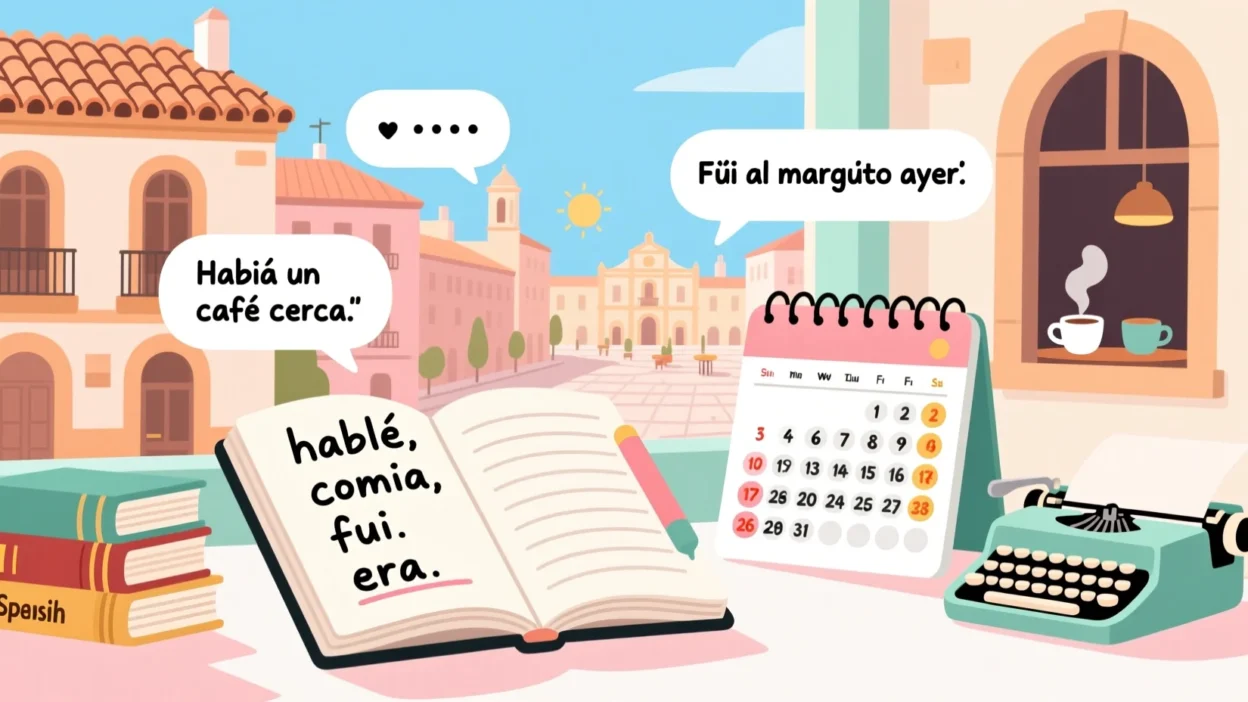
Learning past tense verbs in Spanish is a key step for students, language learners, writers, and grammar enthusiasts aiming to communicate fluently.
Spanish has multiple past tenses, primarily the preterite and imperfect, each serving unique purposes.
If you’re narrating a story, describing past habits, or sharing experiences, mastering these tenses opens doors to richer conversations.
This beginner-friendly guide simplifies the Spanish past tense, offering clear explanations, real-life examples, and practical tips.
By the end, you’ll confidently recognize, conjugate, and use past tense verbs in Spanish in various contexts.
Let’s dive into the essentials of the preterite and imperfect tenses, explore their structures, and practice with examples to make your Spanish shine!
What Is the Past Tense in Spanish?
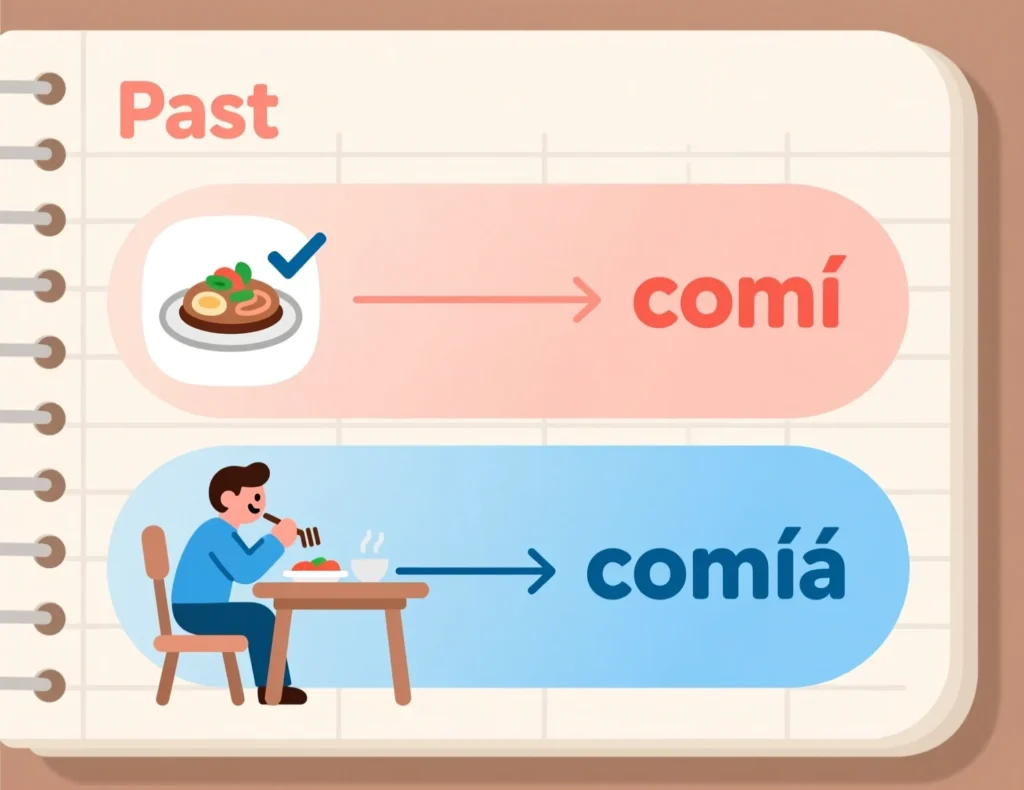
The past tense in Spanish refers to verb forms used to describe actions or states that occurred in the past. The two main tenses are the preterite (for completed actions) and the imperfect (for ongoing or habitual past actions). For example, “I ate” (comí, preterite) indicates a finished action, while “I was eating” (comía, imperfect) suggests an ongoing one. Understanding when to use past tense verbs in Spanish helps convey precise timelines in storytelling or descriptions. These tenses are essential for expressing past events clearly, whether you’re talking about a one-time event or a recurring habit.
How to Recognize Past Tense Verbs in Spanish?
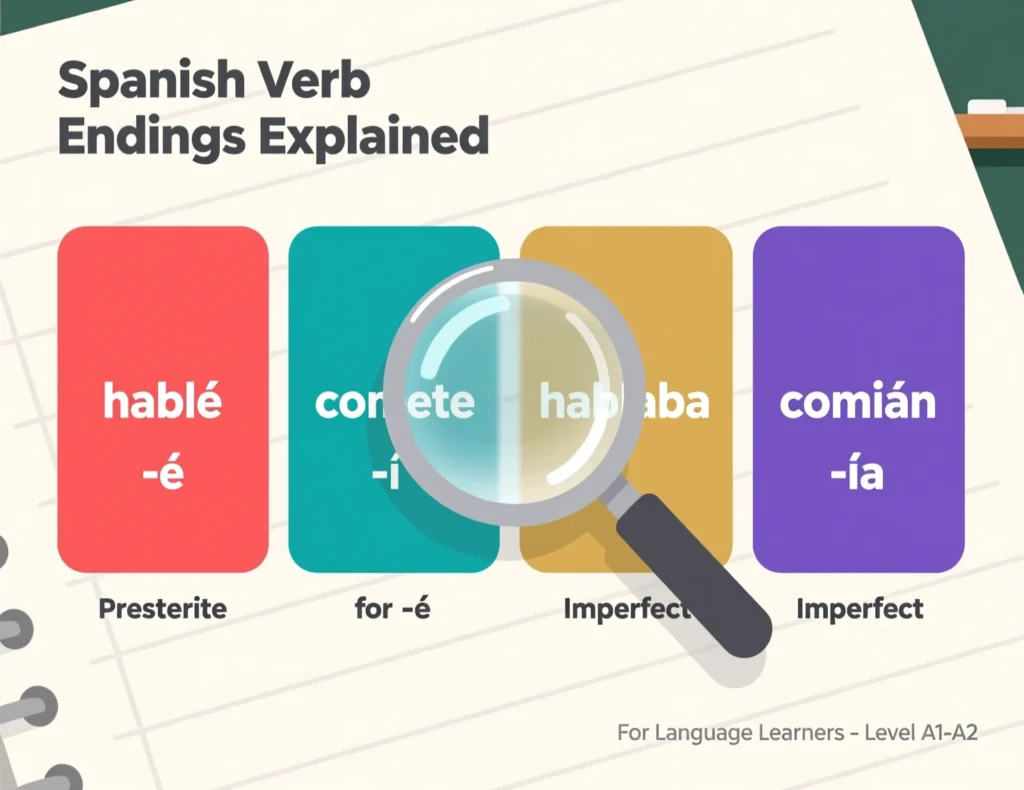
To identify past tense verbs in Spanish, look for specific verb endings that differ from present or future tenses. In the preterite, regular verbs end in -é, -aste, -ó, -amos, -asteis, -aron (for -ar verbs) or -í, -iste, -ió, -imos, -isteis, -ieron (for -er/-ir verbs). For example, hablé (I spoke) or comí (I ate). In the imperfect, endings are -aba, -abas, -aba, -ábamos, -abais, -aban (for -ar verbs) or -ía, -ías, -ía, -íamos, -íais, -ían (for -er/-ir verbs), like hablaba (I was speaking). Context also helps: preterite describes completed actions, while imperfect paints ongoing or background scenes.
Structure of a Sentence in Past Tense
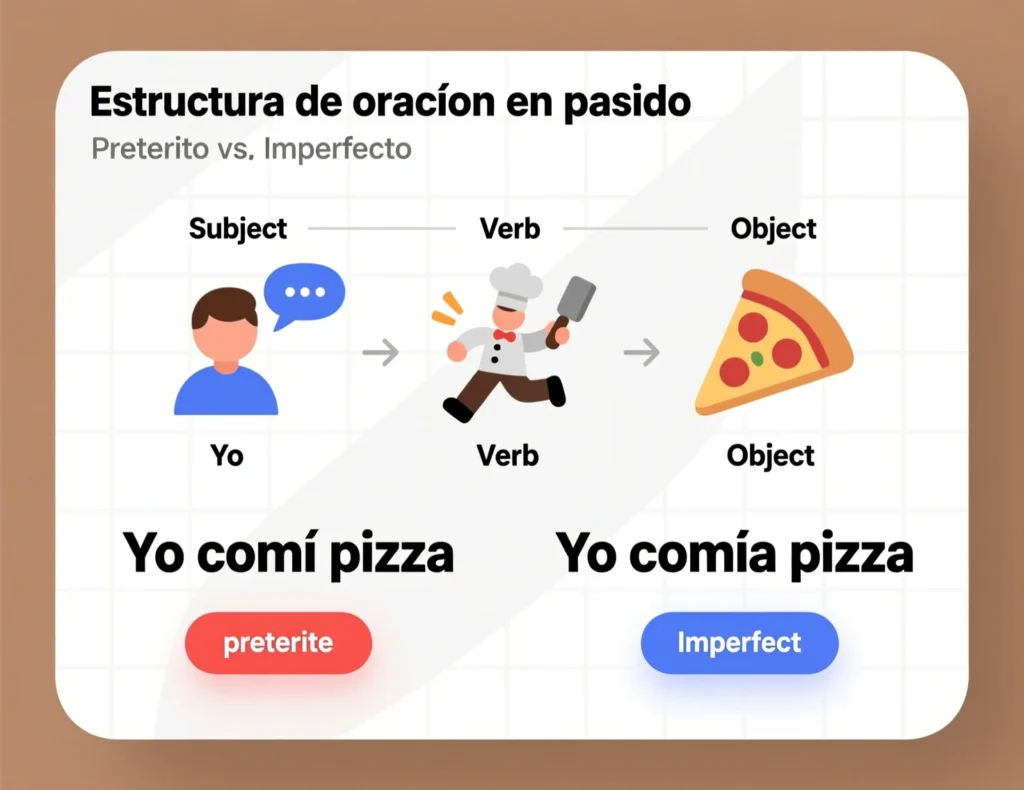
A Spanish past tense sentence typically follows a subject-verb-object structure, similar to English. For example:
- Preterite: Yo comí pizza (I ate pizza).
- Imperfect: Yo comía pizza (I was eating pizza).
The subject (e.g., yo, tú, él) comes first, followed by the conjugated verb in the appropriate tense, then the object or additional details. Adverbs like ayer (yesterday) often signal preterite, while siempre (always) may suggest imperfect. Understanding this structure helps you craft clear past tense verb sentences in Spanish.
Formation of Past Tense Verbs
Forming past tense verbs in Spanish involves conjugating verbs based on their infinitive endings (-ar, -er, -ir) and the desired tense (preterite or imperfect). Here’s a quick breakdown:
- Preterite: Add endings to the verb stem. For hablar (to speak): hablé, hablaste, habló, hablamos, hablasteis, hablaron. For comer (to eat): comí, comiste, comió, comimos, comisteis, comieron.
- Imperfect: Add endings to the verb stem. For hablar: hablaba, hablabas, hablaba, hablábamos, hablabais, hablaban. For comer: comía, comías, comía, comíamos, comíais, comían.
Irregular verbs, like ir (to go), have unique forms (e.g., preterite: fui, fuiste, fue).
Verbs in Past Tense
Spanish verbs in the past tense fall into regular and irregular categories. Regular verbs follow predictable patterns, while irregular verbs, like ser (to be) or tener (to have), change stems or endings. The preterite is used for actions with a clear start and end, like viajé (I traveled). The imperfect describes ongoing actions or states, like vivía (I was living). Both tenses are crucial for storytelling, with the preterite focusing on events and the imperfect setting the scene.
Helping Verbs in Past Tense
Spanish past tense verbs rarely use helping verbs like English’s “have” or “had” (e.g., I had eaten). Instead, Spanish relies on single conjugated verbs to express the past. However, compound tenses like the perfect preterite (e.g., he comido, I have eaten) use haber as a helping verb in the preterite (hube, hubiste, hubo, etc.) plus the past participle. For example, hube hablado (I had spoken). These are less common in everyday speech but useful in formal or literary contexts.
Explanation of Some Verbs with Reference to Past Tense
Let’s explore key verbs in the past tense in Spanish:
- Hablar (to speak): Preterite (hablé, I spoke) for a specific conversation; imperfect (hablaba, I was speaking) for ongoing talk.
- Comer (to eat): Preterite (comí, I ate) for a finished meal; imperfect (comía, I was eating) for eating in progress.
- Vivir (to live): Preterite (viví, I lived) for a set period; imperfect (vivía, I was living) for a general timeframe.
These distinctions help convey whether an action was completed or ongoing, shaping the narrative’s clarity.
Table of Regular and Irregular Verbs in Past Tense
| Verb | Preterite (Yo) | Imperfect (Yo) | Type |
| Hablar | Hablé | Hablaba | Regular |
| Comer | Comí | Comía | Regular |
| Vivir | Viví | Vivía | Regular |
| Ser | Fui | Era | Irregular |
| Ir | Fui | Iba | Irregular |
| Tener | Tuve | Tenía | Irregular |
| Hacer | Hice | Hacía | Irregular |
| Venir | Vine | Venía | Irregular |
| Decir | Dije | Decía | Irregular |
| Saber | Supe | Sabía | Irregular |
Simple Sentence Examples
- Yo hablé con mi amigo ayer. (I spoke with my friend yesterday.)
- Tú comiste tacos anoche. (You ate tacos last night.)
- Él vivió en México por un año. (He lived in Mexico for a year.)
- Nosotros fuimos al cine. (We went to the movies.)
- Vosotros viajasteis a España. (You all traveled to Spain.)
- Ellas corrieron en el parque. (They ran in the park.)
- Ella escribió una carta. (She wrote a letter.)
- Yo supe la verdad. (I found out the truth.)
- Tú hiciste la tarea. (You did the homework.)
- Él dijo adiós. (He said goodbye.)
Negative Sentence Examples
- No hablé con nadie ayer. (I didn’t speak with anyone yesterday.)
- No comiste la sopa. (You didn’t eat the soup.)
- No vivió en la ciudad. (He didn’t live in the city.)
- No fuimos a la playa. (We didn’t go to the beach.)
- No viajasteis este verano. (You all didn’t travel this summer.)
- No corrieron rápido. (They didn’t run fast.)
- No escribió el correo. (She didn’t write the email.)
- No supe la respuesta. (I didn’t know the answer.)
- No hiciste nada. (You didn’t do anything.)
- No dijo la verdad. (He didn’t tell the truth.)
Interrogative Sentence Examples
- ¿Hablaste con ella? (Did you speak with her?)
- ¿Comiste pizza anoche? (Did you eat pizza last night?)
- ¿Vivió en Madrid? (Did he live in Madrid?)
- ¿Fuimos al museo? (Did we go to the museum?)
- ¿Viajasteis a Francia? (Did you all travel to France?)
- ¿Corrieron en la carrera? (Did they run in the race?)
- ¿Escribió un libro? (Did she write a book?)
- ¿Supiste el secreto? (Did you find out the secret?)
- ¿Hiciste la cena? (Did you make dinner?)
- ¿Dijo algo? (Did he say something?)
Negative and Interrogative Sentence Examples
- ¿No hablaste con el profesor? (Didn’t you speak with the teacher?)
- ¿No comiste el pastel? (Didn’t you eat the cake?)
- ¿No vivió en Perú? (Didn’t he live in Peru?)
- ¿No fuimos a la fiesta? (Didn’t we go to the party?)
- ¿No viajasteis ayer? (Didn’t you all travel yesterday?)
- ¿No corrieron en el estadio? (Didn’t they run in the stadium?)
- ¿No escribió la nota? (Didn’t she write the note?)
- ¿No supe la noticia? (Didn’t I know the news?)
- ¿No hiciste el proyecto? (Didn’t you do the project?)
- ¿No dijo nada? (Didn’t he say anything?)
How to Conjugate Past Tense Verbs in Spanish
- Identify the verb’s infinitive ending (-ar, -er, -ir).
- Choose the tense: preterite for completed actions, imperfect for ongoing actions.
- Remove the infinitive ending to get the stem (e.g., hablar → habl-).
- Add preterite endings for -ar verbs: -é, -aste, -ó, -amos, -asteis, -aron.
- Add preterite endings for -er/-ir verbs: -í, -iste, -ió, -imos, -isteis, -ieron.
- Add imperfect endings for -ar verbs: -aba, -abas, -aba, -ábamos, -abais, -aban.
- Add imperfect endings for -er/-ir verbs: -ía, -ías, -ía, -íamos, -íais, -ían.
- Check for irregular verbs (e.g., ser: fui, eras).
- Use context to decide between preterite and imperfect.
- Practice with different subjects (yo, tú, él, etc.).
Conjugation Table for Hablar and Comer
| Subject | Hablar (Preterite) | Hablar (Imperfect) | Comer (Preterite) | Comer (Imperfect) |
| Yo | Hablé | Hablaba | Comí | Comía |
| Tú | Hablaste | Hablabas | Comiste | Comías |
| Él/Ella | Habló | Hablaba | Comió | Comía |
| Nosotros | Hablamos | Hablábamos | Comimos | Comíamos |
| Vosotros | Hablasteis | Hablabais | Comisteis | Comíais |
| Ellos | Hablaron | Hablaban | Comieron | Comían |
Spelling Changes or Irregularities
Some past tense verbs in Spanish have spelling changes or irregularities:
- -car verbs (e.g., buscar → busqué): c → qu in preterite yo form.
- -gar verbs (e.g., pagar → pagué): g → gu in preterite yo form.
- -zar verbs (e.g., empezar → empecé): z → c in preterite yo form.
- Stem-changing -ir verbs (e.g., dormir → durmió, dormía): change in preterite third person.
- Irregular preterite stems (e.g., tener → tuve, hacer → hice).
- Ser/Ir: Share preterite forms (fui, fuiste, fue).
- Decir: Preterite stem dic- (dije, dijiste).
- Venir: Preterite stem vin- (vine, viniste).
- Imperfect irregulars: Only ser (era), ir (iba), ver (veía).
- Check dictionaries for unique irregular forms.
Sentence Examples with Different Subjects
- Yo comí una manzana. (I ate an apple.)
- Tú hablaste con el jefe. (You spoke with the boss.)
- Él fue al mercado. (He went to the market.)
- Ella vivía en Chile. (She was living in Chile.)
- Nosotros escribimos un poema. (We wrote a poem.)
- Vosotros corristeis rápido. (You all ran fast.)
- Ellas sabían la respuesta. (They knew the answer.)
- Yo hacía mi tarea. (I was doing my homework.)
- Tú dijiste algo gracioso. (You said something funny.)
- Él tuvo una idea. (He had an idea.)
- Nosotros viajábamos cada verano. (We were traveling every summer.)
- Ella corrió en la maratón. (She ran in the marathon.)
- Ellos comían pizza. (They were eating pizza.)
- Tú fuiste mi héroe. (You were my hero.)
- Yo vi una película. (I saw a movie.)
Common Mistakes with Past Tense Verbs in Spanish
- Using preterite instead of imperfect for ongoing actions (e.g., saying comí instead of comía for “I was eating”).
- Using imperfect for completed actions (e.g., hablaba instead of hablé for “I spoke”).
- Forgetting irregular preterite forms (e.g., saying tení instead of tuve).
- Mixing ser and ir preterite forms (both are fui).
- Incorrect yo form spelling changes (e.g., buscé instead of busqué).
- Overusing haber in compound tenses unnecessarily.
- Ignoring context clues for tense choice.
- Misconjugating stem-changing verbs in preterite third person.
- Using English-like structures (e.g., yo estaba comiendo instead of comía).
- Not practicing both tenses regularly.
How to Avoid Common Mistakes
- Study preterite vs. imperfect triggers (e.g., “yesterday” for preterite, “always” for imperfect).
- Memorize irregular verb forms using flashcards.
- Practice with native speakers to hear context.
- Use conjugation charts for reference.
- Write sentences and check with a grammar tool.
- Read Spanish stories to see tense usage.
- Focus on one tense at a time initially.
- Ask “Is the action complete?” to choose preterite or imperfect.
- Review spelling changes for -car, -gar, -zar verbs.
- Practice daily to build confidence.
Related Verbs and Synonyms for Past Tense
Some verbs are confused with past tense verbs in Spanish:
- Ser (to be, fui/era) vs. Estar (to be, estuve/estaba): Use ser for identity, estar for states.
- Saber (to know, supe/sabía) vs. Conocer (to know, conocí/conocía): Saber for facts, conocer for people/places.
- Hacer (to do, hice/hacía) vs. Realizar (to carry out, realicé/realizaba).
- Ir (to go, fui/iba) vs. Venir (to come, vine/venía).
- Decir (to say, dije/decía) vs. Hablar (to speak, hablé/hablaba).
Sentence comparison: Dije la verdad (I said the truth) vs. Hablé con honestidad (I spoke honestly).
Tips to Practice Using Past Tense Verbs in Spanish
- Write a daily journal in Spanish using preterite and imperfect.
- Narrate past events to a friend in Spanish.
- Watch Spanish movies and note past tense verbs.
- Use apps like Duolingo for conjugation drills.
- Create flashcards for irregular verbs.
- Read children’s books in Spanish for simple examples.
- Join a language exchange group.
- Practice with online quizzes.
- Record yourself speaking and review.
- Use a grammar checker for feedback.
Frequently Asked Questions
- What’s the difference between preterite and imperfect? Preterite is for completed actions; imperfect is for ongoing or habitual actions.
- How do I know which past tense to use? Check context: specific events (preterite) vs. background or habits (imperfect).
- Are there irregular verbs in the imperfect? Only ser, ir, and ver are irregular.
- Why do ser and ir have the same preterite forms? Historical language evolution; context clarifies meaning.
- Can I use both tenses in one sentence? Yes, e.g., Hablaba cuando llegó (I was speaking when he arrived).
- How do I conjugate -ir verbs in preterite? Use -í, -iste, -ió, -imos, -isteis, -ieron.
- What are common preterite triggers? Words like ayer, anoche, or una vez.
- What are common imperfect triggers? Words like siempre, a menudo, or mientras.
- Is the perfect preterite common? It’s rare in everyday speech.
- How can I practice past tense? Write stories, use apps, or speak with natives.
Exercises
- Conjugate cantar in preterite for all subjects.
- Conjugate vivir in imperfect for all subjects.
- Write 5 preterite sentences about yesterday.
- Write 5 imperfect sentences about childhood.
- Identify the tense in: Ella corrió rápido.
- Correct: Yo comía la cena anoche. (Hint: tense error.)
- Translate: “I was reading a book.”
- Fill in: Nosotros ___ (ir) al parque.
- Combine tenses: “I was eating when she called.”
- List 3 irregular preterite verbs.
Quizzes
- Preterite or imperfect? “I ate” → Comí (Preterite).
- Conjugate hacer in preterite yo form: Hice.
- True or False: Ser is regular in imperfect. (False.)
- Translate: Hablaba → I was speaking.
- Correct: Yo fui a la tienda ayer → Correct.
- Fill in: Tú ___ (decir) la verdad. → Dijiste.
- Identify: Vivía → Imperfect.
- Choose: Ella ___ (correr) en el parque. → Corrió.
- Translate: “They went” → Fueron.
- Correct: Nosotros comimos la sopa. → Correct.
True or False
- Preterite is for ongoing actions. (False.)
- Imperfect has only three irregular verbs. (True.)
- Ser and ir share preterite forms. (True.)
- Hablar is irregular in preterite. (False.)
- Ayer triggers imperfect. (False.)
- Siempre suggests imperfect. (True.)
- Hacer has a regular imperfect form. (True.)
- Stem-changing verbs change in imperfect. (False.)
- Perfect preterite uses haber. (True.)
- All -ar verbs follow the same preterite pattern. (True.)
Conclusion
Mastering past tense verbs in Spanish transforms your ability to share stories, describe experiences, and connect with others.
The preterite and imperfect tenses, while distinct, work together to paint vivid pictures of the past.
By understanding their conjugation, recognizing their uses, and practicing with real-life examples, you’ll gain confidence in using Spanish past tense verbs correctly.
Avoid common pitfalls by focusing on context and irregular forms, and use our tips to practice daily. Ready to take your Spanish to the next level?
Try writing a short story using both tenses or use a grammar checker to refine your skills.
Share your sentences in the comments or join a language group to keep learning!