The past tense of see, which is saw, is a key component of English grammar that every student, language learner, writer, and grammar enthusiast should understand.
If you’re crafting a story, writing an essay, or simply chatting with friends, knowing how to use saw correctly adds clarity and precision to your communication.
This article breaks down the past tense of see in a beginner-friendly way, with clear explanations, real-life examples, and practical tips.
We’ll explore how to form sentences, conjugate the verb, avoid common mistakes, and practice effectively.
By the end, you’ll feel confident using saw in your writing and conversations.
Let’s dive into the world of verb tenses and discover how the past tense of see works in everyday English!
What Is the “Saw” Tense?
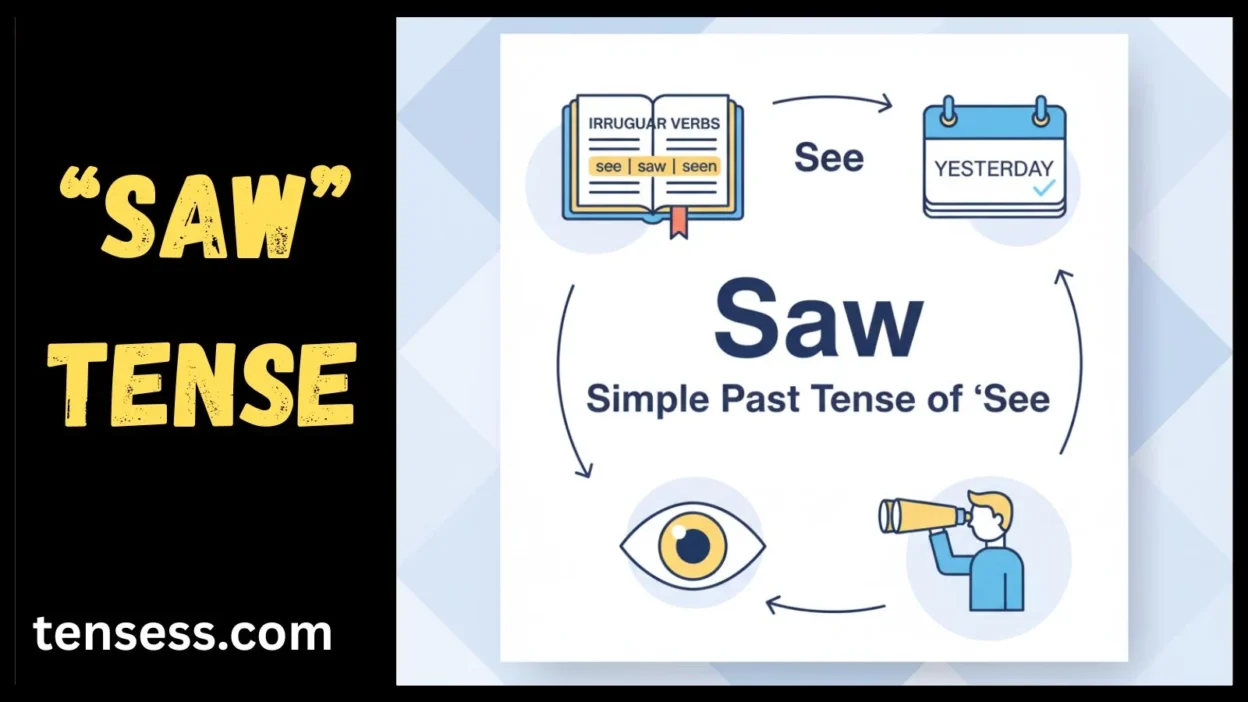
The past tense of see is saw, an irregular verb form used to describe actions or observations that happened in the past. Unlike regular verbs that add “-ed” (e.g., walk → walked), see transforms into saw without following a standard pattern. It’s used to indicate that someone observed, noticed, or witnessed something at a specific time in the past. For example, “I saw a beautiful sunset yesterday” refers to a completed action. Understanding saw is essential for storytelling, describing past events, or reflecting on experiences, making it a must-know for language learners.
How to Recognize the “Saw” Tense?
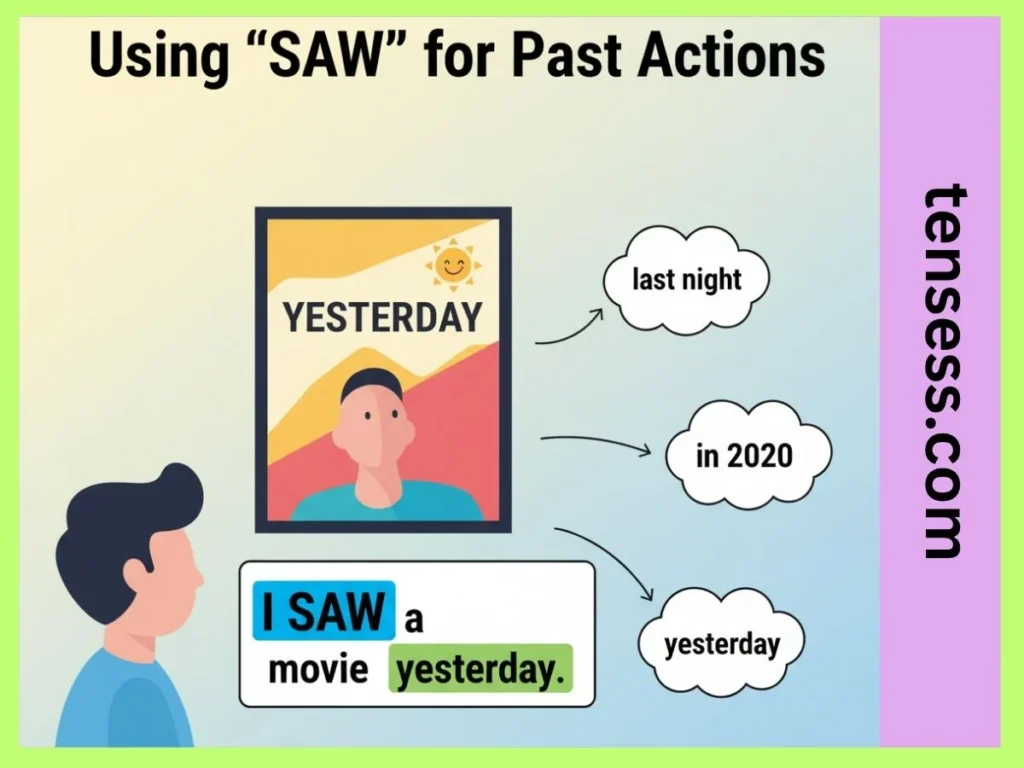
Recognizing saw in a sentence is simple: it’s the verb used when the action of seeing occurred in the past. Look for time markers like “yesterday,” “last week,” or “in 2020” that signal past events. For instance, in “She saw a movie last night,” saw indicates a completed observation. Unlike the present tense (see) or future tense (will see), saw always points to something that already happened. Pay attention to the subject (I, you, he, etc.) and ensure the verb remains saw, as it doesn’t change based on the subject.
Structure of Sentences
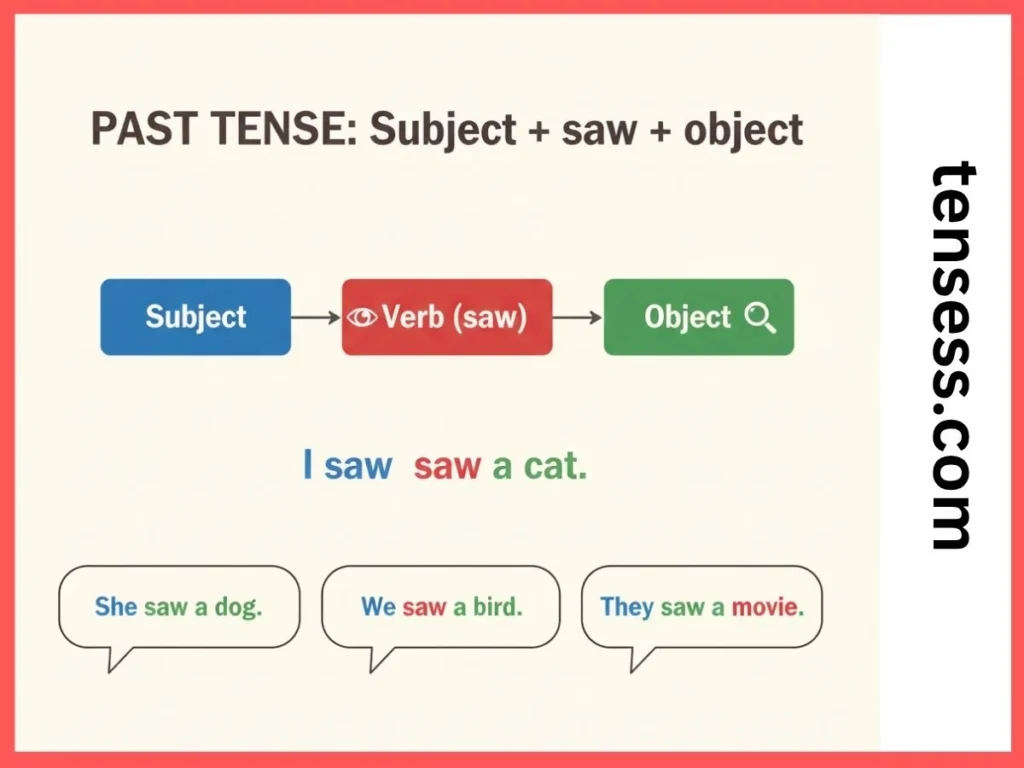
Sentences using saw follow a straightforward structure: Subject + saw + object/complement. For example:
- I saw a bird. (Subject: I, Verb: saw, Object: a bird)
- They saw the concert. (Subject: They, Verb: saw, Object: the concert)
No helping verbs like “have” or “had” are needed for the simple past tense, unlike perfect tenses (e.g., “I have seen”). The structure remains consistent across subjects, making saw easy to use in simple past tense sentences.
Formation
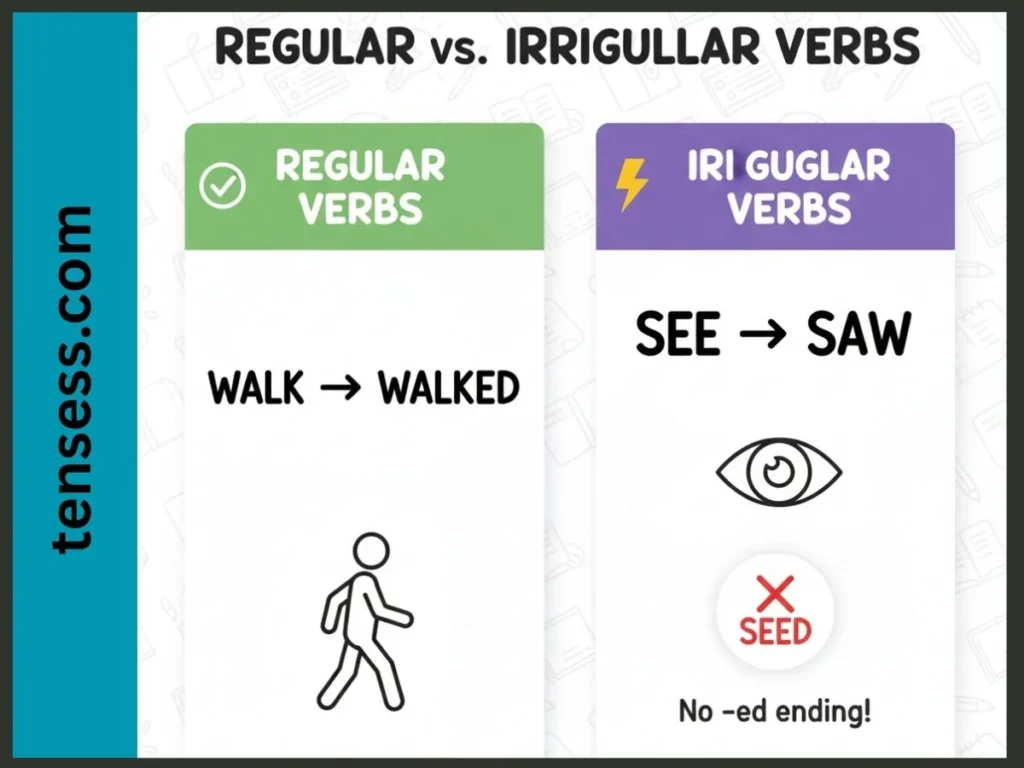
Forming the past tense of see is simple because saw is an irregular verb that doesn’t follow regular conjugation rules. You don’t add suffixes like “-ed.” Instead, replace see with saw for any subject. For example:
- Present: I see a dog.
- Past: I saw a dog.
The key is to memorize that see becomes saw for all subjects (I, you, he, she, it, we, they) in the simple past tense.
Verbs
The verb see is irregular, meaning it doesn’t follow the standard “-ed” ending for past tense. Its forms are:
- Base: see
- Past: saw
- Past Participle: seen (used with helping verbs like “have” in perfect tenses)
No other variations exist for the simple past tense, so saw is the only form to use when describing past observations.
Helping Verbs
The simple past tense of see (saw) doesn’t require helping verbs like “have,” “had,” or “was.” For example:
- Correct: I saw a star. (No helping verb needed)
- Incorrect: I was saw a star.
However, in perfect tenses (e.g., present perfect or past perfect), the past participle seen is used with helping verbs like “have” or “had” (e.g., “I have seen that movie”).
Explanation of Some Verbs with Reference to “Saw”
The verb see belongs to a group of irregular verbs with unique past tense forms. Here are some similar verbs:
- Go → went (e.g., I went to the park.)
- Come → came (e.g., She came to the party.)
- Take → took (e.g., He took a picture.)
Like saw, these verbs change unpredictably in the past tense, requiring memorization. For example, “I saw the show” follows the same irregular pattern as “I went home.”
Table of Some Regular or Irregular Verbs in “Saw” Tense
| Base Verb | Past Tense | Type |
| See | Saw | Irregular |
| Go | Went | Irregular |
| Come | Came | Irregular |
| Take | Took | Irregular |
| Walk | Walked | Regular |
| Talk | Talked | Regular |
| Look | Looked | Regular |
| Run | Ran | Irregular |
| Eat | Ate | Irregular |
| Write | Wrote | Irregular |
Simple Sentence Examples
Here are 10 simple sentence examples using saw:
- I saw a rainbow yesterday.
- You saw the new museum exhibit.
- He saw a deer in the forest.
- She saw her favorite band live.
- It saw its reflection in the water.
- We saw a shooting star last night.
- They saw the parade downtown.
- John saw the accident happen.
- The kids saw a clown at the fair.
- My friend saw a rare bird.
Negative Sentence Examples
To form negative sentences, use didn’t + see (not saw). Here are 10 examples:
- I didn’t see the movie.
- You didn’t see the warning sign.
- He didn’t see the email.
- She didn’t see the sunset.
- It didn’t see the danger.
- We didn’t see the game.
- They didn’t see the fireworks.
- Sarah didn’t see the new store.
- The dog didn’t see the cat.
- My parents didn’t see the play.
Interrogative Sentence Examples
For questions, use Did + subject + see? Here are 10 examples:
- Did I see that right?
- Did you see the news?
- Did he see the car crash?
- Did she see the painting?
- Did it see the shadow?
- Did we see the same movie?
- Did they see the concert?
- Did John see the mistake?
- Did the kids see the magician?
- Did your friend see the bird?
Negative and Interrogative Sentence Examples
Combine negation and questions with Didn’t + subject + see? Here are 10 examples:
- Didn’t I see you at the party?
- Didn’t you see the sign?
- Didn’t he see the email?
- Didn’t she see the show?
- Didn’t it see the danger?
- Didn’t we see that movie before?
- Didn’t they see the parade?
- Didn’t John see the accident?
- Didn’t the kids see the clown?
- Didn’t your friend see the sunset?
How to Conjugate “Saw” Tense
The verb see in the simple past tense is saw for all subjects. No conjugation changes are needed. Here’s how it works for all subjects:
- I saw
- You saw
- He saw
- She saw
- It saw
- We saw
- They saw
- John saw
- The kids saw
- My friends saw
Conjugation Table
| Subject | Past Tense |
| I | Saw |
| You | Saw |
| He | Saw |
| She | Saw |
| It | Saw |
| We | Saw |
| They | Saw |
| John | Saw |
| The kids | Saw |
| My friends | Saw |
Spelling Changes or Irregularities
The verb see is irregular, so it doesn’t follow the “-ed” rule. Its past tense is saw, and its past participle is seen. There are no spelling changes for saw across subjects, making it straightforward. However, learners often confuse saw with seen, which requires a helping verb (e.g., “I have seen” vs. “I saw”).
Sentence Examples with Different Subjects
Here are 15 examples using saw with various subjects:
- I saw a comet last night.
- You saw the new art gallery.
- He saw a bear in the woods.
- She saw a famous actor.
- It saw its owner return.
- We saw the festival fireworks.
- They saw a historic monument.
- John saw a rare coin.
- The kids saw a magic show.
- My friend saw a car race.
- The teacher saw the mistake.
- Anna saw a dolphin swim.
- The team saw the final goal.
- You all saw the eclipse.
- The dog saw the squirrel.
Common Mistakes with “Saw” Tense
Here are 10 common errors and how to avoid them:
- Using seen instead of saw: “I seen it” → Correct: “I saw it.”
- Adding “-ed”: “I seed it” → Correct: “I saw it.”
- Using helping verbs unnecessarily: “I was saw it” → Correct: “I saw it.”
- Mixing tenses: “I saw it tomorrow” → Correct: “I saw it yesterday.”
- Using saw in perfect tenses: “I have saw it” → Correct: “I have seen it.”
- Incorrect negative form: “I not saw it” → Correct: “I didn’t see it.”
- Wrong question form: “Saw you it?” → Correct: “Did you see it?”
- Confusing with synonyms: “I looked it” → Correct: “I saw it.”
- Omitting time markers: “I saw it” (vague) → Correct: “I saw it yesterday.”
- Overusing saw: “I saw it every day” → Correct: “I see it every day.”
Related Verbs and Synonyms for “Saw”
Synonyms for see in the past tense include:
- Observed: I observed the stars.
- Noticed: She noticed the details.
- Witnessed: He witnessed the event.
- Spotted: They spotted a whale.
- Glimpsed: I glimpsed the sunset.
Sentence Comparisons:
- Saw vs. Observed: “I saw the bird” (casual) vs. “I observed the bird’s behavior” (formal).
- Saw vs. Noticed: “She saw the sign” vs. “She noticed the sign’s error.”
Tips to Practice Using “Saw” Tense
- Write a short story using saw at least five times.
- Describe a past event you witnessed using saw.
- Practice forming negative sentences with didn’t see.
- Create 10 questions using Did + see.
- Read a book and highlight instances of saw.
- Use flashcards to memorize irregular verbs like saw.
- Record yourself using saw in sentences.
- Practice with a friend by describing past observations.
- Write a journal entry about what you saw yesterday.
- Use grammar apps to test your use of saw.
Frequently Asked Questions
- What is the past tense of see?
It’s saw for simple past and seen for perfect tenses. - Does saw change with the subject?
No, saw is used for all subjects. - Can I say “I seen it”?
No, use “I saw it” or “I have seen it.” - How do I form a negative sentence with saw?
Use didn’t see, e.g., “I didn’t see it.” - What’s the difference between saw and seen?
Saw is simple past; seen needs a helping verb. - Is see a regular verb?
No, it’s irregular. - How do I ask a question with saw?
Use Did + subject + see, e.g., “Did you see it?” - Can saw be used for future events?
No, use will see for the future. - What are synonyms for saw?
Observed, noticed, witnessed, spotted. - How can I practice saw?
Write sentences, read, or use grammar exercises.
Exercises
- Write five sentences using saw with different subjects.
- Convert: “I see a bird” to past tense.
- Make three negative sentences with didn’t see.
- Create three questions using Did + see.
- Rewrite: “She saw it” as a negative question.
- Fill in: “Yesterday, I ___ a movie.”
- Correct: “I seen the show.”
- Use saw in a sentence about a past vacation.
- Combine saw with a time marker like “last week.”
- Write a paragraph using saw three times.
Quizzes
- What is the past tense of see? (Answer: Saw)
- Correct or incorrect: “I saw it yesterday”? (Correct)
- Fill in: “She ___ the sunset.” (Answer: saw)
- Negative form: “I didn’t ___ it.” (Answer: see)
- Question form: “___ you see it?” (Answer: Did)
- Synonym for saw: ___ (Answer: Observed)
- Correct: “I was saw it”? (Incorrect, use “I saw it”)
- Past participle of see: ___ (Answer: Seen)
- Irregular or regular: see? (Answer: Irregular)
- Time marker example: ___ (Answer: Yesterday)
True or False
- Saw is the past tense of see. (True)
- Saw requires a helping verb. (False)
- Seen can be used alone in simple past. (False)
- “I saw it” is correct. (True)
- “I seed it” is correct. (False)
- Saw changes with the subject. (False)
- “Did you see it?” is correct. (True)
- Saw is used for future events. (False)
- “I didn’t see it” is correct. (True)
- See is a regular verb. (False)
Conclusion
Mastering the past tense of see, saw, is a small but powerful step toward confident English communication. By understanding its structure, conjugation, and common pitfalls, you can use saw to vividly describe past observations, whether in writing or conversation.
This article has provided clear explanations, practical examples, and engaging exercises to help you grasp this irregular verb.
Practice regularly, and soon, using saw will feel second nature.
Try writing a few sentences using saw, share them with a friend, or use a grammar checker to refine your skills.
Keep exploring verb tenses to enhance your language mastery, and don’t hesitate to revisit this guide for a quick refresher!