The ser imperfect tense is a cornerstone of Spanish grammar, essential for describing past habits, ongoing actions, or states of being.
If you’re a student, language learner, writer, or grammar enthusiast, mastering the ser imperfect tense can elevate your Spanish fluency.
This tense, derived from the verb ser (to be), is used to talk about what was happening in the past, often setting the scene for other events.
This beginner-friendly guide, we’ll break down the ser imperfect tense, including its formation, usage, and common pitfalls.
With clear explanations, real-life verb tense examples, and practical exercises, you’ll gain the confidence to use this tense correctly.
Let’s dive into the world of ser imperfect tense and explore how it can make your Spanish conversations more natural and expressive!
What Is the Ser Imperfect Tense?
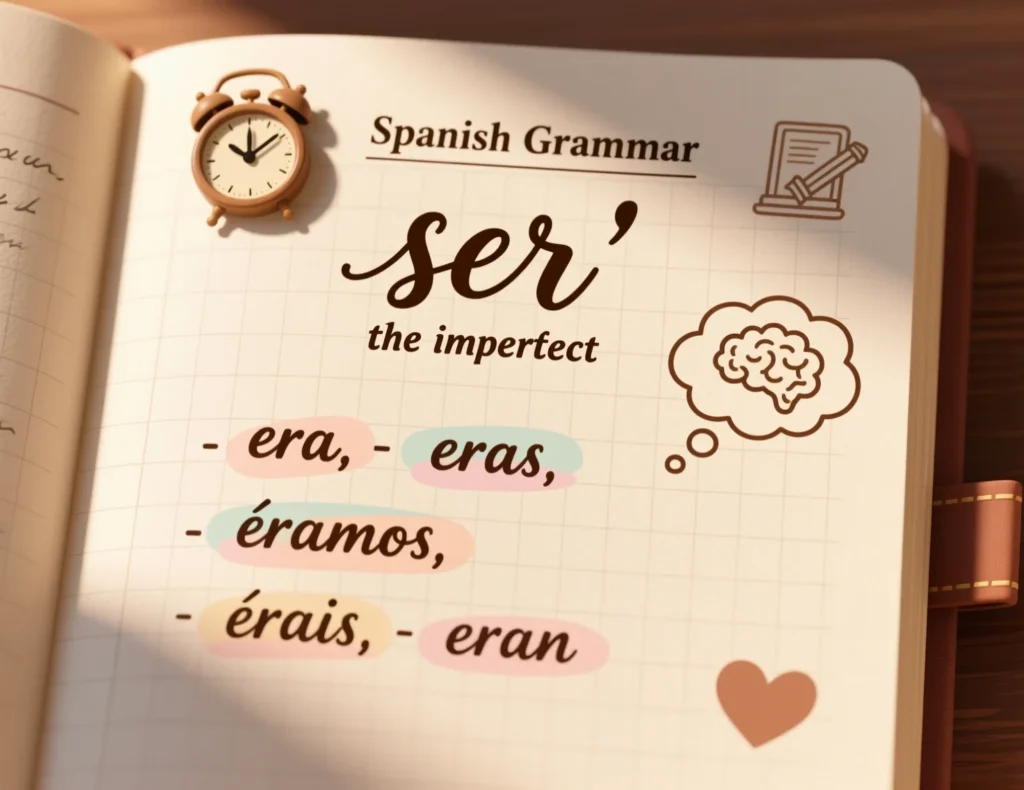
The ser imperfect tense is a past tense in Spanish used to describe ongoing or habitual actions, states, or characteristics that occurred in the past without a specific endpoint. Unlike the preterite, which focuses on completed actions, the ser imperfect tense paints a picture of what was happening over time. For example, it’s used to describe someone’s personality, physical traits, or repeated actions in the past, like “I was being kind” or “She was always happy.” It’s one of two Spanish verbs for “to be” (ser vs. estar), and ser focuses on permanent traits, identity, or time-related expressions. Understanding how to use ser imperfect tense correctly is key for storytelling and describing past scenarios.
How to Recognize the Ser Imperfect Tense?
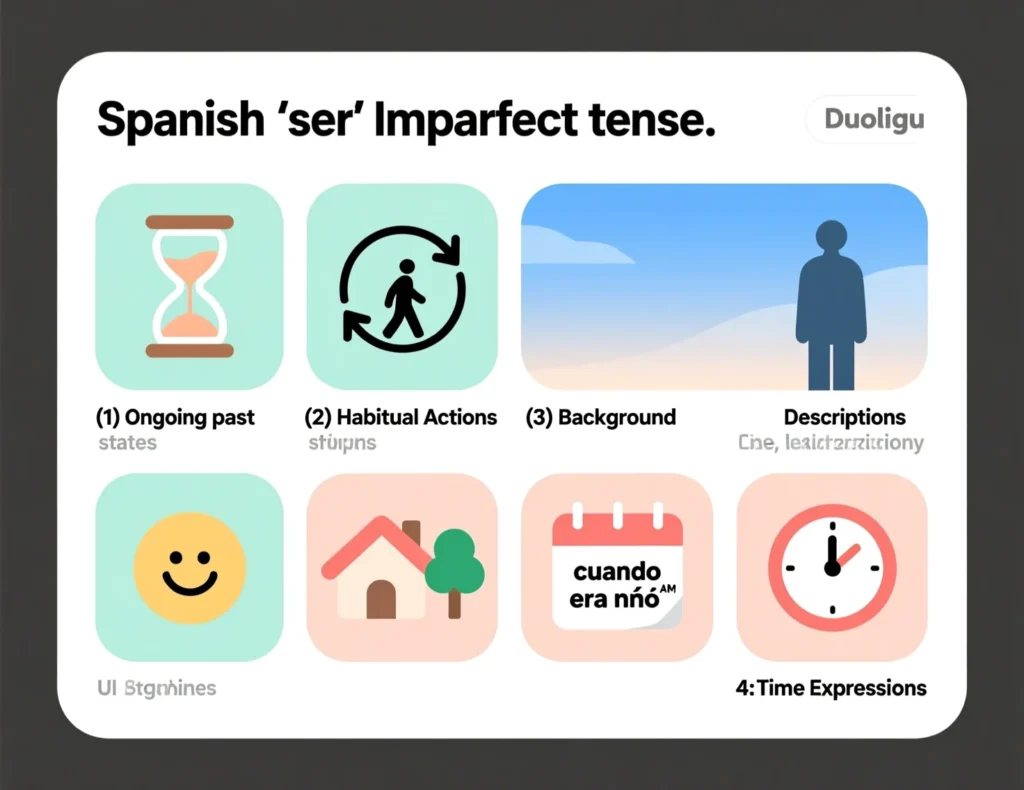
Recognizing the ser imperfect tense is straightforward once you know its patterns. Look for:
- Descriptions of ongoing past states: Sentences like “Ella era amable” (She was kind) describe a continuous state.
- Habitual actions: Phrases like “Siempre éramos puntuales” (We were always punctual) indicate repeated past actions.
- Background information: It sets the scene, e.g., “Era un día soleado” (It was a sunny day).
- Time or age expressions: “Eran las cinco” (It was five o’clock) or “Yo era joven” (I was young).
- No specific endpoint: Unlike the preterite, the ser imperfect tense doesn’t imply the action stopped.
Structure of Sentence
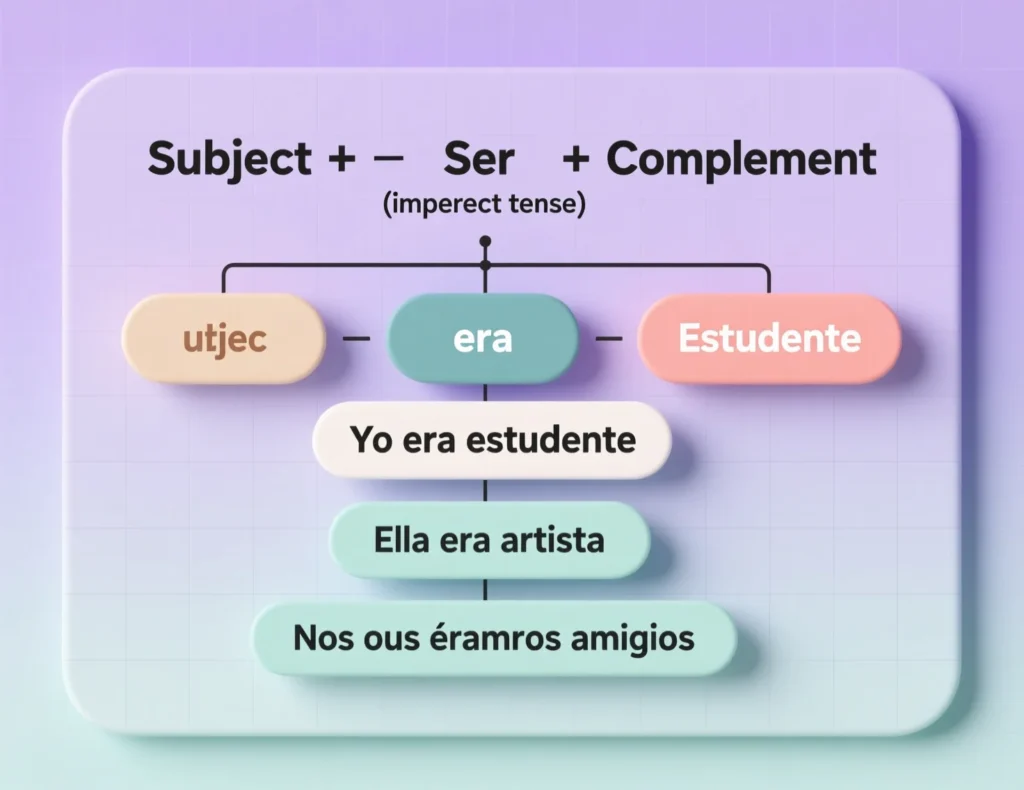
The ser imperfect tense follows a simple sentence structure: Subject + conjugated ser verb + complement. For example:
- Yo era estudiante. (I was a student.)
- Ellos eran altos. (They were tall.)
The verb ser is conjugated based on the subject, and the complement describes the state, characteristic, or time. This structure is consistent across affirmative, negative, and interrogative sentences, making it easy to apply.
Formation
Forming the ser imperfect tense is unique because ser is an irregular verb, and its conjugations don’t follow the standard patterns of regular verbs. To form it, you start with the stem and add specific endings. However, for ser, the entire conjugation is irregular and must be memorized.
Verbs
The verb ser is the focus here, but it’s worth noting that ser is one of two “to be” verbs in Spanish (the other being estar). In the ser imperfect tense, ser is used for:
- Identity: “Ella era médica” (She was a doctor).
- Characteristics: “El coche era rojo” (The car was red).
- Time: “Era medianoche” (It was midnight).
- Origin: “Éramos de México” (We were from Mexico).
Other verbs in the imperfect tense (like comer or vivir) follow different patterns, but ser is distinct due to its irregularity.
Helping Verbs
The ser imperfect tense doesn’t typically use helping verbs like auxiliary verbs in English (e.g., “was” in “was running”). In Spanish, ser itself carries the tense and meaning. However, in complex sentences, it might pair with other verbs in different tenses to set the scene, e.g., “Era feliz cuando llegaste” (I was happy when you arrived), where llegaste is preterite.
Explanation of Some Verbs with Reference to Ser Imperfect Tense
The ser imperfect tense is often used alongside other verbs to provide context. For example:
- Ser + adjective: Describes ongoing traits, e.g., “Era inteligente” (He was intelligent).
- Ser + noun: Indicates identity or profession, e.g., “Éramos estudiantes” (We were students).
- Ser + time: Sets the time, e.g., “Eran las tres” (It was three o’clock).
Unlike estar, which describes temporary states, ser focuses on inherent or long-term qualities. For example, “Era cansado” (He was tired, permanently) vs. “Estaba cansado” (He was tired, temporarily).
Table of Some Regular or Irregular Verbs in Ser Imperfect Tense
Since ser is irregular, its imperfect tense doesn’t follow regular patterns like -ar, -er, or -ir verbs. Below is a table comparing ser with a regular verb (hablar) for reference:
| Subject | Ser (Imperfect) | Hablar (Regular -ar) |
| Yo | era | hablaba |
| Tú | eras | hablabas |
| Él/Ella | era | hablaba |
| Nosotros | éramos | hablábamos |
| Vosotros | erais | hablabais |
| Ellos | eran | hablaban |
Simple Sentence Examples
Here are 10 verb tense examples using the ser imperfect tense:
- Yo era estudiante en 2020. (I was a student in 2020.)
- Tú eras muy amable con todos. (You were very kind to everyone.)
- Él era un gran profesor. (He was a great teacher.)
- Ella era alta y delgada. (She was tall and slim.)
- It era un día lluvioso. (It was a rainy day.)
- Nosotros éramos de España. (We were from Spain.)
- Vosotros erais los mejores amigos. (You all were the best friends.)
- Ellos eran ingenieros. (They were engineers.)
- La casa era grande. (The house was big.)
- Las fiestas eran divertidas. (The parties were fun.)
Negative Sentence Examples
Here are 10 negative ser imperfect tense examples:
- Yo no era médico. (I wasn’t a doctor.)
- Tú no eras tímido. (You weren’t shy.)
- Él no era perezoso. (He wasn’t lazy.)
- Ella no era de aquí. (She wasn’t from here.)
- It no era soleado. (It wasn’t sunny.)
- Nosotros no éramos ricos. (We weren’t rich.)
- Vosotros no erais puntuales. (You all weren’t punctual.)
- Ellos no eran hermanos. (They weren’t brothers.)
- La comida no era sabrosa. (The food wasn’t tasty.)
- Las clases no eran aburridas. (The classes weren’t boring.)
Interrogative Sentence Examples
Here are 10 interrogative ser imperfect tense examples:
- ¿Era yo famoso? (Was I famous?)
- ¿Eras tú el líder? (Were you the leader?)
- ¿Era él alto? (Was he tall?)
- ¿Era ella doctora? (Was she a doctor?)
- ¿Era un día especial? (Was it a special day?)
- ¿Éramos nosotros los ganadores? (Were we the winners?)
- ¿Erais vosotros de Francia? (Were you all from France?)
- ¿Eran ellos artistas? (Were they artists?)
- ¿Era la casa bonita? (Was the house pretty?)
- ¿Eran las noches frías? (Were the nights cold?)
Negative and Interrogative Sentence Examples
Here are 10 negative interrogative ser imperfect tense examples:
- ¿No era yo suficiente? (Wasn’t I enough?)
- ¿No eras tú el jefe? (Weren’t you the boss?)
- ¿No era él amable? (Wasn’t he kind?)
- ¿No era ella ingeniera? (Wasn’t she an engineer?)
- ¿No era un día cálido? (Wasn’t it a warm day?)
- ¿No éramos nosotros amigos? (Weren’t we friends?)
- ¿No erais vosotros estudiantes? (Weren’t you all students?)
- ¿No eran ellos felices? (Weren’t they happy?)
- ¿No era la película interesante? (Wasn’t the movie interesting?)
- ¿No eran las flores hermosas? (Weren’t the flowers beautiful?)
How to Conjugate Ser Imperfect Tense
Conjugating the ser imperfect tense is simple because it follows a fixed, irregular pattern. Here’s how:
- Start with the verb ser.
- Use the irregular conjugations (no stem, just memorize).
- Match the conjugation to the subject pronoun.
- No stem changes or spelling adjustments are needed.
- Apply the same endings for affirmative, negative, or interrogative sentences.
- Use era for singular subjects (yo, él, ella, usted).
- Use éramos for nosotros.
- Use erais for vosotros.
- Use eran for plural subjects (ellos, ellas, ustedes).
- Practice regularly to memorize the forms.
Conjugation Table
Here’s the conjugation table for ser imperfect tense:
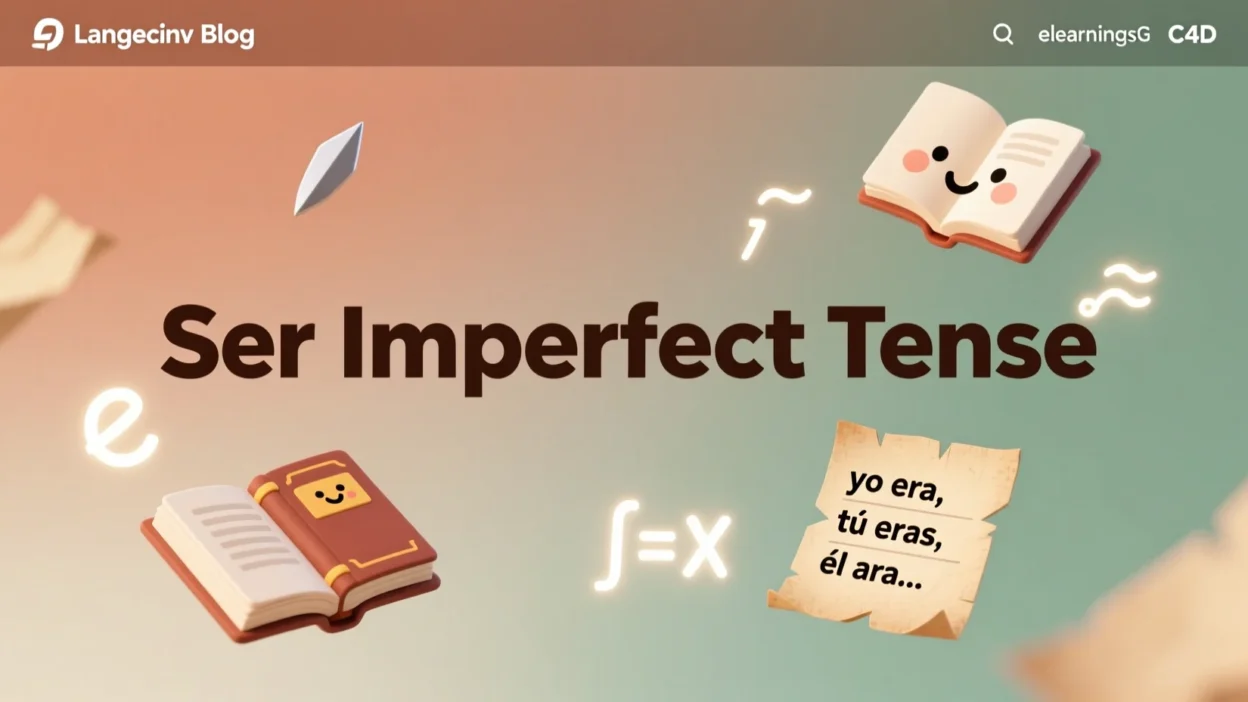
| Subject | Conjugation |
| Yo | era |
| Tú | eras |
| Él/Ella/Usted | era |
| Nosotros | éramos |
| Vosotros | erais |
| Ellos/Ellas/Ustedes | eran |
Spelling Changes or Irregularities
The ser imperfect tense is fully irregular, meaning it doesn’t follow the standard -ar, -er, or -ir verb patterns. There are no spelling changes within its conjugations, but you must memorize the unique forms (era, eras, éramos, erais, eran). Unlike regular verbs, ser doesn’t use a stem or predictable endings, making it an exception to typical imperfect tense rules.
Sentence Examples
Here are 15 verb tense examples with different subjects:
- Yo era un niño curioso. (I was a curious child.)
- Tú eras muy generoso. (You were very generous.)
- Él era músico profesional. (He was a professional musician.)
- Ella era una gran escritora. (She was a great writer.)
- El perro era leal. (The dog was loyal.)
- Nosotros éramos compañeros de clase. (We were classmates.)
- Vosotros erais los más rápidos. (You all were the fastest.)
- Ellos eran de Argentina. (They were from Argentina.)
- Las flores eran coloridas. (The flowers were colorful.)
- Usted era mi vecino. (You were my neighbor.)
- La ciudad era tranquila. (The city was quiet.)
- Mis padres eran estrictos. (My parents were strict.)
- El cielo era azul. (The sky was blue.)
- Las clases eran largas. (The classes were long.)
- Todo era perfecto. (Everything was perfect.)
Common Mistakes with Ser Imperfect Tense
Here are 10 common errors and how to avoid them:
- Confusing ser with estar: Use ser for permanent traits, not temporary states. E.g., “Era feliz” (permanent) vs. “Estaba feliz” (temporary).
- Using preterite instead: Don’t use fui for ongoing actions. E.g., “Era joven” (correct) vs. “Fui joven” (implies you’re no longer young).
- Incorrect conjugation: Memorize era, eras, éramos, erais, eran to avoid errors like estaba.
- Forgetting accents: Ensure éramos has the correct accent on the “á.”
- Overusing ser: Avoid using ser for location or temporary conditions (use estar).
- Wrong subject agreement: Match the verb to the subject, e.g., “Ellos eran” (not era).
- Misplacing negatives: Place no before the verb, e.g., “No era feliz.”
- Ignoring context: Use ser imperfect tense for background, not completed actions.
- Mixing tenses: Don’t combine imperfect and preterite incorrectly, e.g., “Era feliz y comí” is fine, but check context.
- Not practicing: Regular practice prevents forgetting the irregular forms.
Related Verbs and Synonyms for Ser Imperfect Tense
The ser imperfect tense is unique, but it’s often confused with:
- Estar imperfect tense: Estaba, estabas, etc., used for temporary states or locations.
- Parecer (to seem): “Parecía feliz” (It seemed happy) vs. “Era feliz” (It was happy).
- Sentirse (to feel): “Se sentía bien” (He felt good) vs. “Era bueno” (He was good).
Sentence comparisons: - Ser: “Ella era enfermera” (She was a nurse, identity).
- Estar: “Ella estaba enferma” (She was sick, temporary).
- Parecer: “Parecía enferma” (She seemed sick).
Tips to Practice Using Ser Imperfect Tense
- Write a daily journal describing past habits using ser imperfect tense.
- Narrate childhood memories with era, eras, éramos.
- Create flashcards for ser conjugations.
- Read Spanish stories and highlight ser imperfect tense examples.
- Practice with a language partner, describing past events.
- Use apps like Duolingo for verb conjugation drills.
- Watch Spanish movies and note ser imperfect tense usage.
- Translate English “was/were” sentences into Spanish.
- Join online forums to discuss past experiences in Spanish.
- Take the quizzes and exercises below to test your skills.
Frequently Asked Questions
- What’s the difference between ser and estar in the imperfect? Ser describes permanent traits; estar describes temporary states.
- When do I use ser imperfect tense? For ongoing past states, habits, or descriptions.
- Is ser irregular in the imperfect? Yes, it has unique forms like era, éramos.
- Can ser imperfect describe time? Yes, e.g., “Eran las diez” (It was ten o’clock).
- How do I know if it’s imperfect or preterite? Imperfect is ongoing; preterite is completed.
- Are there spelling changes in ser imperfect? No, just memorize the forms.
- Can ser imperfect be negative? Yes, e.g., “No era feliz.”
- Is ser used for location? No, use estar for location.
- How do I practice ser imperfect? Write sentences and use exercises below.
- Why is éramos accented? To stress the correct syllable.
Exercises
- Conjugate ser for “nosotros” in the imperfect tense.
- Write a sentence using era with “yo.”
- Make a negative sentence with “ellos.”
- Create an interrogative sentence with “tú.”
- Describe a past habit using éramos.
- Translate: “She was a teacher.”
- Correct: “Yo era en la escuela” (hint: wrong verb).
- Write a sentence about a past time using eran.
- Combine era with an adjective for “ella.”
- Describe your childhood using ser imperfect tense.
Quizzes
- What is the conjugation of ser for “tú”? (A) era (B) eras (C) éramos
- Which is correct? (A) Era feliz (B) Fui feliz (C) Estaba feliz
- What does “Éramos amigos” mean? (A) We are friends (B) We were friends (C) We will be friends
- Fill in: “No ___ estudiante.” (A) era (B) fui (C) estaba
- True or False: Ser is used for temporary states.
- Conjugate ser for “ellos.”
- Which tense is “Era un día soleado”? (A) Preterite (B) Imperfect (C) Present
- Correct the mistake: “Ellos era altos.”
- Translate: “Were you happy?”
- Choose: “___ las cinco.” (A) Era (B) Fui (C) Estaban
True or False
- The ser imperfect tense describes completed actions. (False)
- Era is used for “yo” and “él.” (True)
- Ser is regular in the imperfect tense. (False)
- “No éramos ricos” is a correct negative sentence. (True)
- Ser is used for temporary states. (False)
- “¿Eras tú el jefe?” is interrogative. (True)
- The imperfect tense sets the scene in storytelling. (True)
- Éramos needs an accent on the “á.” (True)
- Ser can describe time, like “Eran las dos.” (True)
- You need helping verbs for ser imperfect tense. (False)
Conclusion
Mastering the ser imperfect tense is a game-changer for Spanish learners, allowing you to describe past habits, characteristics, and settings with ease.
By understanding its unique conjugations, recognizing when to use ser over estar, and practicing with real-life examples, you’ll soon use this tense naturally.
Avoid common mistakes like confusing ser with estar or misusing the preterite, and try the exercises and quizzes above to solidify your skills.
Keep practicing with daily sentences, conversations, or a grammar checker to refine your fluency.
Ready to take your Spanish to the next level? Start using the ser imperfect tense in your next conversation or writing, and watch your confidence soar!
Share your progress in the comments or try a grammar tool for instant feedback.