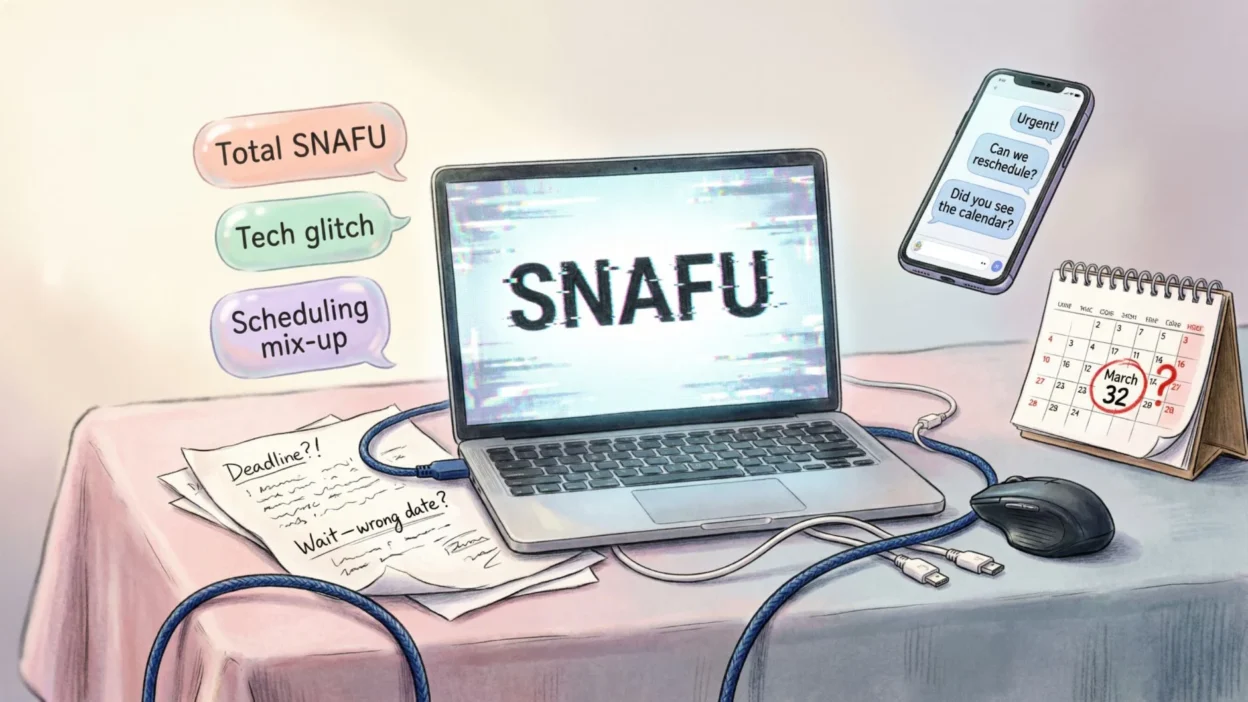
SNAFU in text means a messy situation, mistake, or problem that happened because of confusion or poor organization. People use it casually in chats to describe everyday mix-ups, tech issues, or awkward moments.
You’ll often see this term in group chats, workplace messages, gaming threads, or social media comments. It isn’t new slang, but it has made a quiet comeback online.
Many people search for it because they saw it in a message and weren’t sure whether it was an insult, a joke, or an acronym. The meaning can shift slightly depending on tone.
Here’s exactly what SNAFU means in text, how people use it across platforms, and how you should reply when someone says it to you.
SNAFU Meaning in Text Explained Clearly
The SNAFU meaning in text refers to a situation that has gone wrong, usually due to miscommunication, disorganization, or an unexpected mistake.
Originally, SNAFU is an acronym that stands for “Situation Normal: All Fouled Up.” It began as military slang during World War II, where soldiers used it humorously to describe chaotic conditions.
Today, the slang meaning is lighter. It simply means:
- A mess-up
- A scheduling mistake
- A tech glitch
- A misunderstanding
- A small crisis
When someone says, “That meeting was a total SNAFU,” they mean it was disorganized or confusing.
What Does SNAFU Mean in Chat?
In chat conversations, SNAFU usually means something went wrong — but in a calm, sometimes sarcastic way.
It’s not aggressive. It’s more like saying:
- “What a mess.”
- “That didn’t go as planned.”
- “Everything got mixed up.”
Example:
A: Why did the file get deleted?
B: Total SNAFU. IT restored the wrong backup.
A: Wow. Classic.
Is SNAFU an Acronym, Slang, or Meme?
SNAFU is:
- Originally an acronym
- Now used as modern slang
- Not a meme-based term
- Not a typing shortcut like “idk”
- Not phonetic spelling
It functions as a noun in most sentences.
SNAFU Meaning on Snapchat
On Snapchat, SNAFU is usually used in private chats or group snaps.
It often describes:
- Missed meetups
- Story misunderstandings
- Wrong screenshots
- Plans gone wrong
Tone: Casual, slightly humorous.
Example:
A: You sent that snap to the wrong person 😭
B: Total SNAFU. I meant to send it to you.
SNAFU Meaning on TikTok
On TikTok, SNAFU appears in captions or comments when something chaotic happens.
Examples include:
- “My morning routine was a SNAFU.”
- “Group project = SNAFU.”
Tone: Often sarcastic or dramatic.
It’s not as common as trending slang, but older internet users and professionals sometimes use it in comment sections.
SNAFU Meaning on Instagram
On Instagram, SNAFU is used in:
- Story captions
- Work-related posts
- Business humor content
Example:
“Tech SNAFU delayed today’s launch.”
Tone: Slightly more mature compared to TikTok.
SNAFU Meaning on WhatsApp
On WhatsApp, SNAFU appears mostly in work chats or family group chats.
Example:
A: Why is the Zoom link not working?
B: Scheduling SNAFU. I’ll resend.
Tone: Neutral to mildly serious.
SNAFU Meaning in SMS Texting
In SMS, the tone depends heavily on context.
Example:
“Sorry about yesterday. Total SNAFU on my end.”
Here it functions almost like an apology without directly saying sorry.
SNAFU Tone & Context Variations
1. Funny Tone
Used jokingly.
A: You locked your keys in the car again?
B: Yep. Daily SNAFU.
A: At least you’re consistent.
2. Sarcastic Tone
Used when something predictably goes wrong.
A: The printer broke before the deadline.
B: Another office SNAFU.
A: Of course it did.
3. Romantic Tone
Rare, but possible.
A: I forgot our anniversary dinner reservation.
B: That’s a serious SNAFU.
A: I’m fixing it right now.
4. Angry Tone
Can sound critical.
A: Why wasn’t this submitted?
B: There was a SNAFU with approvals.
A: That shouldn’t happen again.
5. Playful Tone
Light-hearted use.
A: We showed up at the wrong theater.
B: Date night SNAFU.
A: At least we’re together.
15 Real Chat Examples of SNAFU
- “Yesterday’s event was a SNAFU from start to finish.”
- “Sorry, scheduling SNAFU.”
- “Tech SNAFU delayed the upload.”
- “It’s a payment SNAFU.”
- “Minor SNAFU, nothing serious.”
- “Total group project SNAFU.”
- “Airport SNAFU ruined the trip.”
- “Communication SNAFU.”
- “That was a management SNAFU.”
- “Logistics SNAFU again.”
- “Calendar SNAFU.”
- “Delivery SNAFU.”
- “Password reset SNAFU.”
- “Wedding planning SNAFU.”
- “Classic Monday SNAFU.”
Grammar & Language Role of SNAFU
Part of Speech
- Primarily a noun
- Sometimes used as a verb informally (“We snafued the plan” — rare)
Sentence Role
Usually appears:
- After “a” or “the”
- As the object of a sentence
Example:
“That was a SNAFU.”
Does It Replace a Full Sentence?
Sometimes.
Instead of saying, “Everything went wrong,” someone might just write:
“SNAFU.”
Formal vs Informal Usage
- Informal: Very common
- Professional casual: Acceptable
- Academic writing: Not recommended
Tone impact: Slightly humorous, mildly critical.
How to Reply When Someone Says “SNAFU”
Funny Replies
- “At least it wasn’t a disaster.”
- “Add it to the chaos list.”
- “Plot twist of the day.”
Serious Replies
- “What happened exactly?”
- “How can we fix it?”
- “Let’s correct it quickly.”
Flirty Replies
- “Guess we need a redo date.”
- “I’ll rescue you from the SNAFU.”
- “Our love survives all SNAFUs.”
Neutral Replies
- “Got it.”
- “Thanks for the update.”
- “Let me know if you need help.”
Is SNAFU Rude or Bad?
Is SNAFU rude?
Not typically. It’s mild slang.
Is it disrespectful?
Only if used to blame someone directly.
Is it a bad word?
The original acronym includes mild profanity. However, most people today don’t think about that part.
Can you use it in school?
Yes, in casual conversation.
Can you use it at work?
Yes, especially in informal team communication.
Who Uses This Term?
- Millennials
- Gen X
- Some Gen Z users
- Professionals in tech or corporate fields
Most common in:
- US
- UK
- English-speaking internet spaces
It’s less common among very young TikTok users.
Origin & Internet Culture
SNAFU started as military slang during World War II.
Soldiers used it humorously to cope with chaotic systems and bureaucracy.
Over time, it entered mainstream English and later online chat culture.
It resurfaced in digital communication because:
- It’s short
- It sounds expressive
- It captures frustration without sounding aggressive
Comparison Table: SNAFU vs Similar Slang
| Term | Meaning | Formal/Informal | Tone | Popularity | Confusion Risk |
|---|---|---|---|---|---|
| SNAFU | Situation went wrong | Informal | Humorous/Neutral | Moderate | Medium |
| idk | I don’t know | Informal | Neutral | Very High | Low |
| ion | I don’t | Very informal | Casual | Medium | High |
| dunno | Don’t know | Informal | Relaxed | High | Low |
| idc | I don’t care | Informal | Blunt | Very High | Low |
Real-World Insight
In real chats, SNAFU is often used by people who want to acknowledge a mistake without escalating drama.
Instead of saying “This is a disaster,” they say “It’s a SNAFU.”
It softens tension.
It sounds responsible but calm.
That’s why it remains useful in professional texting.
Frequently Asked Questions About SNAFU
What Does SNAFU Mean in Text Messages and Online Chat?
It means a messy or confused situation, usually caused by miscommunication or poor planning.
What Does SNAFU Mean on Snapchat and TikTok?
On Snapchat, it refers to personal mix-ups.
On TikTok, it’s often used sarcastically in captions about chaotic moments.
Is SNAFU Rude, Disrespectful, or Harmless Slang?
It’s generally harmless. Tone determines whether it feels critical.
How Should You Reply When Someone Says “SNAFU”?
You can respond seriously, humorously, or supportively depending on context.
Is SNAFU the Same as IDK or Different?
No. IDK means “I don’t know.”
SNAFU means “a situation went wrong.”
Can You Use SNAFU in School or Work?
Yes, in casual communication. Avoid it in formal documents.
Final Summary: When to Use and When to Avoid SNAFU
Use SNAFU when:
- Plans go wrong
- There’s confusion
- You want a calm tone
- You’re texting casually
Avoid SNAFU when:
- Writing academic essays
- Speaking formally
- Communicating with someone unfamiliar with slang
Common mistake:
Thinking it means “I don’t know.” It doesn’t.
SNAFU is about situations, not uncertainty.
Used correctly, it adds humor and clarity to everyday messaging.