The Spanish conditional tense is a vital tool for anyone learning Spanish.
It’s used to express what would happen under certain conditions, making it perfect for polite requests, hypothetical scenarios, or future possibilities from a past perspective.
If you’re a student, language learner, writer, or grammar enthusiast, mastering this tense will enhance your fluency and confidence in Spanish.
This beginner-friendly guide breaks down the Spanish conditional tense, offering clear explanations, real-life examples, and practical tips to help you use it correctly.
By the end, you’ll understand how to form and use this tense, avoid common mistakes, and practice effectively. Let’s dive into the world of Spanish verb conjugation and explore the conditional tense!
What Is the Spanish Conditional Tense?
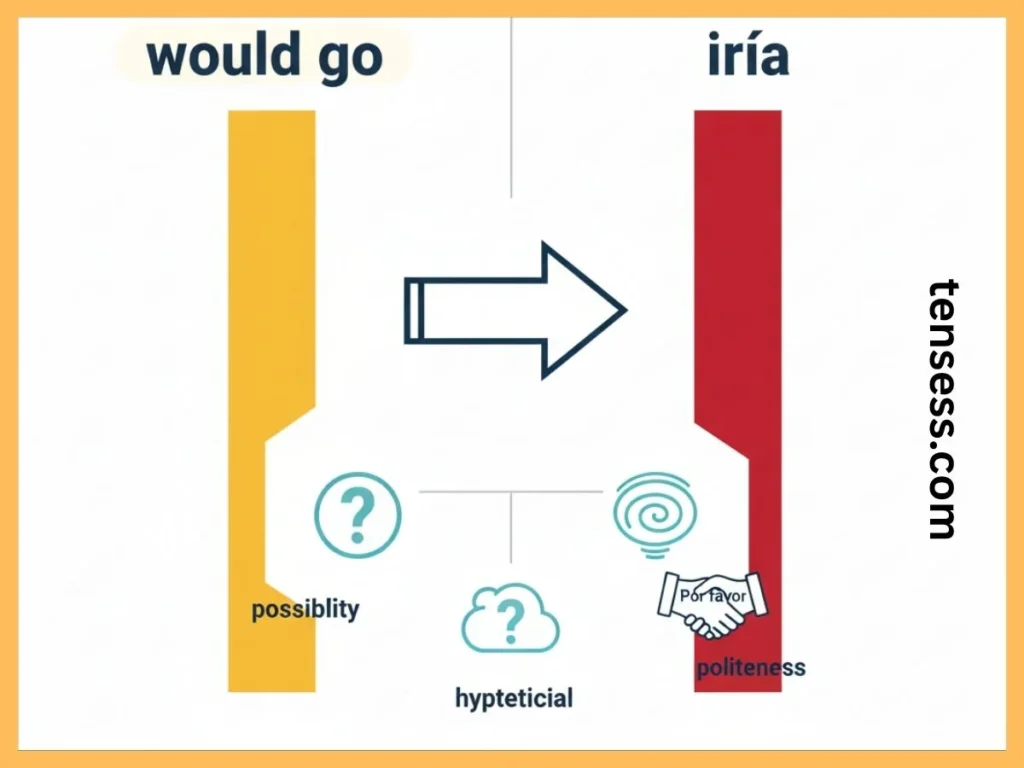
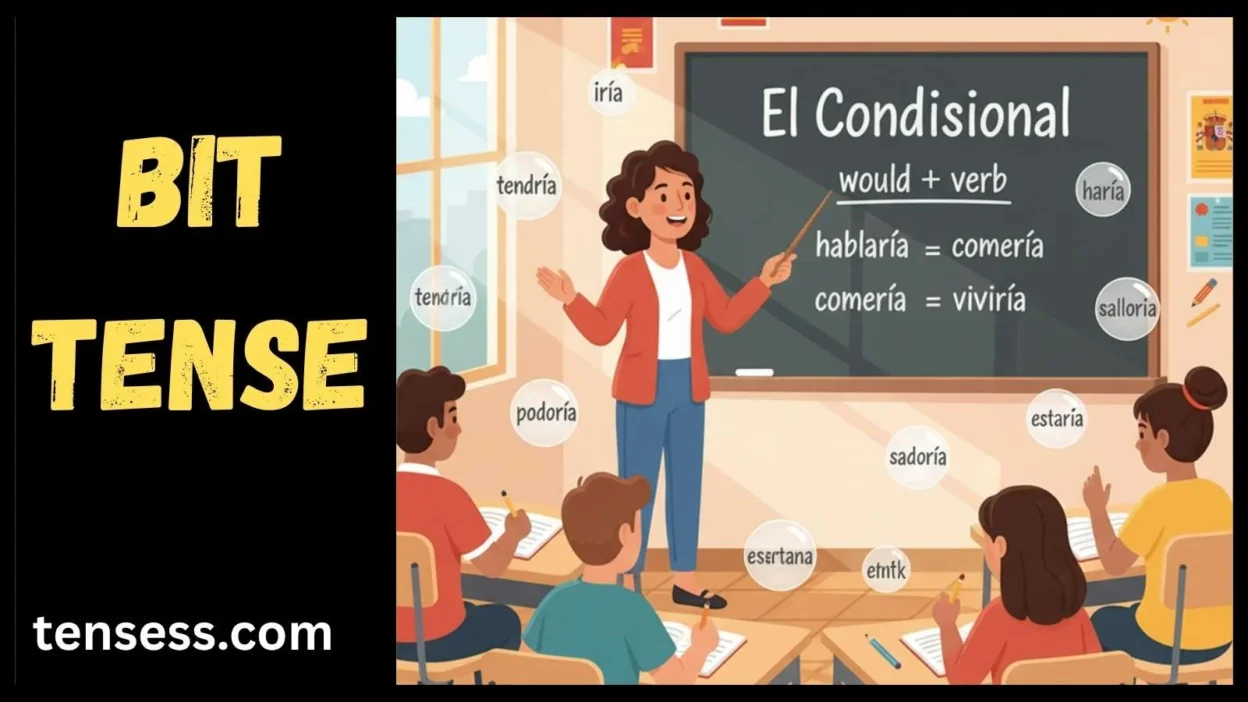
The Spanish conditional tense (el condicional) expresses actions that would happen under specific circumstances. It’s often used for hypothetical situations, polite requests, or to describe future actions from a past viewpoint. For example, “I would go” translates to “Yo iría.” It’s equivalent to the English “would + verb.” This tense is essential for expressing possibilities, desires, or speculation, making it a cornerstone of conversational Spanish.
How to Recognize the Spanish Conditional Tense?
You can spot the Spanish conditional tense by its unique endings, such as -ía, -ías, -íamos, or -ían. These endings are added to the infinitive form of the verb. For instance, in “Ella comería” (She would eat), the ending -ía signals the conditional tense. Look for these endings in sentences discussing hypothetical or polite scenarios, like “Si tuviera tiempo, viajaría” (If I had time, I would travel).
Structure of a Sentence in the Spanish Conditional Tense
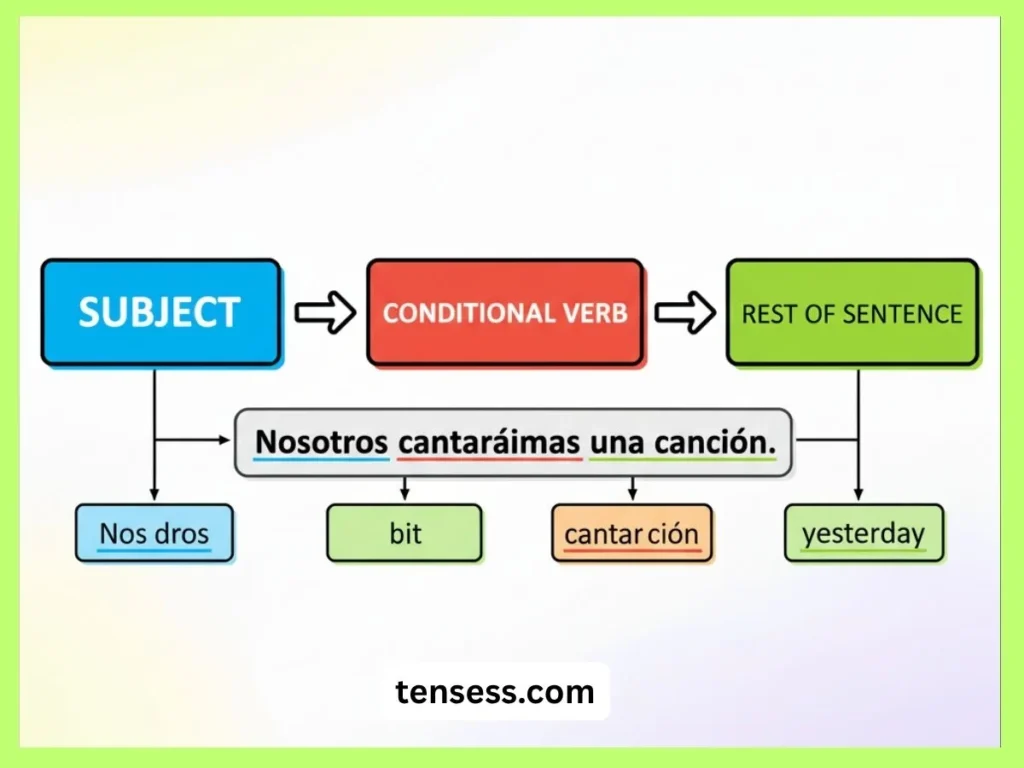
A typical sentence in the Spanish conditional tense follows this structure:
- Subject + conjugated verb in conditional tense + rest of the sentence.
For example: “Nosotros cantaríamos una canción” (We would sing a song). The conjugated verb always carries the conditional endings, and the sentence often includes a condition or context, though it’s not always explicit.
Formation of the Spanish Conditional Tense
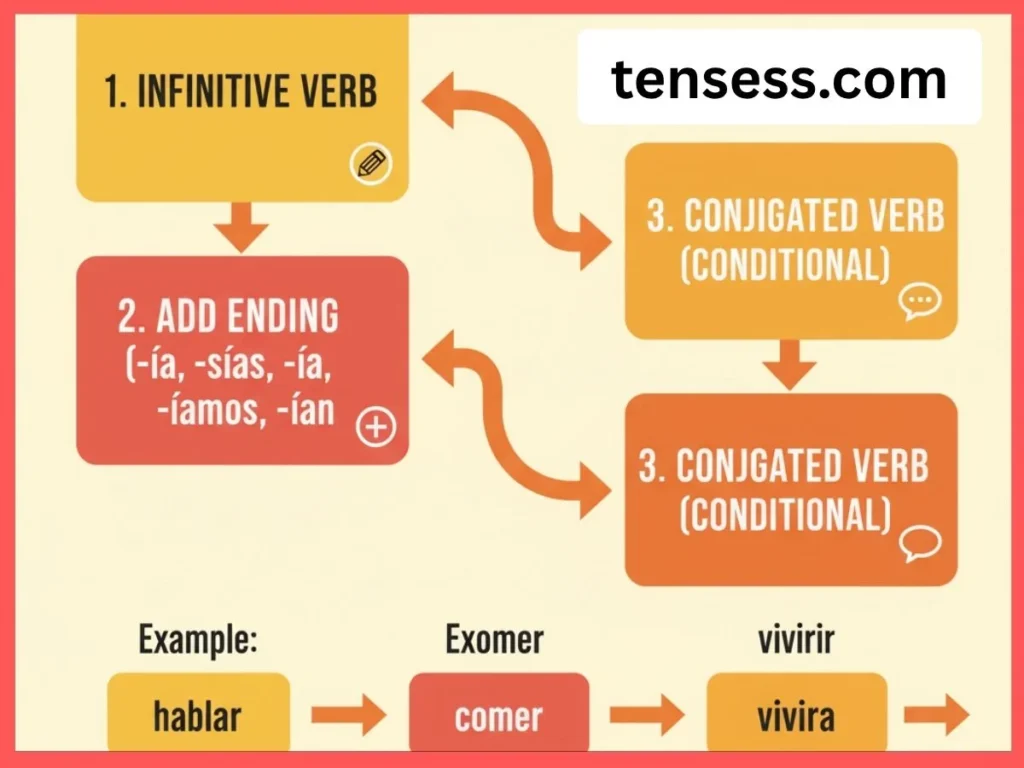
To form the Spanish conditional tense, take the full infinitive of the verb (e.g., hablar, comer, vivir) and add the appropriate endings: -ía, -ías, -ía, -íamos, -íais, -ían. Unlike other tenses, the conditional doesn’t require a stem change for regular verbs. For example:
- Hablar → Hablaría (I would speak)
- Comer → Comería (I would eat)
- Vivir → Viviría (I would live)
Verbs in the Spanish Conditional Tense
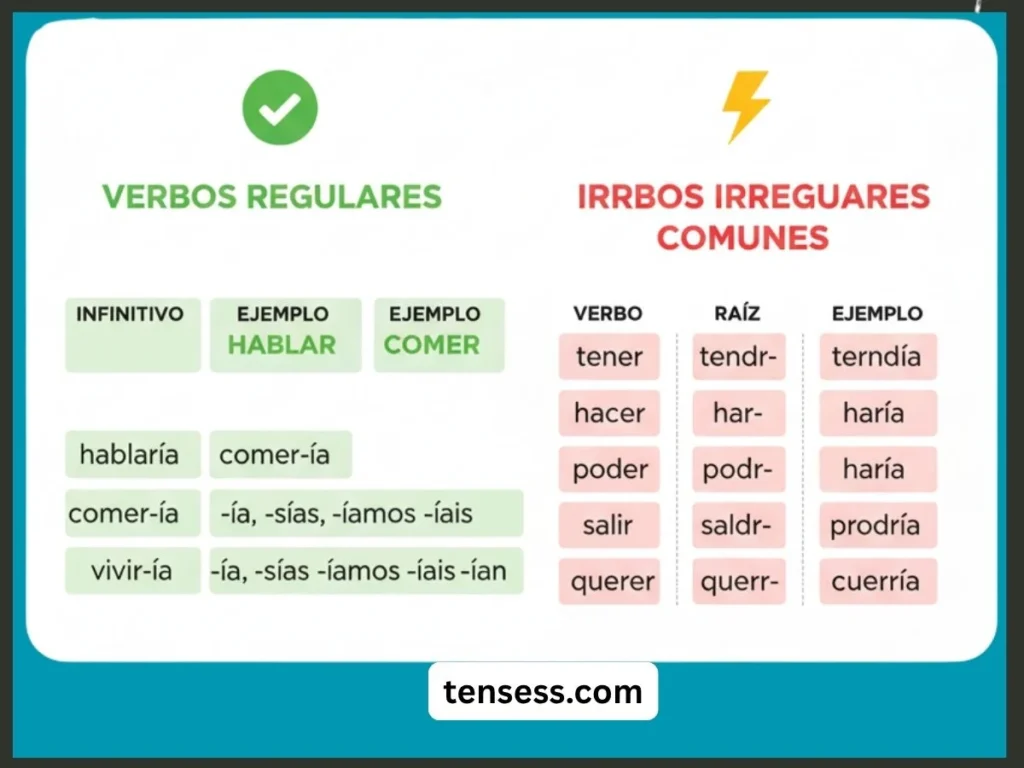
The Spanish conditional tense works with all verb types: -ar, -er, and -ir verbs. Regular verbs follow the standard formation pattern, while irregular verbs have unique stems but use the same endings. Common verbs like ser (to be), tener (to have), or hacer (to do) have irregular stems but are frequently used in this tense.
Helping Verbs in the Spanish Conditional Tense
The Spanish conditional tense doesn’t rely on auxiliary verbs like “would” in English. Instead, the conditional endings directly convey the “would” meaning. However, modal verbs like poder (would be able to) or querer (would want) are often used to add nuance. For example: “Podría ayudarte” (I would be able to help you).
Explanation of Some Verbs in the Spanish Conditional Tense
Here’s how key verbs behave in the Spanish conditional tense:
- Ser (to be): Stem changes to ser-, e.g., “Yo sería” (I would be).
- Tener (to have): Stem changes to tendr-, e.g., “Tendrías” (You would have).
- Hacer (to do/make): Stem changes to har-, e.g., “Haríamos” (We would do).
These irregular stems are consistent across all subjects, making them easier to memorize.
Table of Regular and Irregular Verbs in the Spanish Conditional Tense
| Verb | Type | Stem | Yo Form | Ellos/Ellas Form |
| Hablar | Regular | Hablar- | Hablaría | Hablarían |
| Comer | Regular | Comer- | Comería | Comerían |
| Vivir | Regular | Vivir- | Viviría | Vivirían |
| Ser | Irregular | Ser- | Sería | Serían |
| Tener | Irregular | Tendr- | Tendría | Tendrían |
| Hacer | Irregular | Har- | Haría | Harían |
| Poder | Irregular | Podr- | Podría | Podrían |
| Querer | Irregular | Querr- | Querría | Querrían |
| Saber | Irregular | Sabr- | Sabría | Sabrían |
| Venir | Irregular | Vendr- | Vendría | Vendrían |
Simple Sentence Examples in the Spanish Conditional Tense
- Yo estudiaría más si tuviera tiempo. (I would study more if I had time.)
- Tú viajarías a España, ¿verdad? (You would travel to Spain, right?)
- Él trabajaría en una oficina grande. (He would work in a big office.)
- Ella cantaría en el coro. (She would sing in the choir.)
- Nosotros viviríamos en la playa. (We would live on the beach.)
- Vosotros comeríais pizza cada día. (You all would eat pizza every day.)
- Ellos jugarían fútbol si no lloviera. (They would play soccer if it didn’t rain.)
- Usted aprendería español rápidamente. (You would learn Spanish quickly.)
- Nosotras bailaríamos toda la noche. (We would dance all night.)
- Ellas escribirían un libro juntas. (They would write a book together.)
Negative Sentence Examples in the Spanish Conditional Tense
- Yo no hablaría con extraños. (I wouldn’t speak with strangers.)
- Tú no comerías comida picante. (You wouldn’t eat spicy food.)
- Él no trabajaría los fines de semana. (He wouldn’t work on weekends.)
- Ella no iría a la fiesta sola. (She wouldn’t go to the party alone.)
- Nosotros no viviríamos en una ciudad ruidosa. (We wouldn’t live in a noisy city.)
- Vosotros no estudiaríais sin motivación. (You all wouldn’t study without motivation.)
- Ellos no jugarían bajo la lluvia. (They wouldn’t play in the rain.)
- Usted no compraría ese coche caro. (You wouldn’t buy that expensive car.)
- Nosotras no cantaríamos sin música. (We wouldn’t sing without music.)
- Ellas no viajarían sin un plan. (They wouldn’t travel without a plan.)
Interrogative Sentence Examples in the Spanish Conditional Tense
- ¿Estudiarías tú en el extranjero? (Would you study abroad?)
- ¿Viajaría él solo a México? (Would he travel to Mexico alone?)
- ¿Cantaría ella en público? (Would she sing in public?)
- ¿Viviríamos nosotros en las montañas? (Would we live in the mountains?)
- ¿Jugaríais vosotros al tenis? (Would you all play tennis?)
- ¿Trabajarían ellos en equipo? (Would they work as a team?)
- ¿Aprendería usted piano a su edad? (Would you learn piano at your age?)
- ¿Bailarían ellas en el festival? (Would they dance at the festival?)
- ¿Escribiría él una novela? (Would he write a novel?)
- ¿Comeríamos nosotras comida italiana? (Would we eat Italian food?)
Negative and Interrogative Sentence Examples in the Spanish Conditional Tense
- ¿No hablarías tú con más confianza? (Wouldn’t you speak with more confidence?)
- ¿No viajaría él a Europa este año? (Wouldn’t he travel to Europe this year?)
- ¿No cantaría ella sin nervios? (Wouldn’t she sing without nerves?)
- ¿No viviríamos nosotros en una casa grande? (Wouldn’t we live in a big house?)
- ¿No jugaríais vosotros al fútbol? (Wouldn’t you all play soccer?)
- ¿No trabajarían ellos en otro país? (Wouldn’t they work in another country?)
- ¿No aprendería usted más rápido? (Wouldn’t you learn faster?)
- ¿No bailarían ellas con más energía? (Wouldn’t they dance with more energy?)
- ¿No escribiría él un poema? (Wouldn’t he write a poem?)
- ¿No comeríamos nosotras algo dulce? (Wouldn’t we eat something sweet?)
How to Conjugate the Spanish Conditional Tense
Conjugating the Spanish conditional tense is straightforward for regular verbs. Follow these steps:
- Take the full infinitive (e.g., hablar, comer, vivir).
- Add the endings: -ía, -ías, -ía, -íamos, -íais, -ían.
- For irregular verbs, use the modified stem (e.g., tener → tendr-).
- Apply the same endings to irregular stems.
- Ensure the subject matches the ending (e.g., yo → -ía, tú → -ías).
- Check for context to ensure the conditional is appropriate.
- Practice with common verbs like ser, estar, or poder.
- Memorize irregular stems for fluency.
- Use the tense in hypothetical or polite contexts.
- Review conjugations regularly to build confidence.
Conjugation Table for the Spanish Conditional Tense
| Subject | Hablar (to speak) | Comer (to eat) | Vivir (to live) | Ser (to be) | Tener (to have) |
| Yo | Hablaría | Comería | Viviría | Sería | Tendría |
| Tú | Hablarías | Comerías | Vivirías | Serías | Tendrías |
| Él/Ella/Ud. | Hablaría | Comería | Viviría | Sería | Tendría |
| Nosotros | Hablaríamos | Comeríamos | Viviríamos | Seríamos | Tendríamos |
| Vosotros | Hablaríais | Comeríais | Viviríais | Seríais | Tendríais |
| Ellos/Ellas | Hablarían | Comerían | Vivirían | Serían | Tendrían |
Spelling Changes or Irregularities
The Spanish conditional tense has no spelling changes for regular verbs, but irregular verbs use unique stems. Common irregulars include:
- Ser → ser-
- Tener → tendr-
- Hacer → har-
- Poder → podr-
- Querer → querr-
These stems are consistent across all subjects, and the standard conditional endings are applied. No additional spelling changes occur, making irregularities predictable once the stems are memorized.
Sentence Examples with Different Subjects
- Yo trabajaría toda la noche si fuera necesario. (I would work all night if necessary.)
- Tú cantarías mejor con práctica. (You would sing better with practice.)
- Él viajaría a Japón si tuviera dinero. (He would travel to Japan if he had money.)
- Ella estudiaría medicina en la universidad. (She would study medicine at university.)
- Nosotros jugaríamos al ajedrez si tuviéramos tiempo. (We would play chess if we had time.)
- Vosotros comeríais comida mexicana cada día. (You all would eat Mexican food every day.)
- Ellos serían más felices en el campo. (They would be happier in the countryside.)
- Usted aprendería a bailar salsa con clases. (You would learn to dance salsa with lessons.)
- Nosotras viviríamos en una ciudad pequeña. (We would live in a small city.)
- Ellas escribirían cartas románticas. (They would write romantic letters.)
- Yo tendría un perro si pudiera. (I would have a dog if I could.)
- Tú harías un pastel delicioso. (You would make a delicious cake.)
- Él podría terminar el proyecto a tiempo. (He would be able to finish the project on time.)
- Nosotros querríamos visitar Italia. (We would want to visit Italy.)
- Ellas sabrían la verdad si preguntaran. (They would know the truth if they asked.)
Common Mistakes with the Spanish Conditional Tense
- Using the subjunctive instead of conditional for hypotheticals.
- Forgetting irregular stems (e.g., using “tenería” instead of tendría).
- Mixing up endings (e.g., using -ías for yo instead of -ía).
- Overusing the conditional in non-hypothetical contexts.
- Confusing sería (would be) with fuera (subjunctive).
- Omitting the condition in incomplete sentences.
- Using regular stems for irregular verbs (e.g., “podería” instead of podría).
- Incorrect subject-verb agreement (e.g., “yo hablarían”).
- Misplacing the conditional in complex sentences.
- Ignoring context, leading to awkward usage.
How to Avoid Common Mistakes
- Practice distinguishing conditional from subjunctive with examples.
- Memorize irregular stems like tendr-, har-, and podr-.
- Double-check endings for each subject pronoun.
- Use the conditional only for “would” scenarios.
- Compare sería vs. fuera in context to clarify usage.
- Always include a condition for clarity (e.g., “si tuviera…”).
- Review irregular verb lists regularly.
- Ensure subject-verb agreement in every sentence.
- Practice with native speakers to refine usage.
- Use grammar checkers to catch errors early.
Related Verbs and Synonyms for the Spanish Conditional Tense
The Spanish conditional tense doesn’t have direct synonyms, but related verbs include modal verbs like poder (would be able to), querer (would want), and deber (would should). These add nuance to conditional sentences. For example:
- Podría vs. querría: “Podría ir” (I could go) vs. “Querría ir” (I would want to go).
- Debería vs. sería: “Debería estudiar” (I should study) vs. “Sería mejor” (It would be better).
Sentence Comparisons for Clarity
- Podría ayudar vs. Querría ayudar. (I could help vs. I would want to help.)
- Debería callar vs. Sería callado. (I should be quiet vs. I would be quiet.)
- Tendría tiempo vs. Sabría usarlo. (I would have time vs. I would know how to use it.)
- Haría un esfuerzo vs. Podría fallar. (I would make an effort vs. I could fail.)
- Querría viajar vs. Viviría viajando. (I would want to travel vs. I would live traveling.)
- Sería feliz vs. Estaría feliz. (I would be happy vs. I would feel happy.)
- Comería más vs. Cocinaría más. (I would eat more vs. I would cook more.)
- Jugaría mejor vs. Entrenaría más. (I would play better vs. I would train more.)
- Escribiría un libro vs. Publicaría un libro. (I would write a book vs. I would publish a book.)
- Viviría en paz vs. Tendría paz. (I would live in peace vs. I would have peace.)
Tips to Practice Using the Spanish Conditional Tense
- Write 5 daily sentences using the conditional tense.
- Practice with a language partner using hypothetical scenarios.
- Use flashcards to memorize irregular stems.
- Listen to Spanish songs and identify conditional verbs.
- Watch Spanish shows and note conditional usage.
- Create “if…then” sentences with si clauses.
- Use apps like Duolingo for conditional exercises.
- Read Spanish books and highlight conditional verbs.
- Practice polite requests in real-life situations.
- Join online forums to discuss hypotheticals in Spanish.
Frequently Asked Questions
- What is the Spanish conditional tense used for? It expresses what would happen under certain conditions.
- How do I form the conditional tense? Add -ía, -ías, etc., to the infinitive or irregular stem.
- Are there irregular verbs in the conditional tense? Yes, like ser, tener, and poder.
- Can I use the conditional without “if”? Yes, for polite requests or standalone hypotheticals.
- How does the conditional differ from the subjunctive? The conditional uses “would,” while the subjunctive expresses doubt or desire.
- Why is tendría irregular? It uses the stem tendr- instead of tener-.
- Can I use the conditional for past events? Yes, for future-in-the-past scenarios.
- Is the conditional tense formal? It’s used in both formal and informal contexts.
- How do I practice the conditional tense? Use exercises, apps, or real-life conversations.
- What’s a common mistake? Confusing conditional with subjunctive forms like sería vs. fuera.
Exercises
- Conjugate hablar for all subjects in the conditional tense.
- Write 3 sentences using poder in the conditional.
- Create a dialogue with 5 conditional sentences.
- Translate: “I would eat pizza if I weren’t full.”
- Identify the conditional verb in: “Ellos viajarían si tuvieran dinero.”
- Rewrite a present tense sentence in the conditional.
- Use ser in a hypothetical sentence.
- Form a negative conditional sentence with vivir.
- Write an interrogative sentence with comer.
- Combine si with a conditional verb in a sentence.
Quizzes
- What’s the correct form of tener for “tú”? (Answer: Tendrías)
- Is “comería” regular or irregular? (Answer: Regular)
- What’s the stem for hacer? (Answer: Har-)
- Translate: “We would dance.” (Answer: Bailaríamos)
- Which ending does “nosotros” take? (Answer: -íamos)
- Is “sería” conditional or subjunctive? (Answer: Conditional)
- Conjugate vivir for “ellos.” (Answer: Vivirían)
- What’s wrong with “yo hablarían”? (Answer: Wrong ending for “yo”)
- Form a negative sentence with jugar. (Answer: No jugaría)
- Identify the verb in “Podríamos ayudar.” (Answer: Poder)
True or False
- The conditional tense always requires “si.” (False)
- Sería is an irregular form. (True)
- Regular verbs change stems in the conditional. (False)
- Podría means “I would be able to.” (True)
- The conditional is only for formal speech. (False)
- Tendría uses the stem tener-. (False)
- The ending -ías is for “tú.” (True)
- The conditional can express polite requests. (True)
- Hacería is correct. (False, it’s haría)
- The conditional tense is used for past actions. (False, it’s for “would” scenarios)
Conclusion
The Spanish conditional tense is a versatile and essential part of Spanish grammar, allowing you to express hypotheticals, polite requests, and future-in-the-past scenarios.
By understanding its formation, recognizing irregular verbs, and practicing with real-life examples, you can master this tense with ease.
Avoid common pitfalls like confusing it with the subjunctive or forgetting irregular stems, and use our exercises and tips to build confidence.
Whether you’re a student, writer, or language enthusiast, the conditional tense will elevate your Spanish fluency.
Start practicing today by writing your own sentences or using a grammar checker to refine your skills.
Share your progress in the comments or join a language community to keep learning!