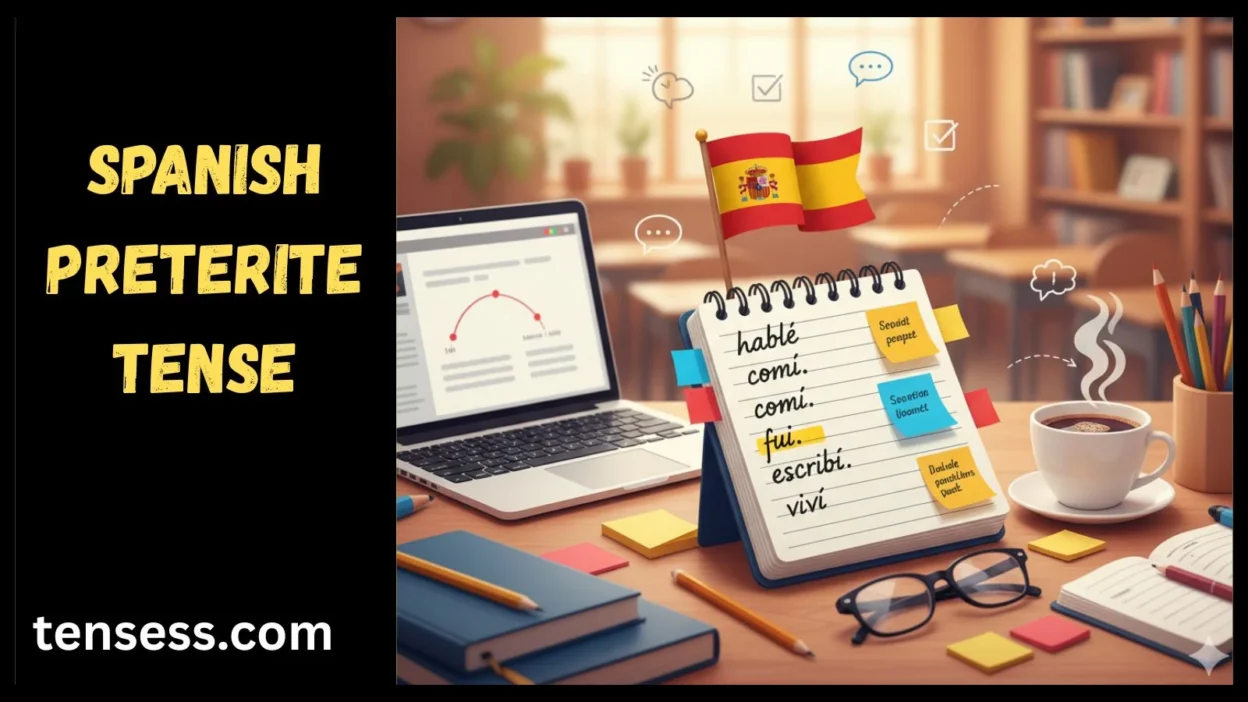
The Spanish preterite tense is a fundamental aspect of Spanish grammar, essential for anyone learning the language.
If you’re a student, language enthusiast, or writer, mastering the preterite tense allows you to describe completed actions in the past with precision.
This tense is commonly used to narrate events, share stories, or discuss specific moments that have a clear beginning and end.
In this beginner-friendly guide, we’ll break down the Spanish preterite tense, explain its structure, and provide practical examples to help you use it confidently.
From conjugation rules to common mistakes, this article is designed to be skimmable and engaging, with real-life examples to make learning verb conjugation fun and accessible.
Let’s dive into the world of Spanish past tense conjugation and explore how to use it correctly!
What Is the Spanish Preterite Tense?
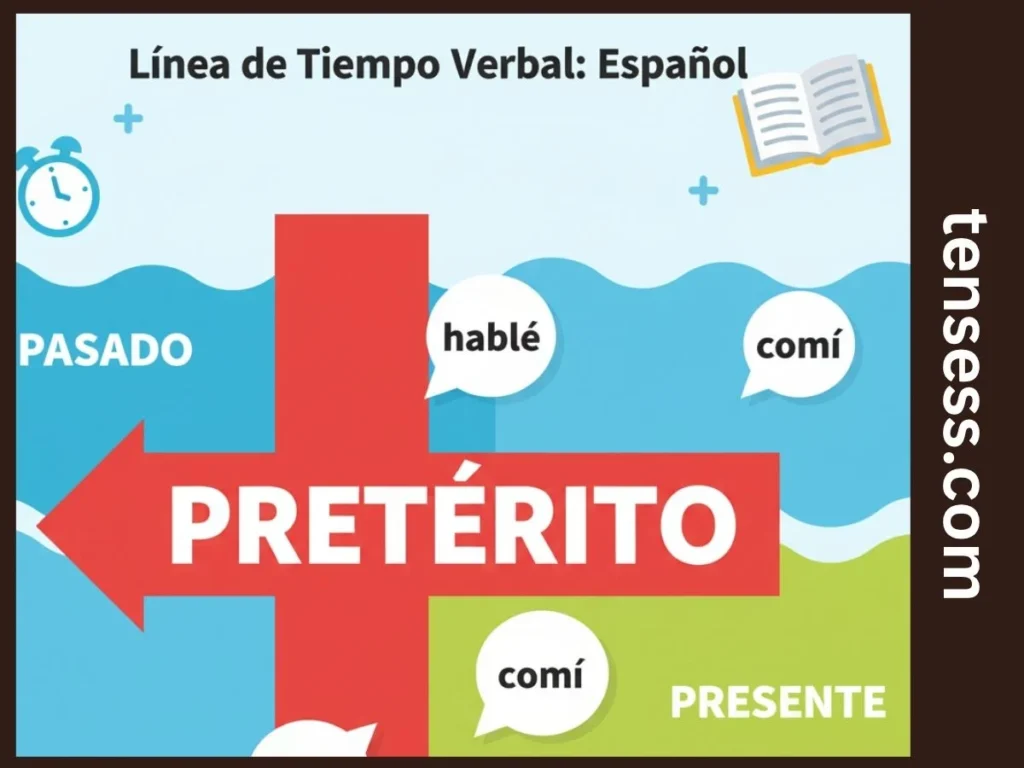
The Spanish preterite tense (pretérito perfecto simple) is used to describe actions that were completed in the past at a specific point in time. Unlike the imperfect tense, which describes ongoing or habitual past actions, the preterite tense focuses on events with a definite end. For example, “I ate dinner” or “She visited Spain” are actions that happened once and are finished. It’s a key tense for storytelling, reporting events, or discussing past experiences. Understanding how to use the preterite tense is crucial for clear communication in Spanish.
How to Recognize the Preterite Tense?
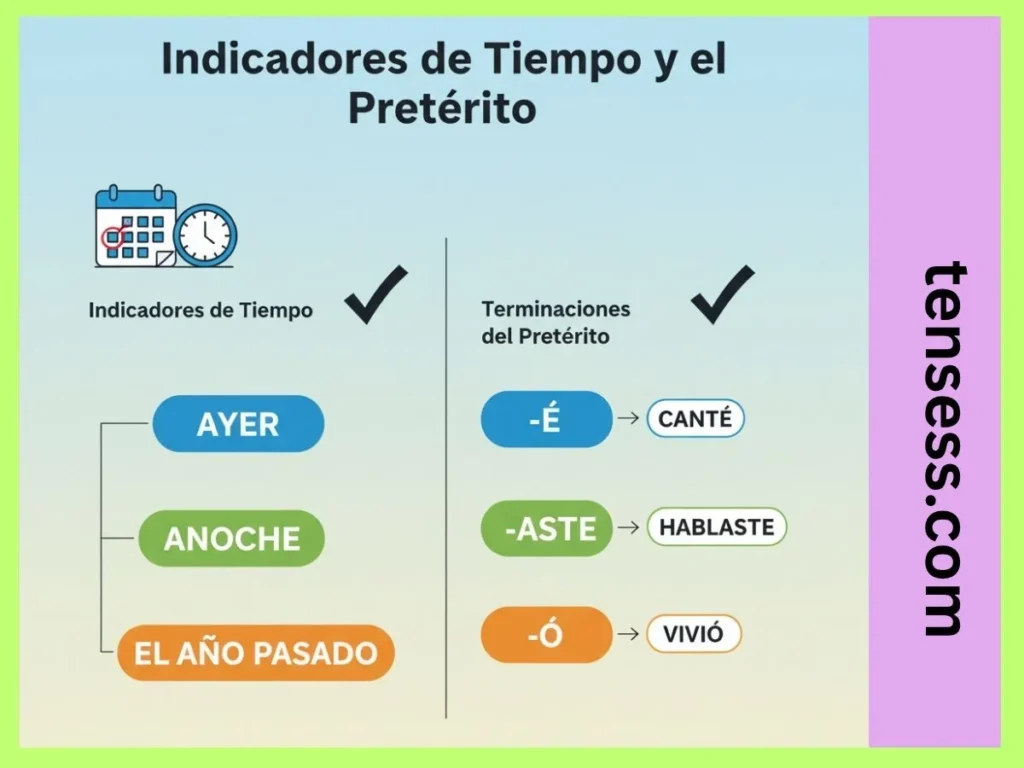
You can recognize the Spanish preterite tense by its distinct verb endings and context. Look for:
- Time-specific phrases: Words like ayer (yesterday), anoche (last night), or el año pasado (last year) often signal the preterite.
- Completed actions: The action has a clear start and end, e.g., “I finished my homework.”
- Specific verb endings: Regular verbs follow predictable patterns (e.g., -ar verbs end in -é, -aste, -ó).
Structure of a Sentence in the Preterite Tense
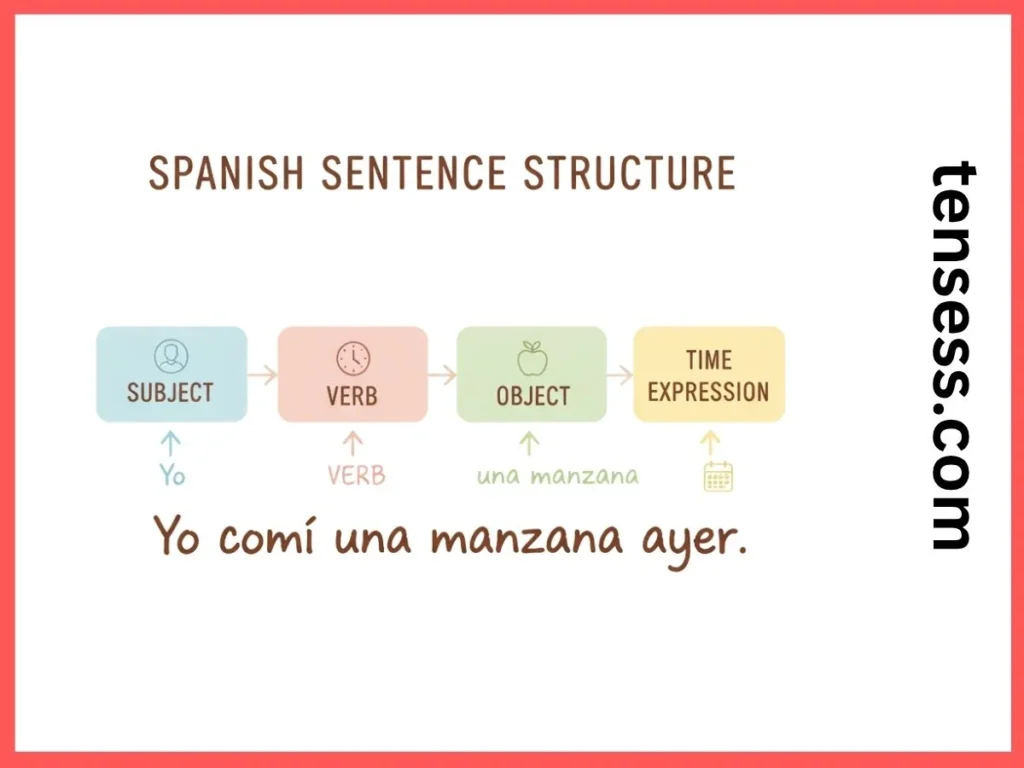
A typical sentence in the Spanish preterite tense follows this structure:
Subject + Conjugated Verb + Object/Complement (optional) + Time Expression (optional).
For example:
- Yo comí una manzana ayer. (I ate an apple yesterday.)
Here, yo is the subject, comí is the conjugated verb, una manzana is the object, and ayer is the time expression.
Formation of the Preterite Tense
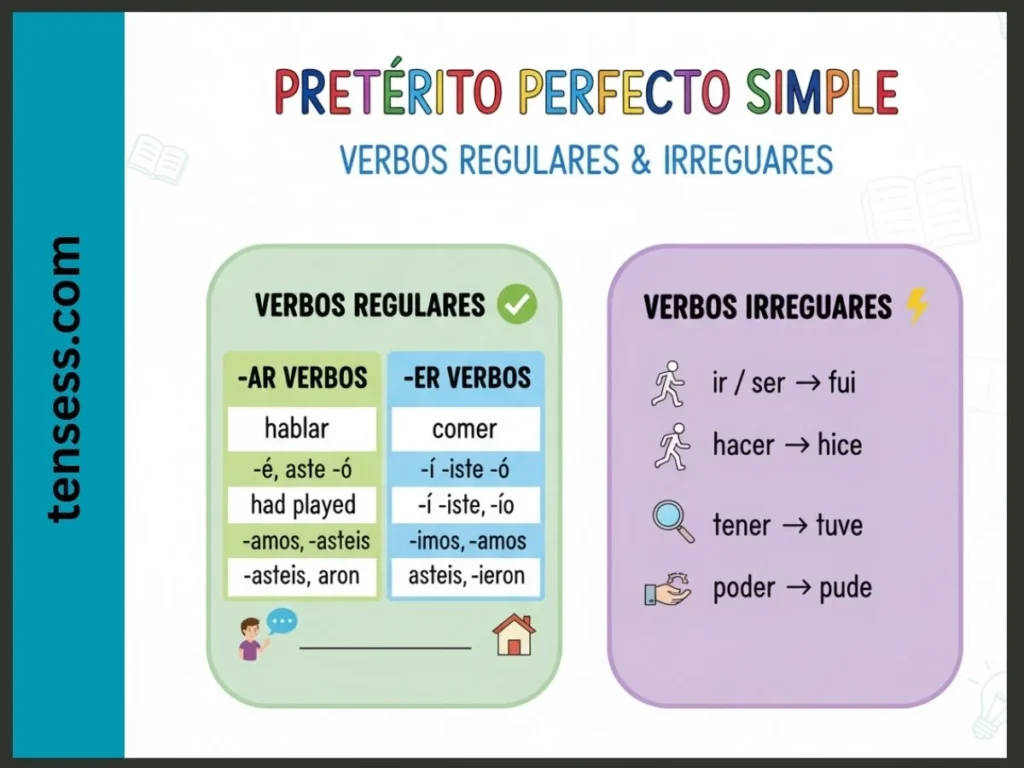
To form the Spanish preterite tense, conjugate verbs based on their infinitive endings (-ar, -er, -ir). Regular verbs follow specific patterns, while irregular verbs have unique conjugations. Below, we’ll explore how to conjugate regular and irregular verbs in the preterite tense.
Verbs in the Preterite Tense
The preterite tense applies to both regular and irregular verbs. Regular verbs follow predictable patterns, while irregular verbs (like ser, ir, or tener) have unique forms. Let’s break down the conjugation rules.
Helping Verbs in the Preterite Tense
The Spanish preterite tense doesn’t typically use “helping verbs” like auxiliary verbs in English (e.g., “have” in “I have eaten”). Instead, the preterite is a simple tense where the verb itself carries the past action. For example, hablé (I spoke) or corrí (I ran) stand alone without additional verbs.
Explanation of Some Verbs in the Preterite Tense
Here’s how some common verbs are used in the Spanish preterite tense:
- Hablar (to speak): Hablé con mi amigo. (I spoke with my friend.)
- Comer (to eat): Comimos pizza anoche. (We ate pizza last night.)
- Vivir (to live): Viví en México por un año. (I lived in Mexico for a year.)
These examples show completed actions, emphasizing the preterite tense’s role in describing specific past events.
Table of Regular and Irregular Verbs in the Preterite Tense
| Infinitive | Subject | Regular (-ar) | Regular (-er) | Irregular (e.g., Ser/Ir) |
| Hablar | Yo | Hablé | Comí | Fui |
| Tú | Hablaste | Comiste | Fuiste | |
| Él/Ella | Habló | Comió | Fue | |
| Nosotros | Hablamos | Comimos | Fuimos | |
| Vosotros | Hablasteis | Comisteis | Fuisteis | |
| Ellos | Hablaron | Comieron | Fueron |
Simple Sentence Examples
- Yo estudié para el examen. (I studied for the exam.)
- Tú caminaste al parque. (You walked to the park.)
- Ella cantó una canción. (She sang a song.)
- Él jugó fútbol ayer. (He played soccer yesterday.)
- Nosotros viajamos a España. (We traveled to Spain.)
- Vosotros corristeis rápido. (You all ran quickly.)
- Ellos escribieron una carta. (They wrote a letter.)
- Yo comí un sándwich. (I ate a sandwich.)
- Tú dormiste tarde. (You slept late.)
- Ella bailó en la fiesta. (She danced at the party.)
Negative Sentence Examples
- No estudié para el examen. (I didn’t study for the exam.)
- Tú no caminaste al parque. (You didn’t walk to the park.)
- Ella no cantó una canción. (She didn’t sing a song.)
- Él no jugó fútbol ayer. (He didn’t play soccer yesterday.)
- Nosotros no viajamos a España. (We didn’t travel to Spain.)
- Vosotros no corristeis rápido. (You all didn’t run quickly.)
- Ellos no escribieron una carta. (They didn’t write a letter.)
- Yo no comí un sándwich. (I didn’t eat a sandwich.)
- Tú no dormiste tarde. (You didn’t sleep late.)
- Ella no bailó en la fiesta. (She didn’t dance at the party.)
Interrogative Sentence Examples
- ¿Estudiaste para el examen? (Did you study for the exam?)
- ¿Caminaste al parque? (Did you walk to the park?)
- ¿Cantó ella una canción? (Did she sing a song?)
- ¿Jugó él fútbol ayer? (Did he play soccer yesterday?)
- ¿Viajamos a España? (Did we travel to Spain?)
- ¿Corristeis vosotros rápido? (Did you all run quickly?)
- ¿Escribieron ellos una carta? (Did they write a letter?)
- ¿Comí un sándwich? (Did I eat a sandwich?)
- ¿Dormiste tarde? (Did you sleep late?)
- ¿Bailó ella en la fiesta? (Did she dance at the party?)
Negative and Interrogative Sentence Examples
- ¿No estudiaste para el examen? (Didn’t you study for the exam?)
- ¿No caminaste al parque? (Didn’t you walk to the park?)
- ¿No cantó ella una canción? (Didn’t she sing a song?)
- ¿No jugó él fútbol ayer? (Didn’t he play soccer yesterday?)
- ¿No viajamos a España? (Didn’t we travel to Spain?)
- ¿No corristeis vosotros rápido? (Didn’t you all run quickly?)
- ¿No escribieron ellos una carta? (Didn’t they write a letter?)
- ¿No comí un sándwich? (Didn’t I eat a sandwich?)
- ¿No dormiste tarde? (Didn’t you sleep late?)
- ¿No bailó ella en la fiesta? (Didn’t she dance at the party?)
How to Conjugate the Preterite Tense
- Identify the verb type: Is it -ar, -er, or -ir?
- Remove the infinitive ending: For hablar, remove -ar to get habl-.
- Add the appropriate ending: For -ar verbs, use -é, -aste, -ó, -amos, -asteis, -aron.
- For -er/-ir verbs: Use -í, -iste, -ió, -imos, -isteis, -ieron.
- Check for irregularities: Verbs like ser or ir have unique forms (e.g., fui, fuiste).
- Stem-changing verbs: Some verbs change their stem (e.g., dormir → dormí).
- Practice regular verbs first: Start with hablar, comer, or vivir.
- Memorize common irregulars: Learn verbs like tener (tuve), hacer (hice).
- Use context clues: Ensure the action is completed.
- Test your conjugations: Write sentences to verify accuracy.
Conjugation Table for All Subjects
| Subject | Hablar (-ar) | Comer (-er) | Vivir (-ir) | Ser/Ir (Irregular) |
| Yo | Hablé | Comí | Viví | Fui |
| Tú | Hablaste | Comiste | Viviste | Fuiste |
| Él/Ella/Usted | Habló | Comió | Vivió | Fue |
| Nosotros | Hablamos | Comimos | Vivimos | Fuimos |
| Vosotros | Hablasteis | Comisteis | Vivisteis | Fuisteis |
| Ellos/Ellas/Ustedes | Hablaron | Comieron | Vivieron | Fueron |
Spelling Changes or Irregularities
- Stem-changing verbs: Some -ir verbs like dormir (slept: dormí, dormiste, durmió) have a stem change (o → u).
- Irregular verbs: Verbs like ser/ir (fui), tener (tuve), or hacer (hice) don’t follow regular patterns.
- -Car, -gar, -zar verbs:
- Buscar → busqué (c → qu).
- Llegar → llegué (g → gu).
- Empezar → empecé (z → c).
10–15 Sentence Examples with Different Subjects
- Yo escribí un libro. (I wrote a book.)
- Tú compraste un coche. (You bought a car.)
- Ella vio una película. (She watched a movie.)
- Él corrió una maratón. (He ran a marathon.)
- Nosotros fuimos al zoo. (We went to the zoo.)
- Vosotros bailasteis en la boda. (You all danced at the wedding.)
- Ellos hablaron con el profesor. (They spoke with the teacher.)
- Yo tuve una idea. (I had an idea.)
- Tú hiciste una torta. (You made a cake.)
- Ella durmió toda la mañana. (She slept all morning.)
- Él salió temprano. (He left early.)
- Nosotros comimos paella. (We ate paella.)
- Vosotros estudiasteis mucho. (You all studied a lot.)
- Ellos viajaron a Francia. (They traveled to France.)
- Yo canté en el coro. (I sang in the choir.)
Common Mistakes with the Preterite Tense
- Confusing preterite with imperfect: Using preterite for ongoing actions (e.g., Yo comí instead of Yo comía for “I was eating”).
- Forgetting irregular forms: Using tení instead of tuve for tener.
- Incorrect endings: Adding -er endings to -ar verbs (e.g., hablí instead of hablé).
- Ignoring spelling changes: Forgetting busqué for buscar.
- Overusing preterite: Using it for habitual actions (e.g., Siempre hablé instead of Siempre hablaba).
- Mixing subjects: Using habló for yo instead of hablé.
- Stem-change errors: Applying stem changes to -ar/-er verbs.
- Forgetting accents: Writing hable instead of hablé.
- Misusing ser/ir: Confusing their identical preterite forms (fui).
- Incorrect context: Using preterite for incomplete actions.
How to Avoid Common Mistakes
- Learn preterite vs. imperfect: Preterite is for completed actions; imperfect is for ongoing/habitual.
- Memorize irregulars: Use flashcards for verbs like tener, hacer.
- Practice endings: Write out conjugation tables.
- Check spelling changes: Review car/gar/zar rules.
- Use time clues: Words like ayer signal preterite.
- Test sentences: Write and check your conjugations.
- Read examples: See how native speakers use the tense.
- Use grammar checkers: Tools like Grammarly can help.
- Ask for feedback: Have a teacher review your work.
- Practice regularly: Consistency prevents errors.
Related Verbs and Synonyms for the Preterite Tense
Some verbs are often confused with the preterite tense or used interchangeably:
- Ser vs. Estar: Both mean “to be,” but fui (ser) is for permanent states, while estuve (estar) is for temporary locations/states.
- Saber vs. Conocer: Supe (saber) means “I found out,” while conocí (conocer) means “I met.”
- Hacer vs. Realizar: Hice (hacer) is “I did/made,” while realicé (realizar) is “I carried out.”
Sentence comparisons: - Fui a la fiesta. (I went to the party, ser/ir) vs. Estuve en la fiesta. (I was at the party, estar).
- Supe la verdad. (I found out the truth) vs. Conocí a Juan. (I met Juan.)
Tips to Practice Using the Preterite Tense
- Write a diary: Describe yesterday’s events in preterite.
- Use flashcards: Memorize irregular conjugations.
- Tell stories: Narrate past events to a friend.
- Watch Spanish movies: Note preterite usage in dialogue.
- Complete exercises: Try online grammar quizzes.
- Join language apps: Use Duolingo or Babbel.
- Practice with a partner: Conjugate verbs aloud.
- Read short stories: Identify preterite verbs.
- Use grammar checkers: Verify your sentences.
- Set goals: Conjugate 10 verbs daily.
Frequently Asked Questions
- What’s the difference between preterite and imperfect? Preterite is for completed actions; imperfect is for ongoing/habitual actions.
- When do I use fui? Use fui for ser (identity) or ir (going) in the past.
- Are there many irregular verbs? Yes, but common ones like tener, hacer are key.
- How do I know if a verb is irregular? Check conjugation tables or memorize common irregulars.
- Can I use preterite for ongoing actions? No, use imperfect for that.
- What are car/gar/zar verbs? Verbs requiring spelling changes in the preterite.
- How do I practice preterite? Write sentences and use apps.
- Is preterite used in formal writing? Yes, for specific past events.
- Why do ser and ir share forms? They evolved similarly in Spanish.
- Can I skip learning irregulars? No, they’re essential for fluency.
Exercises
- Conjugate hablar for all subjects in preterite.
- Write 5 sentences using comer in preterite.
- Identify the preterite verb in: Ella cantó ayer.
- Correct: Yo comí pizza anoche. to negative.
- Translate: “I went to the store.”
- Conjugate tener in preterite for yo.
- Write an interrogative sentence with vivir.
- Fix: Tú hablí con ella. (wrong ending).
- Create a sentence with hacer in preterite.
- Translate: “Did they dance at the party?”
Quizzes
- What is the preterite form of comer for tú? (Answer: comiste)
- Which verb uses fui? (ser/ir)
- Is hablé preterite or imperfect? (Preterite)
- What’s the preterite of vivir for ellos? (vivieron)
- Correct or incorrect: Yo comió. (Incorrect, should be comí)
- What’s the preterite of buscar for yo? (busqué)
- Translate: Ella no escribió. (She didn’t write.)
- Is dormí regular or irregular? (Irregular, stem change)
- What’s the preterite of hacer for él? (hizo)
- True/False: Preterite is for ongoing actions. (False)
True/False
- The preterite tense describes completed actions. (True)
- Hablé is the imperfect form of hablar. (False)
- Fui can mean “I went” or “I was.” (True)
- All -ar verbs are irregular in preterite. (False)
- Comimos is the preterite for nosotros. (True)
- Buscar becomes buscé for yo. (True)
- Preterite is used for habitual actions. (False)
- Hice is the preterite of hacer. (True)
- Ser and ir have different preterite forms. (False)
- You need auxiliary verbs for preterite. (False)
Conclusion
Mastering the Spanish preterite tense is a game-changer for language learners, enabling you to narrate past events with confidence.
By understanding its structure, practicing conjugations, and avoiding common mistakes, you’ll be able to use this tense effectively in conversations and writing.
The preterite tense is your key to storytelling in Spanish, whether you’re sharing a travel adventure or recounting a fun memory.
Keep practicing with exercises, quizzes, and real-life examples to solidify your skills.
Try writing a short story using the Spanish preterite tense or use a grammar checker to refine your sentences.
With consistent practice, you’ll master verb conjugation and sound like a native speaker in no time! Start today and share your preterite sentences in the comments below!