The Spanish subjunctive tense is a fascinating yet often tricky aspect of Spanish grammar for students, language learners, writers, and grammar enthusiasts.
Unlike the indicative mood, which deals with facts and reality, the subjunctive tense expresses desires, doubts, wishes, hypotheticals, or emotions—things that aren’t certain.
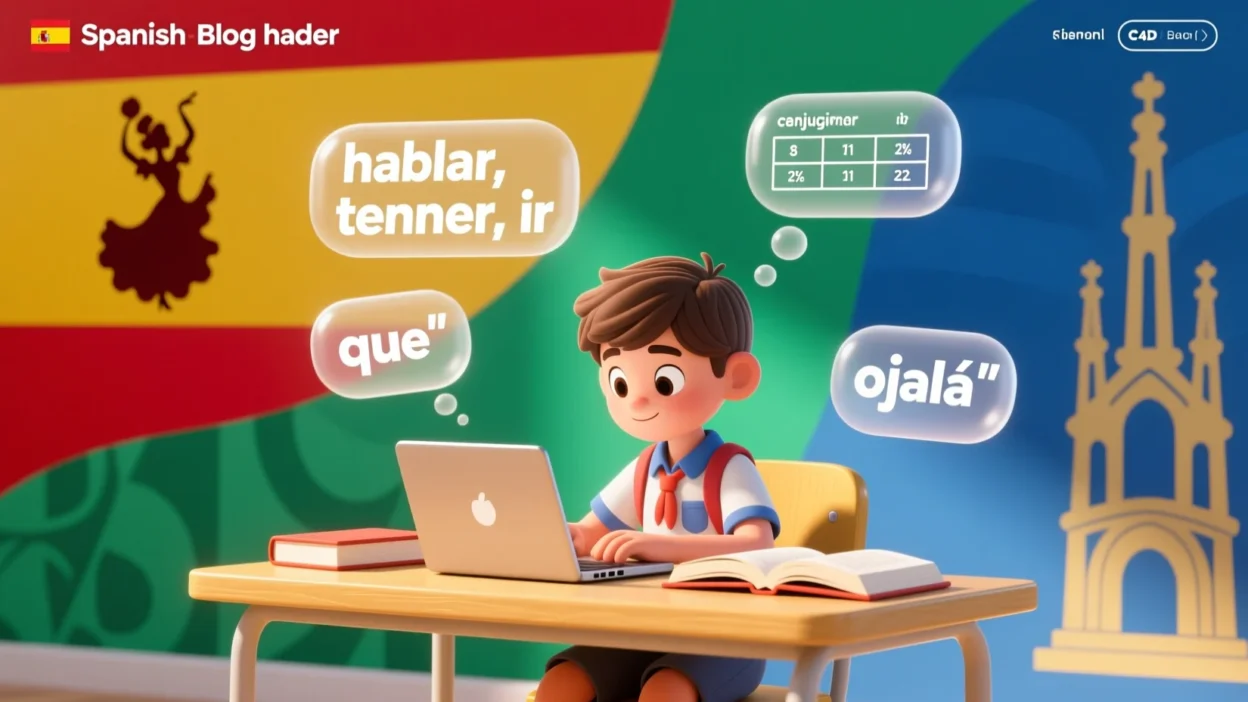
If you’re dreaming about a vacation (¡Ojalá que viajemos pronto!) or giving advice (Espero que estudies más), mastering the subjunctive can elevate your Spanish fluency.
This beginner-friendly guide, we’ll break down the subjunctive tense in Spanish, explain how to form it, provide verb conjugation examples, and offer practical tips to avoid common mistakes.
With clear explanations, real-life examples, and interactive exercises, you’ll gain confidence in using this verb tense correctly.
Let’s dive into the world of Spanish subjunctive and make it approachable and fun!
What Is the Spanish Subjunctive Tense?
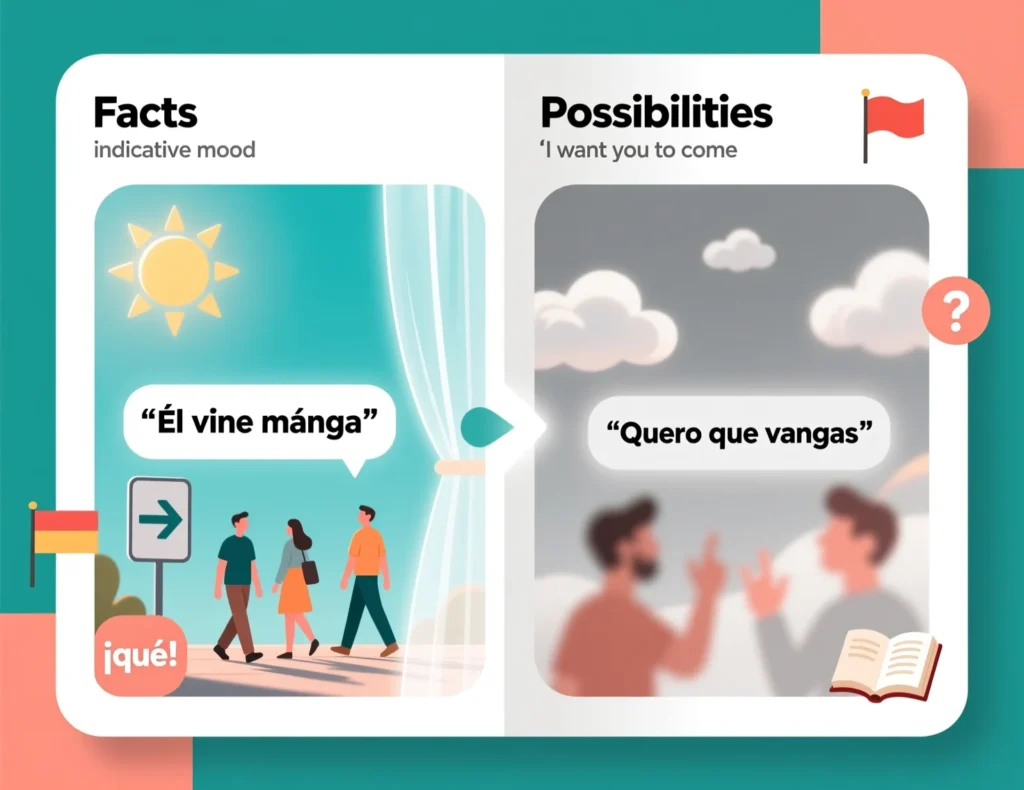
The subjunctive tense in Spanish is a mood, not a tense, used to express subjective ideas like wishes, doubts, possibilities, or recommendations. It contrasts with the indicative mood, which describes facts. For example, in Quiero que vengas (“I want you to come”), the subjunctive (vengas) reflects a desire, not a fact. The subjunctive appears in dependent clauses introduced by triggers like que or ojalá. It’s common in contexts involving emotions (Me alegra que estés aquí), hypothetical situations (Si fuera rico), or commands (Espero que lo hagas). Understanding when to use the subjunctive is key to sounding natural in Spanish.
How to Recognize the Subjunctive Tense?
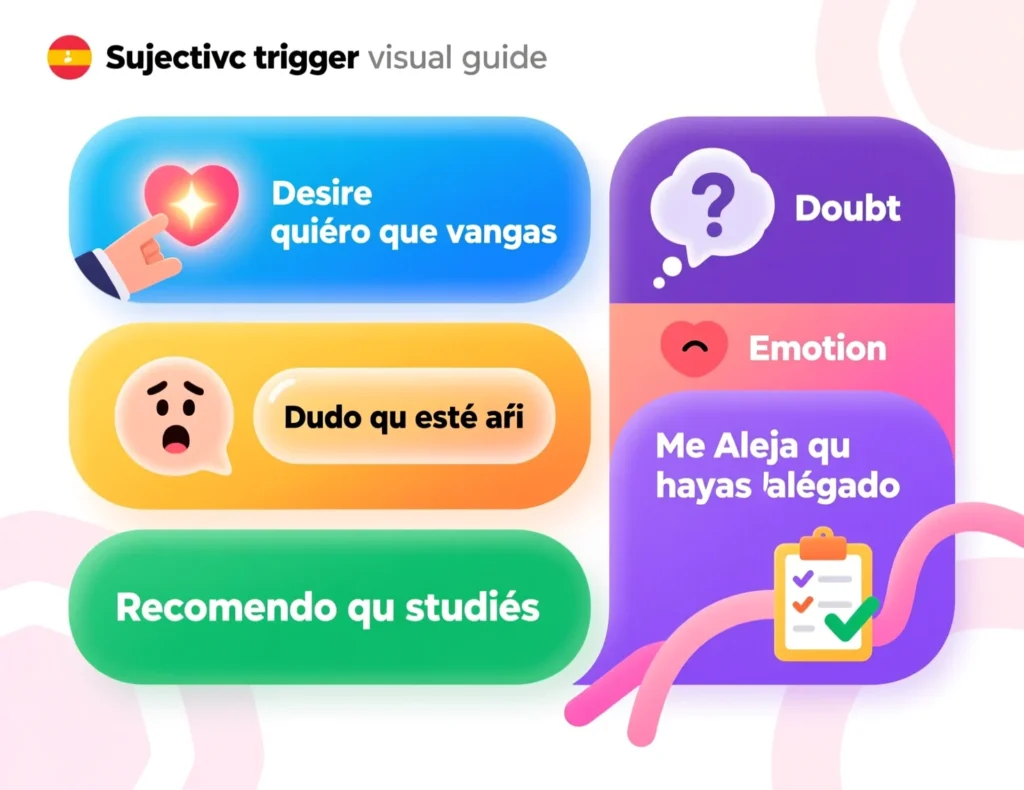
Recognizing the Spanish subjunctive involves spotting specific triggers and contexts. Look for:
- Expressions of desire: Quiero que, Espero que (I hope that).
- Doubt or uncertainty: Dudo que (I doubt that), Es posible que (It’s possible that).
- Emotions: Me sorprende que (I’m surprised that), Temo que (I fear that).
- Hypotheticals: Si clauses (Si tuviera dinero – “If I had money”).
- Commands or advice: Es importante que (It’s important that).
The subjunctive often follows que in a subordinate clause and uses specific verb endings, like -a or -e, depending on the verb type.
Structure of a Subjunctive Sentence
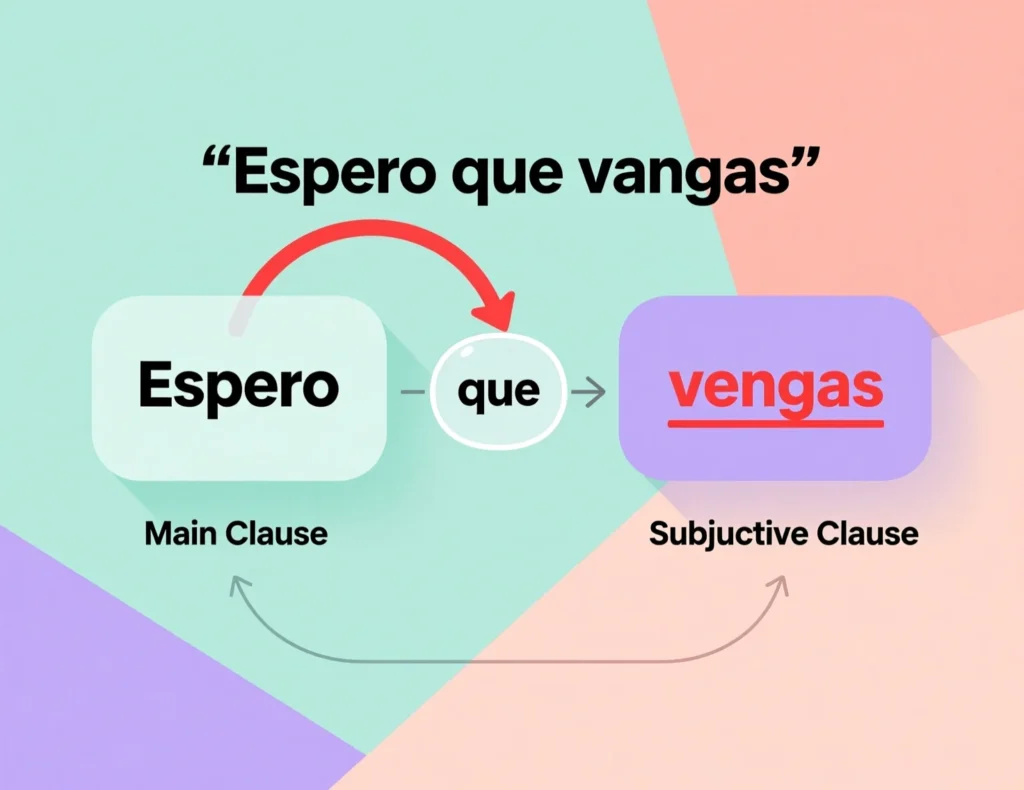
A typical subjunctive sentence in Spanish follows this pattern:
Main clause (indicative) + que + dependent clause (subjunctive).
For example:
- Espero (indicative) que vengas (subjunctive) – “I hope that you come.”
- The main clause expresses the trigger (hope, doubt, etc.), and the dependent clause uses the subjunctive to describe the non-factual or desired action.
Formation of the Subjunctive Tense
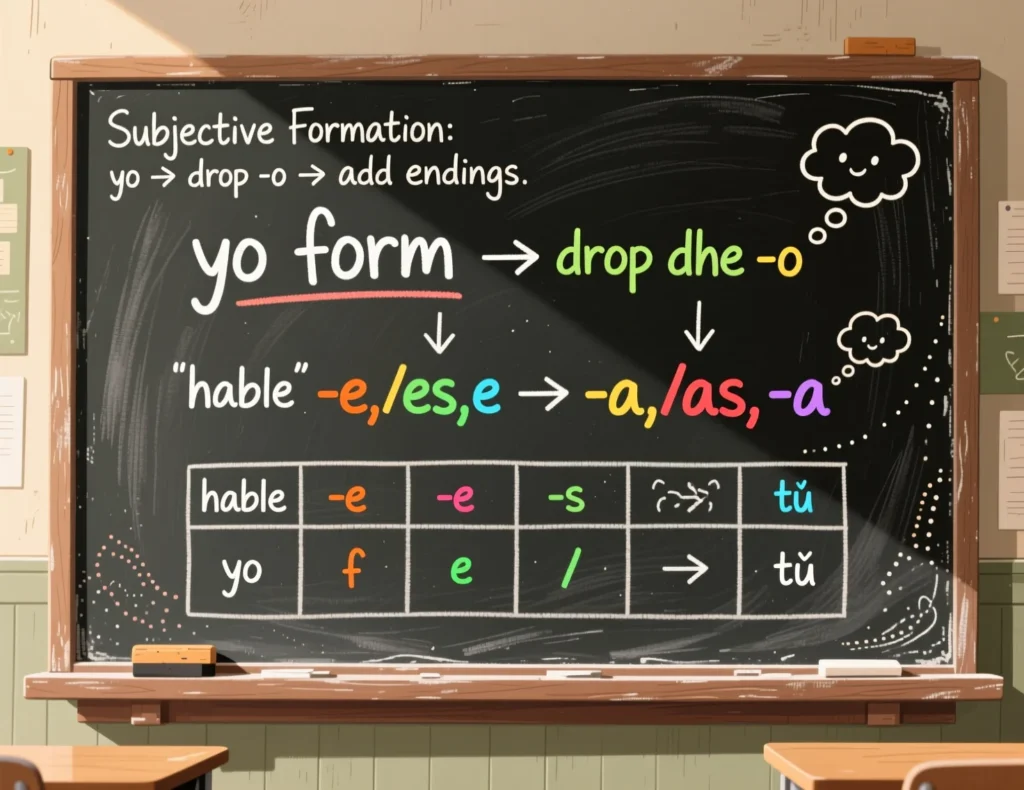
To form the present subjunctive in Spanish:
- Start with the first-person singular (yo) form of the present indicative.
- Drop the -o ending.
- Add the subjunctive endings:
- For -ar verbs: -e, -es, -e, -emos, -éis, -en.
- For -er and -ir verbs: -a, -as, -a, -amos, -áis, -an.
Example (hablar – to speak):
- Yo hablo → habl- → hable, hables, hable, hablemos, habléis, hablen.
Verbs in the Subjunctive Tense
The subjunctive applies to both regular and irregular verbs. Common verbs include:
- -ar verbs: hablar (to speak), cantar (to sing), estudiar (to study).
- -er verbs: comer (to eat), beber (to drink), aprender (to learn).
- -ir verbs: vivir (to live), escribir (to write), decidir (to decide).
Irregular verbs like ser, ir, or tener have unique subjunctive forms (e.g., sea, vaya, tenga).
Helping Verbs in the Subjunctive
Certain verbs act as triggers for the subjunctive when followed by que. These include:
- Wishing: querer (to want), desear (to wish).
- Emotion: alegrarse (to be happy), temer (to fear).
- Doubt: dudar (to doubt), no creer (to not believe).
- Recommendation: recomendar (to recommend), sugerir (to suggest).
Example: Sugiero que leas este libro (“I suggest that you read this book”).
Explanation of Some Verbs in the Subjunctive
- Querer (to want): Used for desires. Quiero que hagas la tarea (“I want you to do the homework”).
- Dudar (to doubt): Expresses uncertainty. Dudo que lleguen a tiempo (“I doubt they’ll arrive on time”).
- Ojalá: Expresses hope. Ojalá que llueva (“I hope it rains”).
- Ser (to be): Irregular, used in hypotheticals. Si fuera presidente (“If I were president”).
Table of Regular and Irregular Verbs in the Subjunctive
| Verb | Yo | Tú | Él/Ella | Nosotros | Vosotros | Ellos/Ellas |
| Hablar | hable | hables | hable | hablemos | habléis | hablen |
| Comer | coma | comas | coma | comamos | comáis | coman |
| Vivir | viva | vivas | viva | vivamos | viváis | vivan |
| Ser | sea | seas | sea | seamos | seáis | sean |
| Ir | vaya | vayas | vaya | vayamos | vayáis | vayan |
Simple Sentence Examples
- Espero que tú hagas la tarea. (I hope you do the homework.)
- Quiero que él venga a la fiesta. (I want him to come to the party.)
- Es importante que nosotros estudiemos. (It’s important that we study.)
- Dudo que ella pueda terminar a tiempo. (I doubt she can finish on time.)
- Ojalá que llueva mañana. (I hope it rains tomorrow.)
- Me alegra que vosotros estéis aquí. (I’m glad you all are here.)
- Temo que él no entienda. (I fear he doesn’t understand.)
- Es posible que ellos lleguen tarde. (It’s possible they’ll arrive late.)
- Sugiero que tú leas más. (I suggest you read more.)
- Si fuera rico, viajaría. (If I were rich, I would travel.)
Negative Sentence Examples
- No creo que tú hagas eso. (I don’t believe you’ll do that.)
- No quiero que él venga. (I don’t want him to come.)
- No es necesario que nosotros hablemos. (It’s not necessary that we speak.)
- No pienso que ella pueda ganar. (I don’t think she can win.)
- No espero que llueva hoy. (I don’t expect it to rain today.)
- No me gusta que vosotros estéis tristes. (I don’t like that you all are sad.)
- No temo que él no entienda. (I’m not afraid he won’t understand.)
- No es probable que ellos lleguen temprano. (It’s not likely they’ll arrive early.)
- No sugiero que tú escribas eso. (I don’t suggest you write that.)
- No creo que sea verdad. (I don’t believe it’s true.)
Interrogative Sentence Examples
- ¿Espero que tú hagas la tarea? (Do I hope you do the homework?)
- ¿Quieres que él venga? (Do you want him to come?)
- ¿Es importante que nosotros estudiemos? (Is it important that we study?)
- ¿Dudas que ella pueda terminar? (Do you doubt she can finish?)
- ¿Ojalá que llueva mañana? (Is it hoped that it rains tomorrow?)
- ¿Te alegra que vosotros estéis aquí? (Are you glad you all are here?)
- ¿Temes que él no entienda? (Do you fear he won’t understand?)
- ¿Es posible que ellos lleguen tarde? (Is it possible they’ll arrive late?)
- ¿Sugieres que tú leas más? (Do you suggest you read more?)
- ¿Crees que sea verdad? (Do you believe it’s true?)
Negative and Interrogative Sentence Examples
- ¿No crees que tú hagas eso? (Don’t you believe you’ll do that?)
- ¿No quieres que él venga? (Don’t you want him to come?)
- ¿No es necesario que nosotros hablemos? (Isn’t it necessary that we speak?)
- ¿No dudas que ella pueda ganar? (Don’t you doubt she can win?)
- ¿No esperas que llueva hoy? (Don’t you expect it to rain today?)
- ¿No te gusta que vosotros estéis tristes? (Don’t you dislike that you all are sad?)
- ¿No temes que él no entienda? (Aren’t you afraid he won’t understand?)
- ¿No es probable que ellos lleguen temprano? (Isn’t it unlikely they’ll arrive early?)
- ¿No sugieres que tú escribas eso? (Don’t you suggest you write that?)
- ¿No crees que sea verdad? (Don’t you believe it’s true?)
How to Conjugate the Subjunctive Tense
- Use the yo form of the present indicative (e.g., hablo, como, vivo).
- Drop the -o (e.g., habl-, com-, viv-).
- Add -ar endings: -e, -es, -e, -emos, -éis, -en.
- Add -er/-ir endings: -a, -as, -a, -amos, -áis, -an.
- For irregulars, memorize unique stems (e.g., ser → sea, ir → vaya).
- Check for stem changes (e.g., pensar → piense).
- Watch for spelling changes (e.g., jugar → juegue).
- Ensure the subject matches the conjugation.
- Use context to confirm subjunctive is needed.
- Practice with common triggers like que or ojalá.
Conjugation Table for All Subjects
| Subject | Hablar (to speak) | Comer (to eat) | Vivir (to live) | Ser (to be) | Ir (to go) |
| Yo | hable | coma | viva | sea | vaya |
| Tú | hables | comas | vivas | seas | vayas |
| Él/Ella/Ud. | hable | coma | viva | sea | vaya |
| Nosotros | hablemos | comamos | vivamos | seamos | vayamos |
| Vosotros | habléis | comáis | viváis | seáis | vayáis |
| Ellos/Uds. | hablen | coman | vivan | sean | vayan |
Spelling Changes or Irregularities
- Stem-changing verbs: e → ie (e.g., pensar → piense), o → ue (e.g., dormir → duerma), e → i (e.g., pedir → pida).
- Irregular verbs: ser (sea), ir (vaya), haber (haya), saber (sepa).
- Spelling changes: Verbs ending in -car (juegue), -gar (pague), -zar (empiece).
Sentence Examples with Different Subjects
- Quiero que yo hable español. (I want to speak Spanish.)
- Espero que tú comas sano. (I hope you eat healthy.)
- Dudo que él viva aquí. (I doubt he lives here.)
- Es importante que ella sea puntual. (It’s important that she be punctual.)
- Ojalá que nosotros vayamos a España. (I hope we go to Spain.)
- Me alegra que vosotros estéis felices. (I’m glad you all are happy.)
- Temo que ellos no entiendan. (I fear they don’t understand.)
- Es posible que usted escriba un libro. (It’s possible you write a book.)
- Sugiero que tú pienses antes. (I suggest you think first.)
- No creo que él pueda venir. (I don’t believe he can come.)
- Quiero que ella decida pronto. (I want her to decide soon.)
- Dudo que nosotros ganemos. (I doubt we’ll win.)
- Es necesario que tú duermas más. (It’s necessary that you sleep more.)
- Ojalá que ellos tengan éxito. (I hope they have success.)
- Me sorprende que ustedes sean tan rápidos. (I’m surprised you all are so fast.)
Common Mistakes with the Subjunctive Tense
- Using indicative instead of subjunctive after triggers like quiero que.
- Forgetting irregular verb forms (e.g., vaya for ir).
- Ignoring stem changes (e.g., piense for pensar).
- Misusing triggers (e.g., using subjunctive after sé que).
- Incorrect endings for -ar vs. -er/-ir verbs.
- Overusing the subjunctive in factual statements.
- Mixing up subjects in dependent clauses.
- Forgetting que in subjunctive structures.
- Incorrect spelling changes (e.g., jugar → juegue).
- Not recognizing impersonal expressions like es importante que.
How to Avoid Common Mistakes
- Memorize subjunctive triggers like querer que, dudar que.
- Practice irregular verbs separately.
- Check for stem changes in conjugation.
- Use indicative for facts (sé que es verdad).
- Double-check -ar and -er/-ir endings.
- Avoid subjunctive in main clauses.
- Ensure subject agreement in clauses.
- Always include que after triggers.
- Review spelling rules for -car, -gar, -zar verbs.
- Practice with impersonal expressions to reinforce usage.
Related Verbs and Synonyms
- Querer (to want) vs. Desear (to wish): Both trigger subjunctive. Quiero que vengas vs. Deseo que vengas.
- Sugerir (to suggest) vs. Recomendar (to recommend): Sugiero que estudies vs. Recomiendo que estudies.
- Dudar (to doubt) vs. No creer (to not believe): Dudo que sea verdad vs. No creo que sea verdad.
- Temer (to fear) vs. Preocuparse (to worry): Temo que pierdas vs. Me preocupo que pierdas.
Sentence Comparisons
- Quiero que hagas la tarea vs. Deseo que hagas la tarea. (Both mean “I want/desire you to do the homework.”)
- Sugiero que leas vs. Recomiendo que leas. (Both suggest/recommend reading.)
- Dudo que venga vs. No creo que venga. (Both express doubt about coming.)
- Temo que llueva vs. Me preocupo que llueva. (Both show concern about rain.)
Tips to Practice Using the Subjunctive Tense
- Write sentences with triggers like espero que.
- Practice conjugating regular and irregular verbs.
- Use flashcards for irregular forms.
- Listen to Spanish songs with subjunctive (e.g., Ojalá by Silvio Rodríguez).
- Speak with native speakers to hear subjunctive in context.
- Create hypothetical scenarios (Si fuera…).
- Practice with online quizzes or apps.
- Read Spanish literature to spot subjunctive usage.
- Record yourself using subjunctive sentences.
- Join language forums to discuss subjunctive challenges.
Frequently Asked Questions
- What is the subjunctive tense in Spanish? A mood for wishes, doubts, or hypotheticals.
- When do I use the subjunctive? After triggers like quiero que or es posible que.
- How is the subjunctive different from the indicative? Subjunctive expresses non-facts; indicative states facts.
- Are there irregular subjunctive verbs? Yes, like ser (sea), ir (vaya).
- What are common subjunctive triggers? Querer que, dudar que, ojalá, etc.
- Can I use subjunctive in main clauses? Rarely, except with ojalá.
- How do I conjugate -ar verbs in subjunctive? Use -e, -es, -e, -emos, -éis, -en.
- What about -er/-ir verbs? Use -a, -as, -a, -amos, -áis, -an.
- Why is the subjunctive hard? It requires memorizing triggers and irregulars.
- How can I practice subjunctive? Use exercises, quizzes, and real-life conversations.
Exercises
- Conjugate hablar in the present subjunctive for all subjects.
- Write a sentence with espero que and comer.
- Create a hypothetical si clause with ser.
- Use dudo que with vivir in a sentence.
- Conjugate ir in the subjunctive for tú.
- Write a sentence with ojalá and llover.
- Use sugiero que with estudiar.
- Create a negative sentence with no creo que and tener.
- Write an interrogative sentence with es posible que and llegar.
- Combine no quiero que and hacer in a sentence.
Quizzes
- What is the subjunctive form of comer for yo? (Answer: coma)
- Which trigger requires subjunctive? Sé que or Dudo que? (Answer: Dudo que)
- Is sea the subjunctive of ser? (Answer: Yes)
- What ending do -ar verbs take in subjunctive? (Answer: -e, -es, -e, -emos, -éis, -en)
- Does espero que trigger subjunctive? (Answer: Yes)
- What is the subjunctive of ir for ellos? (Answer: vayan)
- Is quiero que hagas correct? (Answer: Yes)
- What is the stem change for pensar in subjunctive? (Answer: piense)
- Does sé que use subjunctive? (Answer: No)
- What is the subjunctive of jugar for tú? (Answer: juegues)
True or False
- The subjunctive is a tense, not a mood. (False)
- Quiero que vengas uses the subjunctive. (True)
- Sé que es verdad requires subjunctive. (False)
- Ser in subjunctive is sea for yo. (True)
- -ar verbs use -a endings in subjunctive. (False)
- Ojalá always triggers subjunctive. (True)
- Dudo que uses the indicative. (False)
- Tenga is the subjunctive of tener. (True)
- The subjunctive is only used in main clauses. (False)
- Piense is the subjunctive of pensar. (True)
Conclusion
The Spanish subjunctive tense may seem daunting, but with practice, it becomes a powerful tool to express desires, doubts, and hypotheticals.
By understanding subjunctive triggers, mastering verb conjugation, and practicing with real-life examples, you’ll soon use it confidently.
This guide has provided a clear roadmap, from conjugation tables to common mistakes and practice exercises, to help you navigate this mood
Keep practicing with sentences, quizzes, and conversations to make the subjunctive second nature.
Try writing your own sentences or use a grammar checker to refine your skills.
Ready to take your Spanish to the next level? Start using the subjunctive today and share your progress in the comments!