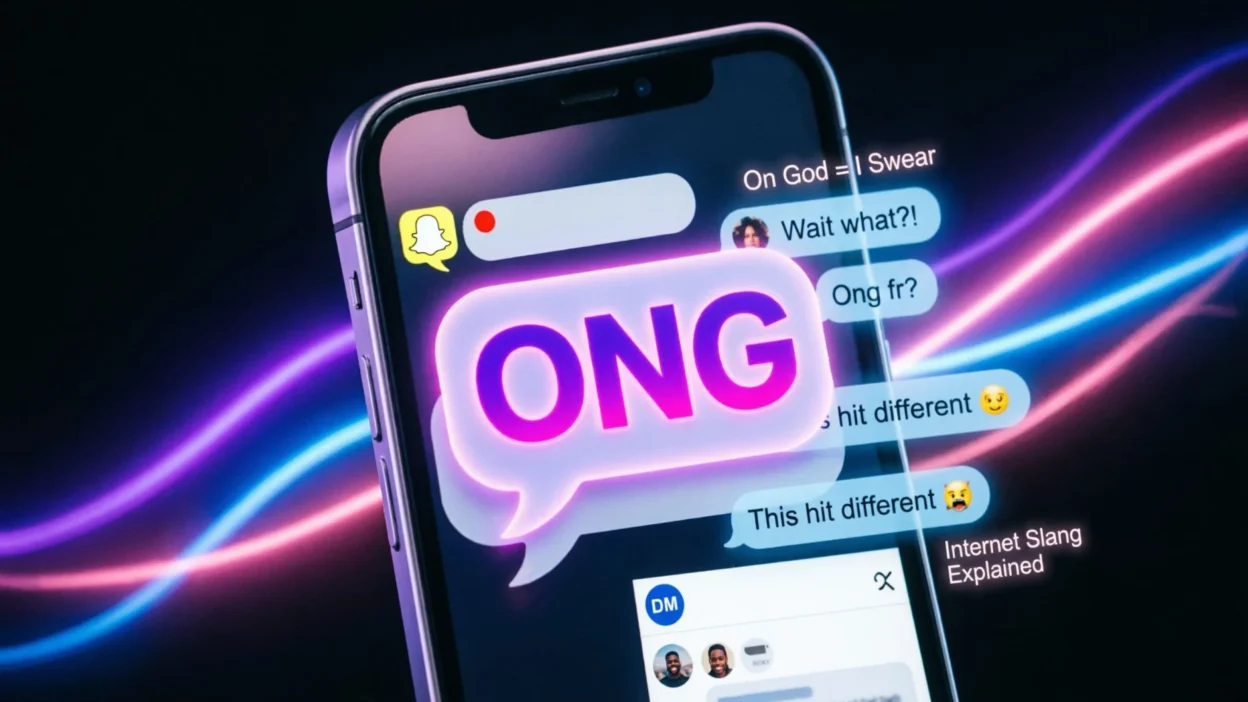
ONG means “On God” in text. It’s a slang phrase people use to swear they’re telling the truth or to strongly emphasize that they’re serious.
You’ll often see it in TikTok comments, Snapchat chats, Instagram DMs, or casual text messages. It isn’t an acronym in the traditional sense. Instead, it’s a shortened slang expression built from a spoken phrase.
Many people search for this term because they see “ONG” in a message and assume it might mean something else. Internet slang moves fast, and not everyone keeps up with Gen Z expressions. If you’ve been confused by this term, you’re in the right place.
Here’s exactly what ONG means, how people use it, and how you should reply.
ONG Meaning in Text: Full Explanation
What Does ONG Mean in Chat?
The ONG meaning in text is simple: it stands for “On God.”
When someone types “ONG,” they’re basically saying:
- “I swear.”
- “I’m not lying.”
- “I’m serious.”
- “This is 100% true.”
It’s a strong form of emphasis. Instead of writing a full sentence like “I promise I’m telling the truth,” people just type “ONG.”
Is ONG an Acronym?
Yes and no.
- It technically represents the words “On God.”
- But it’s more of a slang abbreviation than a formal acronym.
- It comes from spoken culture and was later shortened for texting.
So it’s not a professional acronym like “NASA.” It’s more like “IDK” or “OMG.”
Is ONG Slang?
Yes. The ONG slang meaning is rooted in internet and youth culture.
It’s:
- Informal
- Casual
- Emotion-driven
- Used mostly in personal chats
You wouldn’t use it in an email to your boss. But you’ll absolutely see it in a group chat.
ONG Meaning Across Different Platforms
The meaning stays mostly the same, but the tone can shift depending on the platform.
ONG Meaning on Snapchat
On Snapchat, “ONG” is usually used in:
- Private chats
- Streak messages
- Emotional reactions
Example:
A: “I didn’t study at all.”
B: “ONG same.”
Here, it means strong agreement.
Tone: Casual, relatable, expressive.
ONG Meaning on TikTok
On TikTok, it often appears in:
- Comment sections
- Reaction posts
- Meme captions
Example:
“This is the best song of the year ONG.”
Here it adds dramatic emphasis.
Tone: Exaggerated, expressive, sometimes humorous.
ONG Meaning on Instagram
On Instagram, people use it in:
- DMs
- Story replies
- Comment arguments
Example:
“ONG you’re so talented.”
Tone: Supportive or intense.
ONG Meaning on WhatsApp
On WhatsApp, usage depends on age group.
Among younger users:
“ONG I’m not coming tomorrow.”
It emphasizes seriousness.
Among older users:
Less common.
ONG Meaning in SMS (Regular Texting)
In SMS, it’s direct and personal.
Example:
“I didn’t tell anyone ONG.”
Tone: Defensive or reassuring.
ONG Tone & Context Variations
Like most slang, meaning changes with tone.
1. Funny Tone
A: “You ate the whole pizza?”
B: “ONG I was starving.”
Used dramatically. Not always literal.
2. Sarcastic Tone
A: “You’re the smartest person ever.”
B: “ONG yeah totally.”
Here it can mean the opposite.
3. Romantic Tone
A: “You’re the only one I want.”
B: “ONG?”
This could mean:
“Are you serious?”
4. Angry Tone
A: “I didn’t take your money.”
B: “ONG I didn’t!”
Here it sounds defensive.
5. Playful Tone
A: “You can’t beat me in this game.”
B: “ONG I can.”
Competitive energy.
15 Real Chat Examples Using ONG
- A: “Did you really finish the project?”
B: “ONG I did.” - A: “You like her?”
B: “ONG she’s perfect.” - A: “You didn’t sleep?”
B: “ONG not even one hour.” - A: “Stop lying.”
B: “ONG I’m not.” - A: “That movie was trash.”
B: “ONG it was.” - A: “You’re moving away?”
B: “ONG next month.” - A: “He cheated?”
B: “ONG.” - A: “You serious?”
B: “ONG.” - A: “You’ll come tomorrow?”
B: “ONG.” - A: “That test was easy.”
B: “ONG it was hard.” - A: “You didn’t tell anyone?”
B: “ONG.” - A: “You love me?”
B: “ONG.” - A: “You quit your job?”
B: “ONG I did.” - A: “You saw that fight?”
B: “ONG chaotic.” - A: “You promise?”
B: “ONG.”
Grammar & Language Role of ONG
Part of Speech
“ONG” functions as:
- An interjection
- A sentence intensifier
- Sometimes a full standalone response
Sentence Role
It can:
- Replace “I swear”
- Replace “I promise”
- Stand alone as a reply
- Be added at the end for emphasis
Example:
“I didn’t do it ONG.”
Sentence Position
- Beginning: “ONG that was wild.”
- Middle: Rare.
- End: “I’m serious ONG.”
Formal vs Informal
- Informal only
- Not suitable for school essays
- Not appropriate in professional emails
Tone impact: Strong, emotional, sometimes dramatic.
How to Reply When Someone Says “ONG”
Your reply depends on context.
Funny Replies
- “Okay preacher.”
- “Why you swearing like that?”
- “Relax, I believe you.”
Serious Replies
- “Alright, I trust you.”
- “Thanks for being honest.”
- “I appreciate that.”
Flirty Replies
- “You better be.”
- “Say it again.”
- “I like when you’re serious.”
Neutral Replies
- “Got it.”
- “Okay.”
- “Makes sense.”
If someone says:
“ONG I didn’t tell anyone.”
You can reply:
“Alright, I believe you.”
Keep it natural.
Is ONG Rude or Bad?
Is ONG Rude?
Not necessarily.
But it can feel intense.
Is It Disrespectful?
It depends on the audience.
Some religious people may find it sensitive because it references God.
Is It a Bad Word?
No. It’s not profanity.
But it is slang.
Can You Use It in School?
In casual conversations with friends, yes.
In assignments? No.
Can You Use It at Work?
Avoid it in professional settings.
Use full sentences instead.
Who Uses ONG?
Age Group
Mostly:
- Gen Z
- Teenagers
- Young adults
Millennials use it less often.
Regions
Most popular in:
- United States
- UK urban slang communities
- Global internet culture
Most Common Platforms
- TikTok
- Snapchat
- Instagram DMs
- Gaming chats
Origin & Internet Culture
“On God” existed in spoken English long before texting.
It comes from:
- Urban slang
- Hip-hop culture
- Casual oath expressions
With the rise of short-form content on platforms like TikTok, phrases started shrinking into faster typing forms.
“On God” became “ONG.”
There’s no single viral post that created it. It evolved naturally as people shortened speech for speed.
Fast typing culture encourages:
- Abbreviations
- Emotional intensity
- Quick reactions
That’s how ONG became common.
Comparison Table: ONG vs Similar Slang
| Term | Meaning | Formal/Informal | Tone | Popularity | Confusion Risk |
|---|---|---|---|---|---|
| ONG | On God | Informal | Serious/Emphatic | High (Gen Z) | Medium |
| IDK | I don’t know | Informal | Neutral | Very High | Low |
| ION | I don’t | Informal | Casual | Medium | High |
| Dunno | Don’t know | Informal | Casual | High | Low |
| IDC | I don’t care | Informal | Dismissive | High | Low |
ONG is stronger emotionally than IDK or IDC.
Real-World Observation
In real chats, people rarely overthink “ONG.”
They use it when emotions are high.
I’ve noticed it appears most during:
- Arguments
- Emotional confessions
- Strong agreement moments
It acts like verbal underlining. Instead of typing long explanations, people drop “ONG” to show seriousness instantly.
Frequently Asked Questions About ONG
What Does ONG Mean in Text Messages and Online Chat?
It means “On God.” People use it to swear they’re telling the truth or to strongly emphasize something.
What Does ONG Mean on Snapchat and TikTok?
On Snapchat, it’s usually personal and emotional. On TikTok, it’s dramatic and expressive in comments.
Is ONG Rude, Disrespectful, or Harmless Slang?
It’s harmless slang in most cases. However, because it references God, some people may find it sensitive.
How Should You Reply When Someone Says “ONG”?
Respond based on tone. You can say “I believe you,” “Okay,” or reply playfully depending on the situation.
Is ONG the Same as IDK or Different?
It’s different. IDK means “I don’t know.” ONG means “On God,” which expresses seriousness.
Can You Use ONG in School or Work?
Avoid using it in formal writing or professional settings. It’s best for casual chats only.
Final Summary: When to Use ONG (And When to Avoid It)
ONG means “On God.” It’s slang used to swear you’re telling the truth or to strongly emphasize a statement.
Use it when:
- You’re texting friends
- You want to show seriousness
- You’re agreeing strongly
Avoid it when:
- Writing emails
- Talking to teachers
- In professional environments
Common mistakes:
- Using it in formal writing
- Assuming everyone understands it
- Using it excessively
Like most slang, context is everything. If you’re unsure about the audience, stick to full sentences.