Definition: SMS stands for Short Message Service, a type of text messaging sent over a mobile carrier network. It allows users to send short text messages, usually up to 160 characters, without needing internet access. SMS is widely used for personal texting, business alerts, verification codes, and notifications.
Texting has become one of the most popular ways to communicate, yet many people wonder, “what does SMS mean in texting?” or “what is SMS message?” SMS, or Short Message Service, is the original form of mobile texting, predating internet-based messaging apps like WhatsApp or iMessage.
Understanding SMS meaning is important because it remains essential for personal, business, and security communication, including SMS marketing, verification codes, and alerts.
This article provides a complete guide on SMS messages, explaining what SMS stands for, how SMS works, its advantages and limitations, and how it differs from MMS, RCS, and internet messaging apps.
You will also learn practical examples of SMS, device-specific insights for iPhone and Android, and answers to frequently asked questions such as “what does sent as SMS mean” and “does SMS mean I’m blocked?”
By combining real-life examples, technical accuracy, and EEAT principles, this guide is a trusted resource for understanding SMS texting today.
What Does SMS Mean in Texting?
SMS is short for Short Message Service, the standard way to send text messages between mobile phones using a cellular network. Unlike messaging apps, SMS works without Wi-Fi or mobile data and can reach almost any mobile device worldwide.
SMS messages are usually limited to 160 characters, making them concise and easy to read.
When your phone shows “SMS”, it means the message is being sent using the carrier’s network rather than an internet service. SMS is still widely used for alerts, SMS marketing, verification codes, and personal texting.
Example:
- Sending “Meet me at 6 pm” → SMS
- Receiving a bank OTP → SMS
What Does SMS Stand For?
SMS stands for Short Message Service. The term refers to short, text-based messages sent through mobile carriers.
The name was standardized in the 1980s GSM development, and “short” highlights the 160-character limit, “message” refers to text communication, and “service” indicates a carrier-based network service.
Example:
- SMS alert: “Your delivery will arrive tomorrow.”
- Text reminder from your doctor → SMS
What Is an SMS Message?
An SMS message is a text message sent through the Short Message Service. It works via cellular networks rather than the internet, making it universal and reliable. Messages are concise, ideal for personal texts, OTP codes, business notifications, and alerts.
Example SMS Messages:
- Personal: “Hey! Are we still meeting at 5 pm?”
- Business: “Your appointment is confirmed for 3 pm.”
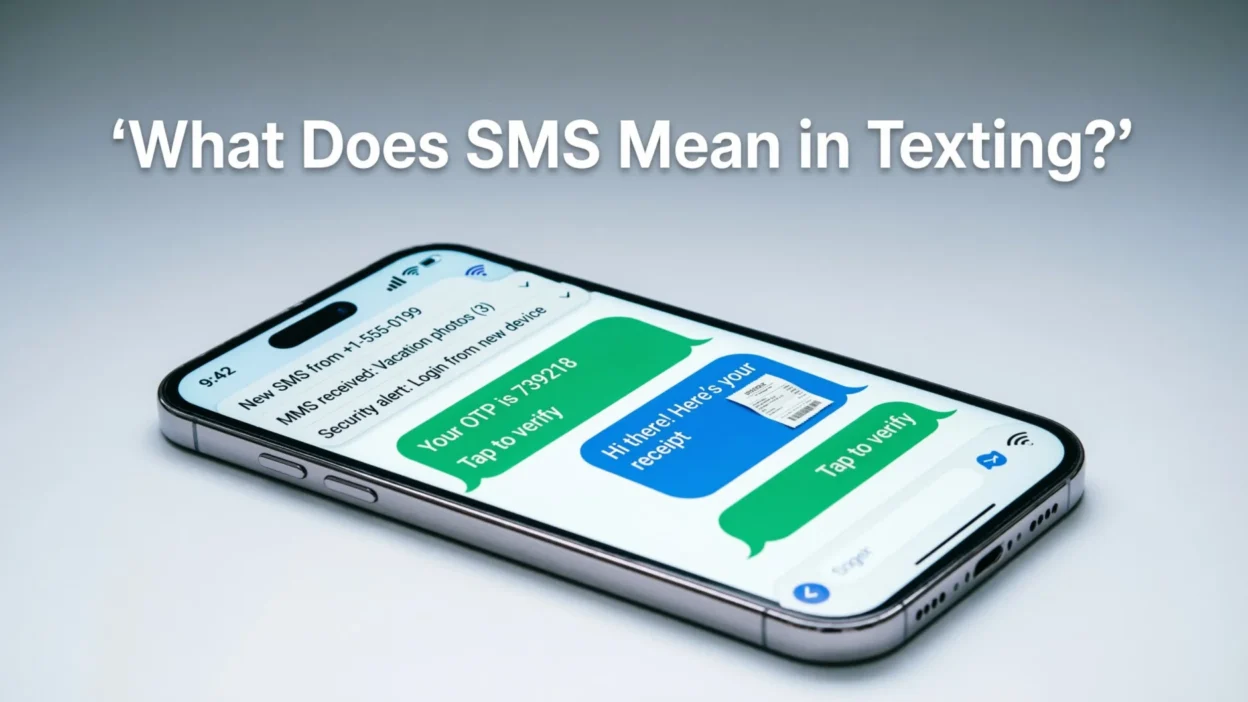
- Security: “Your OTP is 482913.”
Is SMS the Same as a Text Message?
While SMS and text message are often used interchangeably:
- SMS: Technical term for text messages sent via mobile carriers.
- Text message: General term that can include SMS, MMS, or app-based messages like WhatsApp.
Example:
- “Hey, I’ll be late” → SMS
- Sending a photo with text → MMS or app-based message
How SMS Works (Simple Explanation)
SMS messages travel via the cellular network, not the internet:
- You type a message.
- Phone sends it to the nearest cell tower.
- Routed through the Short Message Service Center (SMSC).
- Delivered to the recipient’s phone.
Key Points:
- Works without Wi-Fi or data
- Limited to 160 characters
- Fast and reliable
Example:
- “See you at 6 pm” → Sent via SMS network
SMS vs MMS
| Feature | SMS | MMS |
| Content | Text only | Text + images/videos |
| Character Limit | 160 | Larger, carrier dependent |
| Network | Cellular | Cellular, higher bandwidth |
| Cost | Usually low | Higher |
| Compatibility | Almost all phones | Requires MMS support |
Example:
- SMS: “Don’t forget our meeting at 5 pm”
- MMS: Same text + photo of location
SMS vs Internet Messaging Apps
| Feature | SMS | Internet Messaging (WhatsApp, iMessage, Telegram) |
| Network | Cellular | Internet |
| Cost | Usually free or plan-based | Data/Wi-Fi needed |
| Media | Text only | Text, images, videos, GIFs |
| Delivery Speed | Fast | Internet-dependent |
| Features | Basic | Read receipts, typing indicators |
Key Points:
- SMS works anywhere with a carrier signal
- Apps require both users to have internet & app installed
- RCS enhances SMS with features like read receipts and larger messages
Examples of SMS in Texting
Personal SMS Messages:
- “Hey! Are we still on for 6 pm?”
- “Don’t forget the groceries.”
Business SMS & Alerts:
- “Your package will arrive tomorrow between 10 am – 2 pm.”
- “OTP: 482913 for verification.”
SMS Marketing Examples:
- “Flash sale today only! Visit www.shop.com”
Service & Reminder Alerts:
- “Flight delayed by 30 minutes.”
- “Subscription renewed successfully.”
Advantages and Limitations of SMS
Advantages:
- Works without internet
- Universal compatibility
- Fast and reliable
- Perfect for short updates
- Supports SMS marketing & alerts
Limitations:
- 160-character limit
- Text-only, no media
- No encryption
- Costs may apply depending on carrier
History and Evolution of SMS
- 1980s: Concept introduced in GSM standards
- 1992: First SMS sent (“Merry Christmas”)
- Late 1990s: SMS popularity skyrocketed
- 2000s–Today: SMS still essential for verification codes, alerts, and business communication
Why Is It Called SMS?
- Short → Character limit
- Message → Text communication
- Service → Network-provided
Example:
- Sending “Meet me at 7 pm” → SMS
Is SMS Free or Paid?
- Often included in mobile plans
- Prepaid plans may charge per message
- Businesses pay for bulk SMS
- SMS costs are generally lower than calls
Is SMS Secure?
- Not fully encrypted
- Safe for general communication and verification codes
- Avoid sending sensitive info via SMS
Does SMS Work Without Internet?
Yes! SMS relies entirely on cellular networks, making it usable even without Wi-Fi or data. Perfect for alerts, OTPs, and personal texting.
What Does SMS Mean on iPhone?
- Green bubbles = SMS (carrier network)
- Blue bubbles = iMessage (internet-based)
- SMS works without internet, reaches all phones, text-only
What Does SMS Mean on Android?
- Sent via carrier network, works on all Android devices
- SMS vs MMS: Text-only vs multimedia
- Universal and reliable, no internet needed
FAQs About SMS
- What does SMS mean in texting? – Short Message Service, carrier-based text messaging
- What is SMS message? – Text sent via cellular network
- What does sent as SMS mean? – Your phone sent the message via the carrier network
- SMS vs RCS – RCS supports media, read receipts, SMS is text-only
- Receive SMS online? – Temporary numbers (temp SMS) allow online SMS reception
- SMS marketing? – Businesses sending promotional messages via SMS
- Does SMS mean I’m blocked? – Not necessarily; may depend on delivery
- Why are my texts saying SMS? – Message sent through carrier instead of app
- Should I use SMS or MMS? – SMS for text-only, MMS for media
- What does SMS mean on Instagram/Snapchat/iPhone/Android? – Carrier text messages
Conclusion
SMS is a simple, fast, and universal communication tool.
Understanding what SMS means, how it works, and its differences from MMS, RCS, and internet apps ensures you can communicate effectively.
From personal texts to SMS marketing, verification codes, and alerts, SMS remains reliable and essential in today’s mobile world.