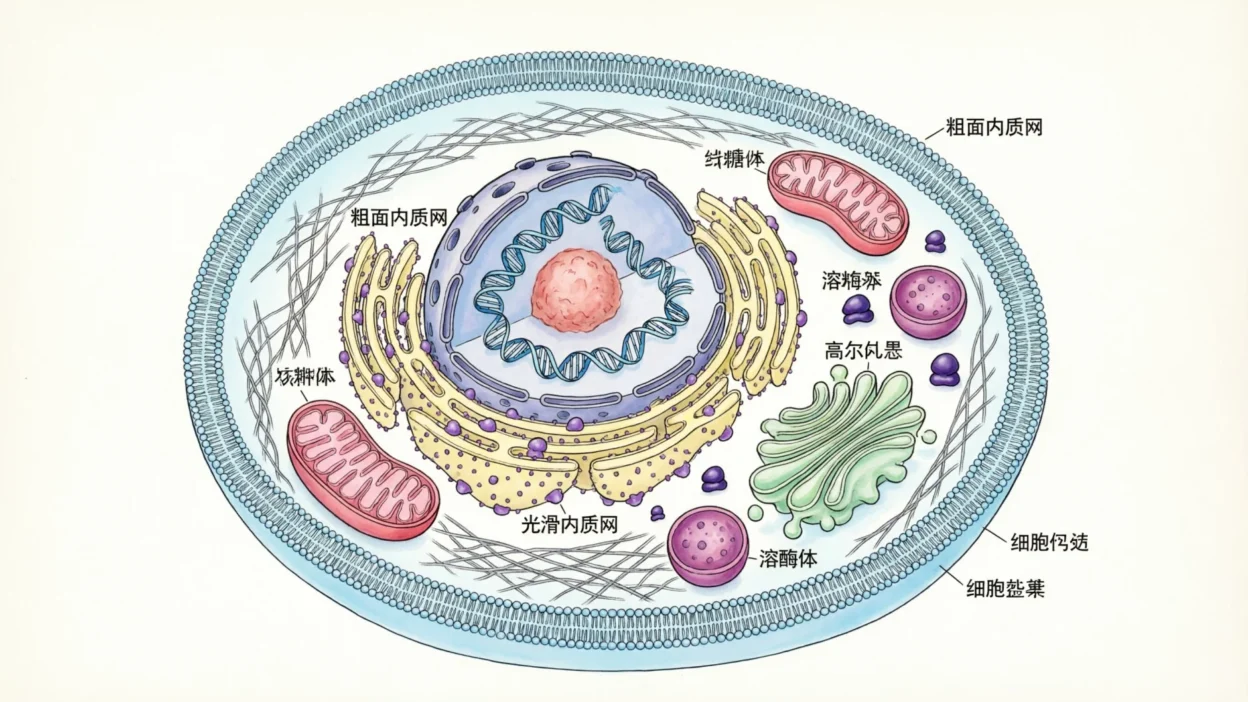
Definition: The nucleus is the control center of a cell, storing DNA and regulating vital processes. It directs growth, reproduction, and protein production while coordinating with other organelles.
The nucleus is one of the most essential organelles in eukaryotic cells, often called the “command center” because it controls nearly all cellular activities.
Its primary role is to store DNA, which acts as the genetic blueprint for building proteins, guiding cell division, and maintaining proper function.
Scientists have studied the nucleus function for decades, uncovering its critical role in growth, repair, and reproduction in both plant and animal cells.
Understanding what the nucleus does is crucial for students, researchers, and anyone curious about how life works at a microscopic level.
The nucleus interacts with the cytoplasm and other organelles to ensure proteins are produced at the right time, cells divide properly, and environmental signals are responded to efficiently.
In this article, we will explore the nucleus structure, its functions, its presence in different cell types, and common questions like “Can a cell survive without a nucleus?”.
Structure of the Nucleus : Understanding Its Key Components
The nucleus structure is highly organized, allowing it to function as the cell nucleus’s command center. It is surrounded by a nuclear envelope, a double membrane that protects DNA while allowing communication through nuclear pores.
The nucleoplasm (or nuclear sap) supports all internal structures, while the nucleolus produces ribosomes for protein synthesis. DNA exists as chromatin, which condenses into chromosomes during cell division.
These structures enable the nucleus to store genetic material safely, control cellular activities, and coordinate protein production. For visual learners, a nucleus drawing or nucleus diagram can help explain these parts clearly.
Understanding the nucleus structure is key for grasping its role in both plant and animal cells.
Functions of the Nucleus: The Cell’s Command Center
The nucleus function is central to cellular life. It stores DNA, directs protein production, and regulates cell division. Through gene expression, the nucleus decides which proteins the cell makes and when.
These proteins support cell growth, repair, and communication. The nucleus also communicates with the cytoplasm to maintain homeostasis, ensuring the cell responds properly to environmental changes.
By controlling these processes, the nucleus ensures survival and proper functioning. Its function of nucleus class 9 is often taught as the control center of the cell, highlighting its importance in biology education.
Understanding what is the function of the nucleus is essential for learning about all living organisms.
The Nucleus and Cell Division: Ensuring Accurate DNA Inheritance
A vital role of the nucleus is regulating cell division, including mitosis and meiosis. During division, chromatin condenses into chromosomes, and the nucleus ensures that DNA is copied and passed to daughter cells accurately.
This prevents genetic errors and ensures proper development. In reproductive cells, the nucleus halves DNA to maintain the correct chromosome number.
The nuclear envelope temporarily breaks down and reforms during division, safeguarding genetic material. By controlling these steps, the nucleus guarantees that new cells inherit the right information, maintaining stability and continuity in all living organisms.
Understanding what does the nucleus do in a cell during division helps students visualize cellular reproduction and growth.
The Nucleus and Protein Production Making Life’s Building Blocks
The nucleus controls protein production, a key life process. Through transcription, DNA is copied into messenger RNA (mRNA), which leaves the nucleus via nuclear pores.
Ribosomes in the cytoplasm then read the mRNA to build proteins, a process called translation. Proteins are essential for cell structures, chemical reactions, and signaling.
By regulating what does the nucleolus do and when, the nucleus ensures the cell produces the correct proteins at the right time. This coordination is why the nucleus is often called the control center of the cell, supporting growth, repair, and overall survival.
For class 9 students, understanding what does the nucleus do class 9 explains how cells produce molecules necessary for life.
Communication Between the Nucleus and Cytoplasm: Coordinating Cellular Activities
The nucleus constantly communicates with the cytoplasm through nuclear pores, allowing molecules like RNA and proteins to move in and out.
Messenger RNA carries instructions from DNA to ribosomes, while proteins from the cytoplasm can signal the nucleus to adjust gene expression. This communication ensures the cell maintains homeostasis, responds to stress, and repairs damage efficiently.
By coordinating activities between the nucleus and cytoplasm, the cell can perform essential functions and survive environmental changes.
Understanding what does cytoplasm do alongside the nucleus highlights how both work together to sustain life.
Nucleus in Different Cell Types: Plant vs. Animal Cells
The nucleus in plant and animal cells has the same essential roles but varies slightly in structure. In animal cells, the nucleus is usually central, managing growth, metabolism, and protein production.
In plant cells, the nucleus is often pushed to the side by the large vacuole but still controls DNA, transcription, and cell division. Some specialized cells, like muscle fibers, may have multiple nuclei to meet high protein demands.
If in plants or animals, the nucleus function remains vital for survival, emphasizing its universal importance in all eukaryotes. For visual references, a nucleus picture or nucleus diagram helps students and researchers alike.
Do Prokaryotes Have a Nucleus?
Prokaryotic cells, such as bacteria, do not have a nucleus, unlike eukaryotic cells. Their DNA floats freely in the cytoplasm in a region called the nucleoid.
This is why questions like “do prokaryotic cells have a nucleus” or “does a prokaryotic cell have a nucleus” are common in biology. In contrast, eukaryotes have a nucleus, which allows for organized DNA storage, controlled protein production, and precise cell division.
Understanding this difference is fundamental to learning cell biology, illustrating why the nucleus is unique to eukaryotic life.
FAQs
- What is the nucleus in very short answer?
The nucleus is the cell’s control center, storing DNA and managing all cell functions. - How to explain nucleus to a child?
The nucleus is like a brain for the cell—it tells the cell what to do. - What does the nucleolus do? / What does the nucleolus do in a cell?
The nucleolus produces ribosomes, which make proteins for the cell. - Can a cell survive without a nucleus?
In most eukaryotic cells, no—it cannot function properly without the nucleus. - What does the nucleus do in a plant cell / animal cell?
It controls growth, DNA storage, protein production, and cell division in both types.
Disorders and Abnormalities Related to the Nucleus: When the Command Center Fails
Defects in the nuclear envelope or DNA can cause serious disorders. Progeria arises from nuclear defects, while chromosomal errors can lead to Down syndrome or aneuploidy.
Mutations in nuclear genes may result in cancer or disrupt cell division. Even minor errors in nuclear function affect protein production, growth, and gene expression.
Studying these disorders highlights the importance of the nucleus in maintaining healthy cells and organisms.
Fun Facts About the Nucleus: Amazing Insights
The nucleus is usually the largest organelle in a cell. DNA stretches for meters if fully uncoiled yet fits inside neatly due to chromatin packing.
Many cells have one or more nucleoli, producing ribosomes. Some specialized cells, like muscle fibers, contain multiple nuclei.
The nucleus is highly dynamic, constantly communicating with the cytoplasm to regulate gene expression and respond to changes.
It is truly an active and adaptable control center essential for life.
Conclusion: Why the Nucleus Is Vital for Life
The nucleus is the brain and command center of the cell.
It stores DNA, directs protein production, regulates cell division, and communicates with the cytoplasm.
From plant cells to animal cells, the nucleus ensures survival, growth, and proper functioning.
Without it, cells cannot coordinate vital processes, leading to dysfunction or death.
Understanding what does the nucleus do provides insight into life at the cellular level and highlights the elegance of eukaryotic biology.